












Spectroscopic evidence of 3-hydroxyflavone sorption within MFI type zeolites: ESIPT and metal complexation
Literature Information
Publication Date
2015-09-10
DOI
10.1039/C5CP04147C
Impact Factor
3.676
Authors
A. Moissette, M. Hureau, A. Le Person, J. P. Cornard, I. De Waele, I. Batonneau-Gener
View Original
Abstract
Due to its chemical and photochemical properties and potential applications in numerous domains as a molecular probe, 3-hydroxyflavone (3HF) is a molecule of high interest. In particular, the processes of intramolecular proton transfer in the excited state and metallic complexation are known to be dependent on the chemical environment. In this context, the particular properties of zeolites make these microporous materials an environment adapted to study the reactivity of isolated molecules adsorbed in their porous void space. Thus, this report investigates the incorporation without any solvent of 3HF into the internal volume of various channel-type MFI zeolites. Using complementary techniques (diffuse reflectance UV-vis absorption, Raman scattering, FTIR, fluorescence emission and molecular modelling), very different spectral behaviours are observed in totally dealuminated silicalite-1 and in Al rich MZSM-5 (M = H+, Na+, Zn2+). In silicalite-1, the non-polar and non-protic internal micro-environment does not induce any valuable interaction between 3HF and the channel walls. Therefore, the molecule shows easy tautomer formation upon excitation. Within HZSM-5, 3HF is adsorbed in close proximity of the acid proton of the zeolite which inhibits the intramolecular proton transfer and then, only the normal form is observed at the excited state. For NaZSM-5, the spectral data show an intermediary behaviour due to the aprotic but polar environment, in agreement with 3HF sorption in close proximity of the Na+ extra framework cation. After mixing 3HF and ZnZSM-5, the spectral features clearly indicate metallic complexation of the guest molecule. The zeolite dependent reactivity reported here demonstrates the adsorption of the guest within the internal volume because the charge balancing cations which clearly control the reaction are principally located in the zeolite channels. The 3HF incorporation into the internal volume is proved by the decrease of the microporous volume observed by nitrogen adsorption–desorption isotherm measurements. The experimental data are confirmed by Monte Carlo molecular modelling which also predicts 3HF sorption in the zeolite channels in the proximity of charge compensating cations. Consequently, as the molecule dimensions are assumed to be slightly larger than the channel size, the flexibility of the molecule and the lattice deformation have to be considered to allow 3HF penetration into the zeolite void space.
Recommended Journals
Related Literature
A structural signature of the breakdown of the Stokes–Einstein relation in metallic liquids
Shi-Dong Feng, Jun-Wei Qiao, Wei-Min Wang, Jing-Yu Qin
2017-07-27
Paper
DOI: 10.1039/C7CP03475J
Anionic fructose-related conformational and positional isomers assigned through PES experiments and DFT calculations
Zhen Zeng, Elliot R. Bernstein
2017-08-08
Paper
DOI: 10.1039/C7CP03492J
Current–voltage characteristics of borophene and borophane sheets
Sahar Izadi Vishkayi, Meysam Bagheri Tagani
2017-07-20
Paper
DOI: 10.1039/C7CP03873A
Ultrasonication-enhanced gelation properties of a versatile amphiphilic formamidine-based gelator exhibiting both organogelation and hydrogelation abilities
Jürgen Bachl, Diego Sampedro, Judith Mayr
2017-08-08
Paper
DOI: 10.1039/C7CP03529B
Differentiating between long and short range disorder in infra-red spectra: on the meaning of “crystallinity” in silica
Luca Nodari, Ivana Angelini, Tiziana Boffa Ballaran
2017-07-19
Paper
DOI: 10.1039/C7CP03446F
Spectroscopic characterization of the on-surface induced (cyclo)dehydrogenation of a N-heteroaromatic compound on noble metal surfaces
I. Palacio, A. L. Pinardi, J. I. Martínez, A. Preobrajenski, A. Cossaro, A. Jancarik, I. Stará, I. Starý, J. Méndez, J. A. Martín-Gago, M. F. López
2017-07-31
Paper
DOI: 10.1039/C7CP03955G
Shaping nanofiltration channels in a carbonaceous membrane via controlling the pyrolysis atmosphere
Zheng Xing, Yeap Hung Ng, Siok-Wei Tay, Rachel Pek Har Oon, Liang Hong
2017-07-18
Paper
DOI: 10.1039/C7CP03973E
Coherent and incoherent phonon transport in a graphene and nitrogenated holey graphene superlattice
Xinyu Wang, Man Wang, Yang Hong, Zongrong Wang, Jingchao Zhang
2017-08-14
Paper
DOI: 10.1039/C7CP04219A
Spin dynamics of light-induced charge separation in composites of semiconducting polymers and PC60BM revealed using Q-band pulse EPR
E. Suturina, E. Reijerse, W. Lubitz
2017-07-26
Paper
DOI: 10.1039/C7CP03680A
Magnetism and spin entropy in Ru doped Na0.5CoO2
M. H. N. Assadi, H. Katayama-Yoshida
2017-08-22
Paper
DOI: 10.1039/C7CP03752J
You might also like
Compound Q&A
Is 6-(3-Fluorophenyl)picolinic acid (CAS: 887982-40-3) safe?
6-(3-Fluorophenyl)picolinic acid is generally considered safe for laboratory use...
887982-40-36-(3-Fluorophenyl)pi...
Compound Q&A
What industries use (3R)-3-Pyrrolidinol (CAS: 2799-21-5)?
(3R)-3-Pyrrolidinol is used in the pharmaceutical industry as a precursor for dr...
2799-21-5(3R)-3-Pyrrolidinol
Compound Q&A
What precautions should be taken when handling (4R,5R)-4,5-Diethoxycarbonyl-2,2-dimethyldioxolane (CAS: 59779-75-8)?
When handling (4R,5R)-4,5-Diethoxycarbonyl-2,2-dimethyldioxolane (CAS: 59779-75-...
59779-75-8(4R,5R)-4,5-Diethoxy...
Compound Q&A
How is 1-(6-Chloroimidazo[1,2-b]pyridazin-3-yl)ethanone (CAS: 90734-71-7) typically synthesized?
1-(6-Chloroimidazo[1,2-b]pyridazin-3-yl)ethanone is often synthesized via a mult...
90734-71-71-(6-Chloroimidazo[1...
Compound Q&A
What is the market or research trend for N-Ethyl-3,4-dimethylbenzylamine (CAS: 39180-83-1)?
The market for N-Ethyl-3,4-dimethylbenzylamine (CAS: 39180-83-1) remains steady,...
39180-83-1N-Ethyl-3,4-dimethyl...
Compound Q&A
What is Tert-butyl 3-(pyrrolidin-1-yl)azetidine-1-carboxylate (CAS: 1019008-21-9)?
Tert-butyl 3-(pyrrolidin-1-yl)azetidine-1-carboxylate is a chemical compound wit...
1019008-21-9Tert-butyl 3-(pyrrol...
Compound Q&A
What regulatory guidelines apply to 1-Bromo-3-chloro-2,4-dimethoxybenzene (CAS: 1228956-93-1)?
1-Bromo-3-chloro-2,4-dimethoxybenzene (CAS: 1228956-93-1) falls under the classi...
1228956-93-11-Bromo-3-chloro-2,4...
Compound Q&A
Is 8-Bromo-2-methyl-3,4-dihydroisoquinolin-1(2H)-one (CAS: 1368622-07-4) safe?
The safety of 8-Bromo-2-methyl-3,4-dihydroisoquinolin-1(2H)-one (CAS: 1368622-07...
1368622-07-48-Bromo-2-methyl-3,4...
Compound Q&A
Is Benzyl [(3S)-2,6-dioxo-3-piperidinyl]carbamate (CAS: 22785-43-9) safe?
Benzyl [(3S)-2,6-dioxo-3-piperidinyl]carbamate is generally safe when handled wi...
22785-43-9Benzyl [(3S)-2,6-dio...
Compound Q&A
How should 1-{[4-(4,4,5,5-Tetramethyl-1,3,2-dioxaborolan-2-yl)phenyl]sulfonyl}pyrrolidine (CAS: 928657-21-0) be stored?
1-{[4-(4,4,5,5-Tetramethyl-1,3,2-dioxaborolan-2-yl)phenyl]sulfonyl}pyrrolidine s...
928657-21-01-{[4-(4,4,5,5-Tetra...
Source Journal
Physical Chemistry Chemical Physics

CiteScore:
5.5
Self-citation Rate:
10.3%
Articles per Year:
3036
Physical Chemistry Chemical Physics (PCCP) is an international journal co-owned by 19 physical chemistry and physics societies from around the world. This journal publishes original, cutting-edge research in physical chemistry, chemical physics and biophysical chemistry. To be suitable for publication in PCCP, articles must include significant innovation and/or insight into physical chemistry; this is the most important criterion that reviewers and Editors will judge against when evaluating submissions. The journal has a broad scope and welcomes contributions spanning experiment, theory, computation and data science. Topical coverage includes spectroscopy, dynamics, kinetics, statistical mechanics, thermodynamics, electrochemistry, catalysis, surface science, quantum mechanics, quantum computing and machine learning. Interdisciplinary research areas such as polymers and soft matter, materials, nanoscience, energy, surfaces/interfaces, and biophysical chemistry are welcomed if they demonstrate significant innovation and/or insight into physical chemistry. Joined experimental/theoretical studies are particularly appreciated when complementary and based on up-to-date approaches.
Recommended Compounds
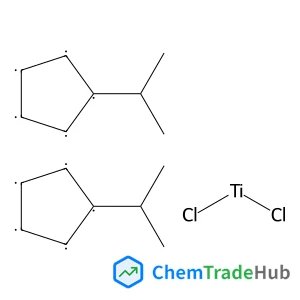
BIS(I-PROPYLCYCLOPENTADIENYL)TITANIUM DICHLORIDE
CAS Number:
12130-65-3
Molecular Formula:
C16H22Cl2Ti
Recommended Suppliers



Disclaimer
This page provides academic journal information for reference and research purposes only. We are not affiliated with any journal publishers and do not handle publication submissions. For publication-related inquiries, please contact the respective journal publishers directly.
If you notice any inaccuracies in the information displayed, please contact us at support@chemtradehub.com. We will promptly review and address your concerns.