












Microwave spectroscopic and theoretical investigations of the strongly hydrogen bonded hexafluoroisopropanol⋯water complex
Literature Information
Publication Date
2015-08-19
DOI
10.1039/C5CP03585F
Impact Factor
3.676
Authors
A. Shahi, E. Arunan
View Original
Abstract
This paper reports microwave spectroscopic and theoretical investigations on the interaction of water with hexafluoroisopropanol (HFIP). The HFIP monomer can exist in two conformations, antiperiplanar (AP) and synclinical (SC). The former is about 5 kJ mol−1 more stable than the latter. Theoretical calculations predicted three potential minima for the complex, two having AP and one having SC conformations. Though, the binding energy for the HFIP(SC)⋯H2O turned out to be larger than that for the other two conformers having HFIP in the AP form, the global minimum for the complex in the potential energy hypersurface had HFIP in the AP form. Experimental rotational constants for four isotopologues measured using a pulsed nozzle Fourier transform microwave spectrometer, correspond to the global minimum in the potential energy hypersurface. The structural parameters and the internal dynamics of the complex could be determined from the rotational spectra of the four isotopologues. The global minimum has the HFIP(AP) as a hydrogen bond donor forming a strong hydrogen bond with H2O. To characterize the strength of the bonding and to probe the other interactions within the complex, atoms in molecules, non-covalent interaction index and natural bond orbital theoretical analyses have been performed.
Related Literature
[1]Benzothieno[3,2-b][1]benzothiophene-based dyes: effect of the ancillary moiety on mechanochromism and aggregation-induced emission
Rajamouli Boddula
2022-05-23
Paper
DOI: 10.1039/D2CP01934E
Heat managing organic materials: phase change materials with high thermal conductivity and shape stability
Hyeyoon Ko, Dong-Gue Kang, Minwoo Rim, Jahyeon Koo, Seok-In Lim, Eunji Jang, Dongmin Yu, Myong-Jae Yoo, Namil Kim, Kwang-Un Jeong
2022-01-12
Communication
DOI: 10.1039/D1PY01318A
Correction: Modeling the heating and cooling of a chromophore after photoexcitation
Elizete Ventura, Silmar Andrade do Monte, Mariana T. do Casal, Max Pinheiro, Jr, Josene Maria Toldo
2022-06-15
Correction
DOI: 10.1039/D2CP90104H
Polarizable molecular dynamics simulations on the conductivity of pure 1-methylimidazolium acetate systems
Christian Schröder
2022-06-06
Paper
DOI: 10.1039/D2CP01501C
Insight on noncovalent interactions and orbital constructs in low-dimensional antimony halide perovskites
Aaron D. Nicholas, Leah C. Garman, Nicolina Albano, Christopher L. Cahill
2022-06-09
Paper
DOI: 10.1039/D2CP01996E
ALS-associated A315E and A315pT variants exhibit distinct mechanisms in inducing irreversible aggregation of TDP-43312–317 peptides
Xianshi Liu, Zenghui Lao, Xuhua Li, Xuewei Dong, Guanghong Wei
2022-06-15
Paper
DOI: 10.1039/D2CP01625G
Nanostructure engineering of two-dimensional diamonds toward high thermal conductivity and approaching zero Poisson's ratio
Yanxiao Hu, Ding Li, Chunbao Feng, Shichang Li, Bole Chen, Dengfeng Li, Gang Zhang
2022-05-31
Paper
DOI: 10.1039/D2CP01745H
Polycyclic aliphatic hydrocarbons: is tetrahedrane present in UIR spectra?
Brent R. Westbrook, Griffin M. Beasley, Ryan C. Fortenberry
2022-05-26
Paper
DOI: 10.1039/D2CP01103D
Three-centre two-electron bonds from the quantum interference perspective‡
David Wilian Oliveira de Sousa, Marco Antonio Chaer Nascimento
2022-06-06
Paper
DOI: 10.1039/D2CP00841F
You might also like
Compound Q&A
What precautions should be taken when handling 2-Methyl-2-propanyl 5-amino-2-thiophenecarboxylate (CAS: 1498311-57-1)?
When handling 2-Methyl-2-propanyl 5-amino-2-thiophenecarboxylate (CAS: 1498311-5...
1498311-57-12-Methyl-2-propanyl ...
Compound Q&A
What are the physical and chemical properties of 5-Bromo-1,2-dichloro-3-fluorobenzene (CAS: 1000572-93-9)?
5-Bromo-1,2-dichloro-3-fluorobenzene (CAS: 1000572-93-9) is a crystalline solid ...
1000572-93-95-Bromo-1,2-dichloro...
Compound Q&A
How should (2R)-2-Amino-2-(4-bromophenyl)ethanol (CAS: 354153-64-3) be stored?
(2R)-2-Amino-2-(4-bromophenyl)ethanol (CAS: 354153-64-3) should be stored in a c...
354153-64-3(2R)-2-Amino-2-(4-br...
Compound Q&A
What regulatory guidelines apply to Methyl 4-(aminomethyl)tetrahydro-2H-pyran-4-carboxylate hydrochloride (CAS: 362707-24-2)?
Methyl 4-(aminomethyl)tetrahydro-2H-pyran-4-carboxylate hydrochloride (CAS: 3627...
362707-24-2Methyl 4-(aminomethy...
Compound Q&A
What are the main uses of 1,4-dimethyl-1H-pyrazole-5-sulfonyl chloride (CAS: 1174834-52-6)?
1,4-Dimethyl-1H-pyrazole-5-sulfonyl chloride is primarily used as an intermediat...
1174834-52-61,4-dimethyl-1H-pyra...
Compound Q&A
Is Dinaphtho[1,2-b:2',1'-d]furan (CAS: 239-69-0) safe?
Dinaphtho[1,2-b:2',1'-d]furan is generally safe when handled with appropriate pe...
239-69-0Dinaphtho[1,2-b:2',1...
Compound Q&A
What is the market or research trend for 7-Methyl-7,9-dihydro-1H-purine-2,6,8(3H)-trione (CAS: 612-37-3)?
The market for 7-Methyl-7,9-dihydro-1H-purine-2,6,8(3H)-trione (CAS: 612-37-3) i...
612-37-37-Methyl-7,9-dihydro...
Compound Q&A
What are the physical and chemical properties of 2-(4-Chlorophenyl)malonaldehyde (CAS: 205676-17-1)?
2-(4-Chlorophenyl)malonaldehyde (CAS: 205676-17-1) is a colorless or light yello...
205676-17-12-(4-Chlorophenyl)ma...
Compound Q&A
How is 2-Methylchrysene (CAS: 3351-32-4) typically synthesized?
2-Methylchrysene (CAS: 3351-32-4) is typically synthesized via the reaction of c...
3351-32-42-Methylchrysene
Compound Q&A
Is N-(6-aminopyrimidin-4-yl)acetamide (CAS: 89533-23-3) safe?
N-(6-aminopyrimidin-4-yl)acetamide (CAS: 89533-23-3) is generally considered saf...
89533-23-3N-(6-aminopyrimidin-...
Source Journal
Physical Chemistry Chemical Physics

CiteScore:
5.5
Self-citation Rate:
10.3%
Articles per Year:
3036
Physical Chemistry Chemical Physics (PCCP) is an international journal co-owned by 19 physical chemistry and physics societies from around the world. This journal publishes original, cutting-edge research in physical chemistry, chemical physics and biophysical chemistry. To be suitable for publication in PCCP, articles must include significant innovation and/or insight into physical chemistry; this is the most important criterion that reviewers and Editors will judge against when evaluating submissions. The journal has a broad scope and welcomes contributions spanning experiment, theory, computation and data science. Topical coverage includes spectroscopy, dynamics, kinetics, statistical mechanics, thermodynamics, electrochemistry, catalysis, surface science, quantum mechanics, quantum computing and machine learning. Interdisciplinary research areas such as polymers and soft matter, materials, nanoscience, energy, surfaces/interfaces, and biophysical chemistry are welcomed if they demonstrate significant innovation and/or insight into physical chemistry. Joined experimental/theoretical studies are particularly appreciated when complementary and based on up-to-date approaches.
Recommended Compounds
![1-{[5-(4,4,5,5-Tetramethyl-1,3,2-dioxaborolan-2-yl)-2-thienyl]methyl}piperidine structure](https://static.chemtradehub.com/structs/121/1218790-44-3-baef.webp "1-{[5-(4,4,5,5-Tetramethyl-1,3,2-dioxaborolan-2-yl)-2-thienyl]methyl}piperidine structure")
1-{[5-(4,4,5,5-Tetramethyl-1,3,2-dioxaborolan-2-yl)-2-thienyl]methyl}piperidine
CAS Number:
1218790-44-3
Molecular Formula:
C16H26BNO2S
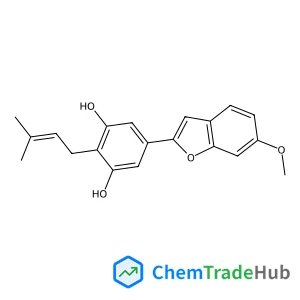
5-(6-Methoxy-1-benzofuran-2-yl)-2-(3-methyl-2-buten-1-yl)-1,3-benzenediol
CAS Number:
1017277-40-5
Molecular Formula:
C20H20O4
Recommended Suppliers






Disclaimer
This page provides academic journal information for reference and research purposes only. We are not affiliated with any journal publishers and do not handle publication submissions. For publication-related inquiries, please contact the respective journal publishers directly.
If you notice any inaccuracies in the information displayed, please contact us at support@chemtradehub.com. We will promptly review and address your concerns.