












Polycyclic aliphatic hydrocarbons: is tetrahedrane present in UIR spectra?
Literature Information
Publication Date
2022-05-26
DOI
10.1039/D2CP01103D
Impact Factor
3.676
Authors
Brent R. Westbrook, Griffin M. Beasley, Ryan C. Fortenberry
View Original
Abstract
The smallest Platonic hydrocarbon, tetrahedrane, has been subject to frequent theoretical and experimental study for 50 years, but its infrared spectrum and synthetic pathway remain a mystery. The recent partial attribution of the ultraviolet extinction bump observed in the interstellar medium (ISM) of the Milky Way galaxy to hydrogenated T-carbon, a larger tetrahedral cluster formed from tetrahedrane and C4 monomers, has brought renewed interest to the molecule. Similarly, as a polycyclic hydrocarbon, tetrahedrane is similar in structure to the molecules proposed to be responsible for the so-called unidentified infrared bands (UIRs) observed in all kinds of astronomical environments. Furthermore, tetrahedrane's ν2 and ν7 fundamental vibrational frequencies, with values of 3210.6 cm−1 (3.11 μm) and 752.5 cm−1 (13.29 μm) as computed in the present quantum chemical study, have substantial intensities of 59 and 183 km mol−1, respectively. These come tantalizingly close to, but potentially distinct from, the 3.3 and 13.2 μm regions of the infrared spectrum typically included in the UIRs. As such, tetrahedrane or related clusters of these polycyclic aliphatic hydrocarbons may have a role to play in both of these sets of observations and could even help to explain the relation between them. Regardless, if tetrahedrane is present in the ISM, the highly-accurate theoretical data reported herein should help to aid in its identification and may assist in guiding future synthetic experiments as well.
Related Literature
Synthesis of a pyridine-fused porphyrinoid: oxopyridochlorin
Sumito Tokuji, Yuji Takahashi, Hideyuki Shinmori, Hiroshi Shinokubo, Atsuhiro Osuka
2009-01-06
Communication
DOI: 10.1039/B819284G
Model systems for flavoenzyme activity: an investigation of the role functionality attached to the C(7) position of the flavin unit has on redox and molecular recognition properties‡
Stuart T. Caldwell, Louis J. Farrugia, Shanika Gunatilaka Hewage, Nadiya Kryvokhyzha, Vincent M. Rotello, Graeme Cooke
2009-02-11
Communication
DOI: 10.1039/B900269N
Single amino acid chelates (SAAC): a strategy for the design of technetium and rhenium radiopharmaceuticals
Mark Bartholomä, John Valliant, Kevin P. Maresca, John Babich, Jon Zubieta
2008-12-01
Feature Article
DOI: 10.1039/B814903H
Detection of single-nucleotide mismatches using scanning electrochemical microscopy
Piotr Michal Diakowski, Heinz-Bernhard Kraatz
2009-01-05
Communication
DOI: 10.1039/B819876D
Formation and dissolution of hen egg white lysozyme amyloid fibrils in protic ionic liquids
Nolene Byrne, C. Austen Angell
2009-02-02
Communication
DOI: 10.1039/B817590J
Catalytic skeletal reorganization of enynes through electrophilicactivation of alkynes: double cleavage of C–C double and triple bonds
Sang Ick Lee, Naoto Chatani
2008-11-18
Feature Article
DOI: 10.1039/B812466C
Preparation, characterization and catalytic performance of Mo–V–O oxide layers linked by alkylamines
Feng Wang, Wataru Ueda
2009-01-05
Communication
DOI: 10.1039/B817118A
Evidence of strong hydrogen bonding by 8-aminoguanine
Aaron E. Engelhart, Thomas Hellman Morton, Nicholas V. Hud
2008-12-01
Communication
DOI: 10.1039/B818409G
Polyester-graft-phosphorylcholine prepared by ring-opening polymerization and click chemistry
Beth M. Cooper, Delphine Chan-Seng, Debasis Samanta, Xiongfei Zhang, Sangram Parelkar, Todd Emrick
2008-12-17
Communication
DOI: 10.1039/B817600K
Activation of metal-bound η5-C5Me5groups to Diels–Alder addition of 3O2 and other dienophiles
Neil M. Boag, K. Mohan Rao
2009-01-27
Communication
DOI: 10.1039/B818537A
You might also like
Compound Q&A
What precautions should be taken when handling 2-Methyl-2-propanyl 5-amino-2-thiophenecarboxylate (CAS: 1498311-57-1)?
When handling 2-Methyl-2-propanyl 5-amino-2-thiophenecarboxylate (CAS: 1498311-5...
1498311-57-12-Methyl-2-propanyl ...
Compound Q&A
What are the physical and chemical properties of 5-Bromo-1,2-dichloro-3-fluorobenzene (CAS: 1000572-93-9)?
5-Bromo-1,2-dichloro-3-fluorobenzene (CAS: 1000572-93-9) is a crystalline solid ...
1000572-93-95-Bromo-1,2-dichloro...
Compound Q&A
How should (2R)-2-Amino-2-(4-bromophenyl)ethanol (CAS: 354153-64-3) be stored?
(2R)-2-Amino-2-(4-bromophenyl)ethanol (CAS: 354153-64-3) should be stored in a c...
354153-64-3(2R)-2-Amino-2-(4-br...
Compound Q&A
What regulatory guidelines apply to Methyl 4-(aminomethyl)tetrahydro-2H-pyran-4-carboxylate hydrochloride (CAS: 362707-24-2)?
Methyl 4-(aminomethyl)tetrahydro-2H-pyran-4-carboxylate hydrochloride (CAS: 3627...
362707-24-2Methyl 4-(aminomethy...
Compound Q&A
What are the main uses of 1,4-dimethyl-1H-pyrazole-5-sulfonyl chloride (CAS: 1174834-52-6)?
1,4-Dimethyl-1H-pyrazole-5-sulfonyl chloride is primarily used as an intermediat...
1174834-52-61,4-dimethyl-1H-pyra...
Compound Q&A
Is Dinaphtho[1,2-b:2',1'-d]furan (CAS: 239-69-0) safe?
Dinaphtho[1,2-b:2',1'-d]furan is generally safe when handled with appropriate pe...
239-69-0Dinaphtho[1,2-b:2',1...
Compound Q&A
What is the market or research trend for 7-Methyl-7,9-dihydro-1H-purine-2,6,8(3H)-trione (CAS: 612-37-3)?
The market for 7-Methyl-7,9-dihydro-1H-purine-2,6,8(3H)-trione (CAS: 612-37-3) i...
612-37-37-Methyl-7,9-dihydro...
Compound Q&A
What are the physical and chemical properties of 2-(4-Chlorophenyl)malonaldehyde (CAS: 205676-17-1)?
2-(4-Chlorophenyl)malonaldehyde (CAS: 205676-17-1) is a colorless or light yello...
205676-17-12-(4-Chlorophenyl)ma...
Compound Q&A
How is 2-Methylchrysene (CAS: 3351-32-4) typically synthesized?
2-Methylchrysene (CAS: 3351-32-4) is typically synthesized via the reaction of c...
3351-32-42-Methylchrysene
Compound Q&A
Is N-(6-aminopyrimidin-4-yl)acetamide (CAS: 89533-23-3) safe?
N-(6-aminopyrimidin-4-yl)acetamide (CAS: 89533-23-3) is generally considered saf...
89533-23-3N-(6-aminopyrimidin-...
Source Journal
Physical Chemistry Chemical Physics

CiteScore:
5.5
Self-citation Rate:
10.3%
Articles per Year:
3036
Physical Chemistry Chemical Physics (PCCP) is an international journal co-owned by 19 physical chemistry and physics societies from around the world. This journal publishes original, cutting-edge research in physical chemistry, chemical physics and biophysical chemistry. To be suitable for publication in PCCP, articles must include significant innovation and/or insight into physical chemistry; this is the most important criterion that reviewers and Editors will judge against when evaluating submissions. The journal has a broad scope and welcomes contributions spanning experiment, theory, computation and data science. Topical coverage includes spectroscopy, dynamics, kinetics, statistical mechanics, thermodynamics, electrochemistry, catalysis, surface science, quantum mechanics, quantum computing and machine learning. Interdisciplinary research areas such as polymers and soft matter, materials, nanoscience, energy, surfaces/interfaces, and biophysical chemistry are welcomed if they demonstrate significant innovation and/or insight into physical chemistry. Joined experimental/theoretical studies are particularly appreciated when complementary and based on up-to-date approaches.
Recommended Compounds
![2,5-Dichloro-1H-pyrrolo[3,2-b]pyridine structure](https://static.chemtradehub.com/structs/100/1000342-87-9-f632.webp "2,5-Dichloro-1H-pyrrolo[3,2-b]pyridine structure")
![4-Chloro-N-{[4-(dimethylamino)phenyl]carbamoyl}benzenesulfonamide structure](https://static.chemtradehub.com/structs/558/5581-42-0-7dcb.webp "4-Chloro-N-{[4-(dimethylamino)phenyl]carbamoyl}benzenesulfonamide structure")
4-Chloro-N-{[4-(dimethylamino)phenyl]carbamoyl}benzenesulfonamide
CAS Number:
5581-42-0
Molecular Formula:
C15H16ClN3O3S
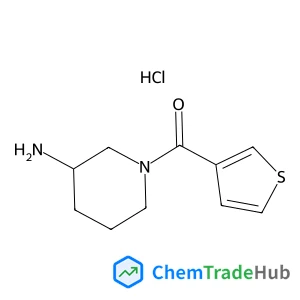
(3-Amino-piperidin-1-yl)-thiophen-3-yl-methanone hydrochloride
CAS Number:
1185316-70-4
Molecular Formula:
C10H15ClN2OS
Recommended Suppliers




Disclaimer
This page provides academic journal information for reference and research purposes only. We are not affiliated with any journal publishers and do not handle publication submissions. For publication-related inquiries, please contact the respective journal publishers directly.
If you notice any inaccuracies in the information displayed, please contact us at support@chemtradehub.com. We will promptly review and address your concerns.