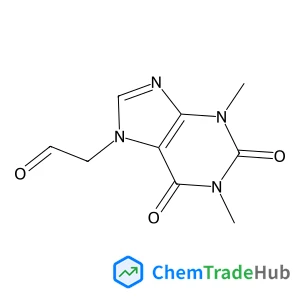
(1,3-Dimethyl-2,6-dioxo-1,2,3,6-tetrahydro-7H-purin-7-yl)acetaldehyde
CAS Number:
5614-53-9
Molecular Formula:
C9H10N4O3
Rajamouli Boddula
It is an established fact that [1]benzothieno[3,2-b][1]benzothiophene (BTBT) is a champion molecule for high-mobility OFET devices. Recently, it has also been utilized in dye-sensitized solar cells (DSSCs) and organic photovoltaics (OPVs) as an alternative to fullerene (non-fullerene acceptor). Considering the advantageous features of BTBT, we herein report its aggregation-induced emission (AIE) and mechanofluorochromic (MFC) behaviour for the first time. We have designed and synthesized two new BTBT derivatives: [1]benzothieno[3,2-b][1]benzothiophene-tetraphenylethylene (BTBT-TPE) and [1]benzothieno[3,2-b][1]benzothiophene-phenyl-N,N-dimethylamine (BTBT-NMe). The donor–π–acceptor–π–donor-integrated BTBT-TPE showed AIE whereas BTBT-NMe showed aggregation-caused quenching (ACQ), as evident by their quantum yield and lifetime results. BTBT-NMe was found to possess great interaction, resulting in the halochromic (protonation) effect. The theoretical calculation of the electronic distribution and energy investigation were consistent with the experimental outcomes. The electron contribution of the HOMO is high for BTBT-NMe at the donor, which can be attributed to the weaker donating nature of TPE compared to that of the NMe group. Overall, the results indicate the potential of the mechanical stimuli and aggregation response of the studied compounds for further investigation.
Na Tian, Zhi-You Zhou, Shi-Gang Sun
DOI: 10.1039/B819751B
Xin-Long Wang, Chao Qin, Ya-Qian Lan, Kui-Zhan Shao, Zhong-Min Su, En-Bo Wang
DOI: 10.1039/B815629H
Neil M. Boag, K. Mohan Rao
DOI: 10.1039/B818537A
Jianwei Fu, Xiaobin Huang, Yawen Huang, Jiawei Zhang, Xiaozhen Tang
DOI: 10.1039/B818071G
Daeha Seo, Choong Il Yoo, Bong Hyun Chung, Im Sik Chung, Hyunjoon Song
DOI: 10.1039/B820220F
Feng Zheng, Xingang Zhang, Feng-Ling Qing
DOI: 10.1039/B819289H
Xianbing Ke, Hao Hu, Keda Zhang, Wenjin Xu, Qifeng Zhu, Lamei Wu, Xianming Hu
DOI: 10.1039/B817910G
Dae-Wi Yoon, Dustin E. Gross, Vincent M. Lynch, Chang-Hee Lee, Philip C. Bennett, Jonathan L. Sessler
DOI: 10.1039/B818077F
When handling 2-Methyl-2-propanyl 5-amino-2-thiophenecarboxylate (CAS: 1498311-5...
5-Bromo-1,2-dichloro-3-fluorobenzene (CAS: 1000572-93-9) is a crystalline solid ...
(2R)-2-Amino-2-(4-bromophenyl)ethanol (CAS: 354153-64-3) should be stored in a c...
Methyl 4-(aminomethyl)tetrahydro-2H-pyran-4-carboxylate hydrochloride (CAS: 3627...
1,4-Dimethyl-1H-pyrazole-5-sulfonyl chloride is primarily used as an intermediat...
Dinaphtho[1,2-b:2',1'-d]furan is generally safe when handled with appropriate pe...
The market for 7-Methyl-7,9-dihydro-1H-purine-2,6,8(3H)-trione (CAS: 612-37-3) i...
2-(4-Chlorophenyl)malonaldehyde (CAS: 205676-17-1) is a colorless or light yello...
2-Methylchrysene (CAS: 3351-32-4) is typically synthesized via the reaction of c...
N-(6-aminopyrimidin-4-yl)acetamide (CAS: 89533-23-3) is generally considered saf...

Physical Chemistry Chemical Physics (PCCP) is an international journal co-owned by 19 physical chemistry and physics societies from around the world. This journal publishes original, cutting-edge research in physical chemistry, chemical physics and biophysical chemistry. To be suitable for publication in PCCP, articles must include significant innovation and/or insight into physical chemistry; this is the most important criterion that reviewers and Editors will judge against when evaluating submissions. The journal has a broad scope and welcomes contributions spanning experiment, theory, computation and data science. Topical coverage includes spectroscopy, dynamics, kinetics, statistical mechanics, thermodynamics, electrochemistry, catalysis, surface science, quantum mechanics, quantum computing and machine learning. Interdisciplinary research areas such as polymers and soft matter, materials, nanoscience, energy, surfaces/interfaces, and biophysical chemistry are welcomed if they demonstrate significant innovation and/or insight into physical chemistry. Joined experimental/theoretical studies are particularly appreciated when complementary and based on up-to-date approaches.

![L-Lysine,N6-[2-[[(1,1-dimethylethoxy)carbonyl]amino]benzoyl]-N2-[(9H-fluoren-9-ylmethoxy)carbonyl]- structure](https://static.chemtradehub.com/structs/159/159322-59-5-c046.webp "L-Lysine,N6-[2-[[(1,1-dimethylethoxy)carbonyl]amino]benzoyl]-N2-[(9H-fluoren-9-ylmethoxy)carbonyl]- structure")
![1-{[5-(4,4,5,5-Tetramethyl-1,3,2-dioxaborolan-2-yl)-2-thienyl]methyl}piperidine structure](https://static.chemtradehub.com/structs/121/1218790-44-3-baef.webp "1-{[5-(4,4,5,5-Tetramethyl-1,3,2-dioxaborolan-2-yl)-2-thienyl]methyl}piperidine structure")