












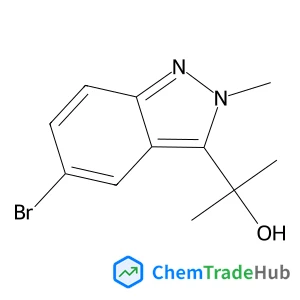
2-(5-Bromo-2-methyl-2H-indazol-3-yl)-2-propanol
CAS Number:
1823787-20-7
Molecular Formula:
C11H13BrN2O
Elizete Ventura, Silmar Andrade do Monte, Mariana T. do Casal, Max Pinheiro, Jr, Josene Maria Toldo
Correction for ‘Modeling the heating and cooling of a chromophore after photoexcitation’ by Elizete Ventura et al., Phys. Chem. Chem. Phys., 2022, 24, 9403–9410, https://doi.org/10.1039/D2CP00686C.
Andrew J. P. White, Molly M. Stevens, Charlotte K. Williams
DOI: 10.1039/B817658B
José Luis García Ruano, Alejandro Parra, José Alemán, Francisco Yuste, Virginia M. Mastranzo
DOI: 10.1039/B816846F
KaKing Yan, Andrew V. Pawlikowski, Chris Ebert, Aaron D. Sadow
DOI: 10.1039/B818630H
Hikaru Yanai, Takeo Taguchi
DOI: 10.1039/B817599C
Teruyasu Yamamoto
DOI: 10.1039/B818792D
Isamu Shiina, Hiroki Fukui
DOI: 10.1039/B814375G
Oksana Sereda, Amélie Blanrue, René Wilhelm
DOI: 10.1039/B817991C
Marco Bella, Daniele M. Scarpino Schietroma, Pier Paolo Cusella, Tecla Gasperi, Valerio Visca
DOI: 10.1039/B816550E
Yong Yan, Xiang Lin, Sihai Yang, Alexander J. Blake, Anne Dailly, Neil R. Champness, Peter Hubberstey, Martin Schröder
DOI: 10.1039/B900013E
When handling 2-Methyl-2-propanyl 5-amino-2-thiophenecarboxylate (CAS: 1498311-5...
5-Bromo-1,2-dichloro-3-fluorobenzene (CAS: 1000572-93-9) is a crystalline solid ...
(2R)-2-Amino-2-(4-bromophenyl)ethanol (CAS: 354153-64-3) should be stored in a c...
Methyl 4-(aminomethyl)tetrahydro-2H-pyran-4-carboxylate hydrochloride (CAS: 3627...
1,4-Dimethyl-1H-pyrazole-5-sulfonyl chloride is primarily used as an intermediat...
Dinaphtho[1,2-b:2',1'-d]furan is generally safe when handled with appropriate pe...
The market for 7-Methyl-7,9-dihydro-1H-purine-2,6,8(3H)-trione (CAS: 612-37-3) i...
2-(4-Chlorophenyl)malonaldehyde (CAS: 205676-17-1) is a colorless or light yello...
2-Methylchrysene (CAS: 3351-32-4) is typically synthesized via the reaction of c...
N-(6-aminopyrimidin-4-yl)acetamide (CAS: 89533-23-3) is generally considered saf...

Physical Chemistry Chemical Physics (PCCP) is an international journal co-owned by 19 physical chemistry and physics societies from around the world. This journal publishes original, cutting-edge research in physical chemistry, chemical physics and biophysical chemistry. To be suitable for publication in PCCP, articles must include significant innovation and/or insight into physical chemistry; this is the most important criterion that reviewers and Editors will judge against when evaluating submissions. The journal has a broad scope and welcomes contributions spanning experiment, theory, computation and data science. Topical coverage includes spectroscopy, dynamics, kinetics, statistical mechanics, thermodynamics, electrochemistry, catalysis, surface science, quantum mechanics, quantum computing and machine learning. Interdisciplinary research areas such as polymers and soft matter, materials, nanoscience, energy, surfaces/interfaces, and biophysical chemistry are welcomed if they demonstrate significant innovation and/or insight into physical chemistry. Joined experimental/theoretical studies are particularly appreciated when complementary and based on up-to-date approaches.
![N-[(1-Ethyl-2-pyrrolidinyl)methyl]-2-hydroxy-5-sulfamoylbenzamide structure](https://static.chemtradehub.com/structs/673/67381-52-6-877f.webp "N-[(1-Ethyl-2-pyrrolidinyl)methyl]-2-hydroxy-5-sulfamoylbenzamide structure")
![2-[2-(2-Methoxyethoxy)ethoxy]-2-methylpropane structure](https://static.chemtradehub.com/structs/527/52788-79-1-71c1.webp "2-[2-(2-Methoxyethoxy)ethoxy]-2-methylpropane structure")



