












A combined crossed molecular beam and theoretical investigation of the reaction of the meta-tolyl radical with vinylacetylene – toward the formation of methylnaphthalenes
Literature Information
Publication Date
2015-07-17
DOI
10.1039/C5CP03285G
Impact Factor
3.676
Authors
Tao Yang, Lloyd Muzangwa, Ralf I. Kaiser, Adeel Jamal
View Original
Abstract
Crossed molecular beam experiments and electronic structure calculations on the reaction of the meta-tolyl radical with vinylacetylene were conducted to probe the formation of methyl-substituted naphthalene isomers. We present the compelling evidence that under single collision conditions 1- and 2-methylnaphthalene can be formed without an entrance barrier via indirect scattering dynamics through a bimolecular collision of two non-PAH reactants: the meta-tolyl radical and vinylacetylene. The electronic structure calculations, conducted at the UCCSD(T)-F12b/cc-pVDZ//UM06-2x/cc-pVTZ + ZPE(UM06-2x/cc-pVTZ) level of theory, reveal that this reaction is initiated by the barrierless addition of the meta-tolyl radical to the terminal vinyl carbon (C1) of vinylacetylene, via a van-der-Waals complex implying that this mechanism can play a key role in forming methyl-substituted PAHs in low temperature extreme environments such as the low temperature interstellar medium and hydrocarbon-rich atmospheres of planets and their moons in the outer solar system. The reaction mechanism, proposed from the C11H11 potential energy surface, involves a sequence of isomerizations involving hydrogen transfer and ring closure, followed by hydrogen dissociation, which eventually leads to 1- and 2-methylnaphthalene in an overall exoergic process.
Related Literature
Azolium hydrogen carbonates and azolium carboxylates as organic pre-catalysts for N-heterocyclic carbene-catalysed group transfer and ring-opening polymerisations
2013-01-25
Paper
DOI: 10.1039/C2PY20915B
A controlled and versatile NCA polymerization method for the synthesis of polypeptides‡
Inmaculada Conejos-Sánchez, Aroa Duro-Castano, Alexander Birke, Matthias Barz, María J. Vicent
2013-04-08
Communication
DOI: 10.1039/C3PY00347G
A continuous-flow approach for the multi-gram scale synthesis of C2-alkyl- or β-amino functionalized 1,3-dicarbonyl derivatives and ondansetron drug using 1,3-dicarbonyls
Nirmala Mohanta, Krishna Nair, Dasharath Vishambar Sutar, Boopathy Gnanaprakasam
2020-06-19
Paper
DOI: 10.1039/D0RE00171F
Synthesis, photophysical and photovoltaic properties of a new class of two-dimensional conjugated polymers containing donor–acceptor chromophores as pendant groups
Yu-Ying Lai, Yen-Ju Cheng, Chiu-Hsiang Chen, Sheng-Wen Cheng, Fong-Yi Cao, Chain-Shu Hsu
2013-03-18
Paper
DOI: 10.1039/C3PY00168G
Ultrafine silver nanoparticles with excellent antibacterial efficacy prepared by a handover of vesicle templating to micelle stabilization
Hang Lu, Li Yu, Qiuming Liu, Jianzhong Du
2013-04-23
Communication
DOI: 10.1039/C3PY00393K
Synthesis of poly(dithienogermole-2,6-diyl)s
Joji Ohshita, Masayuki Miyazaki, Daiki Tanaka, Yasushi Morihara, Yuki Fujita, Yoshihito Kunugi
2013-03-26
Paper
DOI: 10.1039/C3PY00253E
Hydration capabilities and structures of carbonyl and ether groups in poly(3-(2-methoxyethyl)-N-vinyl-2-pyrrolidone) film
Hengjie Lai, Peiyi Wu
2013-03-13
Paper
DOI: 10.1039/C3PY00239J
The importance of ligand reactions in Cu(0)-mediated living radical polymerisation of acrylates
Athina Anastasaki, Christopher Waldron, Paul Wilson, Ronan McHale, David M. Haddleton
2013-03-04
Communication
DOI: 10.1039/C3PY00270E
Dual pH and temperature responsive helical copolymer libraries with pendant chiral leucine moieties
Kamal Bauri, Shashank Pant, Saswati Ghosh Roy, Priyadarsi De
2013-05-07
Paper
DOI: 10.1039/C3PY00434A
You might also like
Compound Q&A
What is 1-(2,4,6-Trifluorophenyl)ethanol (CAS: 1250113-83-7)?
1-(2,4,6-Trifluorophenyl)ethanol is an organic compound with the CAS number 1250...
1250113-83-71-(2,4,6-Trifluoroph...
Compound Q&A
Is 1-(2,4-Dimethoxybenzyl)-4-(hydroxymethyl)-2-pyrrolidinone (CAS: 919111-34-5) safe?
1-(2,4-Dimethoxybenzyl)-4-(hydroxymethyl)-2-pyrrolidinone (CAS: 919111-34-5) is ...
919111-34-51-(2,4-Dimethoxybenz...
Compound Q&A
What are the physical and chemical properties of (7S,15R)-6β,15-Diacetoxy-7α,20-epoxy-7-hydroxykaura-2,16-dien-1-one (CAS: 51419-51-3)?
(7S,15R)-6β,15-Diacetoxy-7α,20-epoxy-7-hydroxykaura-2,16-dien-1-one is a crystal...
51419-51-3(7S,15R)-6β,15-Diace...
Compound Q&A
What regulatory guidelines apply to rac-ethyl (1r,4r)-4-hydroxycyclohexane-1-carboxylate, trans (CAS: 3618-04-0)?
The compound rac-ethyl (1r,4r)-4-hydroxycyclohexane-1-carboxylate, trans (CAS: 3...
3618-04-0rac-ethyl (1r,4r)-4-...
Compound Q&A
What is the market or research trend for 2-(2,4-Difluorophenoxy)-3-nitropyridine (CAS: 175135-62-3)?
The market for 2-(2,4-Difluorophenoxy)-3-nitropyridine (CAS: 175135-62-3) is cur...
175135-62-32-(2,4-Difluoropheno...
Compound Q&A
What are the main uses of 6-Diazo-5-oxo-L-norleucine (CAS: 157-03-9)?
The main uses of 6-Diazo-5-oxo-L-norleucine (CAS: 157-03-9) include research in ...
157-03-96-Diazo-5-oxo-L-norl...
Compound Q&A
What precautions should be taken when handling 2-Aminoethyl-mono-amide-DOTA-tris(tBu ester) (CAS: 173308-19-5)?
When handling 2-Aminoethyl-mono-amide-DOTA-tris(tBu ester) (CAS: 173308-19-5), i...
173308-19-52-Aminoethyl-mono-am...
Compound Q&A
How is 5-Methylimidazo[1,2-a]pyridine-3-carbaldehyde (CAS: 178488-37-4) typically synthesized?
5-Methylimidazo[1,2-a]pyridine-3-carbaldehyde (CAS: 178488-37-4) can be synthesi...
178488-37-45-Methylimidazo[1,2-...
Compound Q&A
Are there alternatives to 2,4,6-Trihydroxyisophthalaldehyde (CAS: 4396-13-8) in synthesis?
There are alternative reagents that can be used in the synthesis of 2,4,6-Trihyd...
4396-13-82,4,6-Trihydroxyisop...
Compound Q&A
What is (2Z)-3-(5-Fluoro-1H-indol-3-yl)-2-sulfanylacrylic acid (CAS: 179461-52-0)?
(2Z)-3-(5-Fluoro-1H-indol-3-yl)-2-sulfanylacrylic acid is a chemical compound wi...
179461-52-0(2Z)-3-(5-Fluoro-1H-...
Source Journal
Physical Chemistry Chemical Physics

CiteScore:
5.5
Self-citation Rate:
10.3%
Articles per Year:
3036
Physical Chemistry Chemical Physics (PCCP) is an international journal co-owned by 19 physical chemistry and physics societies from around the world. This journal publishes original, cutting-edge research in physical chemistry, chemical physics and biophysical chemistry. To be suitable for publication in PCCP, articles must include significant innovation and/or insight into physical chemistry; this is the most important criterion that reviewers and Editors will judge against when evaluating submissions. The journal has a broad scope and welcomes contributions spanning experiment, theory, computation and data science. Topical coverage includes spectroscopy, dynamics, kinetics, statistical mechanics, thermodynamics, electrochemistry, catalysis, surface science, quantum mechanics, quantum computing and machine learning. Interdisciplinary research areas such as polymers and soft matter, materials, nanoscience, energy, surfaces/interfaces, and biophysical chemistry are welcomed if they demonstrate significant innovation and/or insight into physical chemistry. Joined experimental/theoretical studies are particularly appreciated when complementary and based on up-to-date approaches.
Recommended Compounds
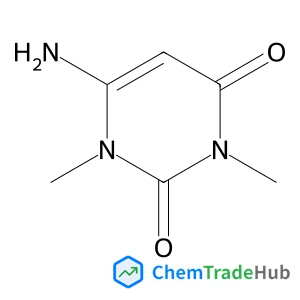
6-amino-1,3-dimethyl-1,2,3,4-tetrahydropyrimidine-2,4-dione
CAS Number:
6642-31-5
Molecular Formula:
C6H9N3O2

Recommended Suppliers





Disclaimer
This page provides academic journal information for reference and research purposes only. We are not affiliated with any journal publishers and do not handle publication submissions. For publication-related inquiries, please contact the respective journal publishers directly.
If you notice any inaccuracies in the information displayed, please contact us at support@chemtradehub.com. We will promptly review and address your concerns.