












Dual pH and temperature responsive helical copolymer libraries with pendant chiral leucine moieties
Literature Information
Publication Date
2013-05-07
DOI
10.1039/C3PY00434A
Impact Factor
5.582
Authors
Kamal Bauri, Shashank Pant, Saswati Ghosh Roy, Priyadarsi De
View Original
Abstract
Reversible addition-fragmentation chain transfer (RAFT) polymerization was employed to afford two different chiral copolymer series having opposite chiroptical properties based on 2-(2-methoxyethoxy)ethyl methacrylate (MEO2MA) and Boc-L/D-leucine methacryloyloxyethyl ester (Boc-L/D-Leu-HEMA) with varying co-monomer proportions. The random nature of the copolymers was indicated by the reactivity ratios of the two monomers for the two systems (MEO2MA with Boc-L-Leu-HEMA and Boc-D-Leu-HEMA), and further supported by smooth variation of the single glass transition temperature (Tg) determined from differential scanning calorimetry (DSC). With an increasing amino acid content in the copolymer, the specific rotation and molar ellipticity values increased, as examined by polarimeter and circular dichroism (CD) spectroscopy, respectively. After Boc-group cleavage under acidic conditions, all the copolymers exhibited cationic nature, as confirmed by dynamic light scattering (DLS), as well as the dual thermo and pH-dependent solubility behaviour in aqueous solution. The temperature induced phase transition of these copolymers was investigated as a function of the copolymer compositions over the pH range from 5.5 to 6.5 using a UV-Vis spectrophotometer. Furthermore, the chiral recognition ability of the synthesized monomers and homopolymers towards 1,1′-bi-2-naphthol (rac-BINOL) was studied by 1H NMR spectroscopy.
Related Literature
Synthesis of high-molecular weight block copolymers of norbornene and propylene with methyl methacrylate initiated by a fluorenylamido titanium complex
Ryo Tanaka, Yuushou Nakayama, Takeshi Shiono
2013-05-03
Paper
DOI: 10.1039/C3PY00400G
Synthesis of poly(dithienogermole-2,6-diyl)s
Joji Ohshita, Masayuki Miyazaki, Daiki Tanaka, Yasushi Morihara, Yuki Fujita, Yoshihito Kunugi
2013-03-26
Paper
DOI: 10.1039/C3PY00253E
Nucleophilic thiol-Michael chemistry and hyperbranched (co)polymers: synthesis and ring-opening metathesis (co)polymerization of novel difunctional exo-7-oxanorbornenes with in situ inimer formation
Meina Liu, Beng Hoon Tan, Robert P. Burford, Andrew B. Lowe
2013-04-08
Paper
DOI: 10.1039/C3PY00110E
Triphenylphosphine as phosphorus catalyst for reversible chain-transfer catalyzed polymerization (RTCP)
Liangjiu Bai, Lifen Zhang, Yuan Liu, Xiangqiang Pan, Zhenping Cheng, Xiulin Zhu
2013-03-04
Paper
DOI: 10.1039/C3PY00187C
Synthesis and characterization of a low band gap quinoxaline based D–A copolymer and its application as a donor for bulk heterojunction polymer solar cells
M. L. Keshtov, D. V. Marochkin, V. S. Kochurov, A. R. Khokhlov
2013-05-01
Paper
DOI: 10.1039/C3PY00391D
Hindrance-functionalized π-stacked polymer based on polystyrene with pendent cardo groups for organic electronics
Cheng-Rong Yin, Yuan Han, Lu Li, Shang-Hui Ye, Wei-Wei Mao, Ming-Dong Yi, Hai-Feng Ling, Ling-Hai Xie, Guang-Wei Zhang
2013-02-08
Paper
DOI: 10.1039/C3PY21154A
Organoselenium compounds: development of a universal “living” free radical polymerization mediator
Jindong Zeng, Jian Zhu, Xiangqiang Pan, Zhengbiao Zhang, Nianchen Zhou, Zhenping Cheng, Wei Zhang, Xiulin Zhu
2013-04-19
Communication
DOI: 10.1039/C3PY00285C
Folate-conjugated poly(N-(2-hydroxypropyl)methacrylamide-co-methacrylic acid) nanohydrogels with pH/redox dual-stimuli response for controlled drug release
Yuan-Jia Pan, Dian Li, Sha Jin, Chuan Wei, Ke-Yi Wu, Jia Guo, Chang-Chun Wang
2013-03-27
Paper
DOI: 10.1039/C3PY00249G
Hydration capabilities and structures of carbonyl and ether groups in poly(3-(2-methoxyethyl)-N-vinyl-2-pyrrolidone) film
Hengjie Lai, Peiyi Wu
2013-03-13
Paper
DOI: 10.1039/C3PY00239J
A facile and highly efficient strategy for esterification of poly(meth)acrylic acid with halogenated compounds at room temperature promoted by 1,1,3,3-tetramethylguanidine
Qianbiao Li, Yinyin Bao, Hu Wang, Fanfan Du, Qing Li, Bangkun Jin, Ruke Bai
2013-03-22
Paper
DOI: 10.1039/C3PY00155E
You might also like
Compound Q&A
What is 1-(2,4,6-Trifluorophenyl)ethanol (CAS: 1250113-83-7)?
1-(2,4,6-Trifluorophenyl)ethanol is an organic compound with the CAS number 1250...
1250113-83-71-(2,4,6-Trifluoroph...
Compound Q&A
Is 1-(2,4-Dimethoxybenzyl)-4-(hydroxymethyl)-2-pyrrolidinone (CAS: 919111-34-5) safe?
1-(2,4-Dimethoxybenzyl)-4-(hydroxymethyl)-2-pyrrolidinone (CAS: 919111-34-5) is ...
919111-34-51-(2,4-Dimethoxybenz...
Compound Q&A
What are the physical and chemical properties of (7S,15R)-6β,15-Diacetoxy-7α,20-epoxy-7-hydroxykaura-2,16-dien-1-one (CAS: 51419-51-3)?
(7S,15R)-6β,15-Diacetoxy-7α,20-epoxy-7-hydroxykaura-2,16-dien-1-one is a crystal...
51419-51-3(7S,15R)-6β,15-Diace...
Compound Q&A
What regulatory guidelines apply to rac-ethyl (1r,4r)-4-hydroxycyclohexane-1-carboxylate, trans (CAS: 3618-04-0)?
The compound rac-ethyl (1r,4r)-4-hydroxycyclohexane-1-carboxylate, trans (CAS: 3...
3618-04-0rac-ethyl (1r,4r)-4-...
Compound Q&A
What is the market or research trend for 2-(2,4-Difluorophenoxy)-3-nitropyridine (CAS: 175135-62-3)?
The market for 2-(2,4-Difluorophenoxy)-3-nitropyridine (CAS: 175135-62-3) is cur...
175135-62-32-(2,4-Difluoropheno...
Compound Q&A
What are the main uses of 6-Diazo-5-oxo-L-norleucine (CAS: 157-03-9)?
The main uses of 6-Diazo-5-oxo-L-norleucine (CAS: 157-03-9) include research in ...
157-03-96-Diazo-5-oxo-L-norl...
Compound Q&A
What precautions should be taken when handling 2-Aminoethyl-mono-amide-DOTA-tris(tBu ester) (CAS: 173308-19-5)?
When handling 2-Aminoethyl-mono-amide-DOTA-tris(tBu ester) (CAS: 173308-19-5), i...
173308-19-52-Aminoethyl-mono-am...
Compound Q&A
How is 5-Methylimidazo[1,2-a]pyridine-3-carbaldehyde (CAS: 178488-37-4) typically synthesized?
5-Methylimidazo[1,2-a]pyridine-3-carbaldehyde (CAS: 178488-37-4) can be synthesi...
178488-37-45-Methylimidazo[1,2-...
Compound Q&A
Are there alternatives to 2,4,6-Trihydroxyisophthalaldehyde (CAS: 4396-13-8) in synthesis?
There are alternative reagents that can be used in the synthesis of 2,4,6-Trihyd...
4396-13-82,4,6-Trihydroxyisop...
Compound Q&A
What is (2Z)-3-(5-Fluoro-1H-indol-3-yl)-2-sulfanylacrylic acid (CAS: 179461-52-0)?
(2Z)-3-(5-Fluoro-1H-indol-3-yl)-2-sulfanylacrylic acid is a chemical compound wi...
179461-52-0(2Z)-3-(5-Fluoro-1H-...
Source Journal
Polymer Chemistry

CiteScore:
8.6
Self-citation Rate:
7.3%
Articles per Year:
457
Polymer Chemistry welcomes submissions in all areas of polymer science that have a strong focus on macromolecular chemistry. Manuscripts may cover a broad range of fields, yet no direct application focus is required.
Recommended Compounds
![5-Bromo-1H-pyrrolo[2,3-b]pyridine structure](https://static.chemtradehub.com/structs/183/183208-35-7-2d72.webp "5-Bromo-1H-pyrrolo[2,3-b]pyridine structure")
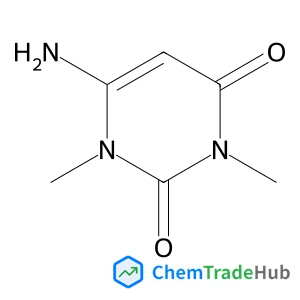
6-amino-1,3-dimethyl-1,2,3,4-tetrahydropyrimidine-2,4-dione
CAS Number:
6642-31-5
Molecular Formula:
C6H9N3O2

Recommended Suppliers





Disclaimer
This page provides academic journal information for reference and research purposes only. We are not affiliated with any journal publishers and do not handle publication submissions. For publication-related inquiries, please contact the respective journal publishers directly.
If you notice any inaccuracies in the information displayed, please contact us at support@chemtradehub.com. We will promptly review and address your concerns.