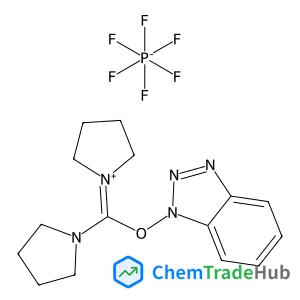
(1H-Benzotriazol-1-yloxy)(di-1-pyrrolidinyl)methylium hexafluorophosphate
CAS Number:
105379-24-6
Molecular Formula:
C15H21F6N5OP
Aizhu Wang, Mingwen Zhao
Fractals are natural phenomena that exhibit a repeating pattern “exactly the same at every scale or nearly the same at different scales”. Defect-free molecular fractals were assembled successfully in a recent work [Shang et al., Nature Chem., 2015, 7, 389–393]. Here, we adopted the feature of a repeating pattern in searching two-dimensional (2D) materials with intrinsic half-metallicity and high stability that are desirable for spintronics applications. Using first-principles calculations, we demonstrate that the electronic properties of fractal frameworks of carbon nitrides have stable ferromagnetism accompanied by half-metallicity, which are highly dependent on the fractal structure. The ferromagnetism increases gradually with the increase of fractal order. The Curie temperature of these metal-free systems estimated from Monte Carlo simulations is considerably higher than room temperature. The stable ferromagnetism, intrinsic half-metallicity, and fractal characteristics of spin distribution in the carbon nitride frameworks open an avenue for the design of metal-free magnetic materials with exotic properties.
Hui Li, Wei Chen, Xiaopeng Shen, Jingwei Liu, Xuri Huang, Guangtao Yu
DOI: 10.1039/C6CP06717D
Arunkumar Kathiravan, Rajadurai Vijay Solomon
DOI: 10.1039/C6CP07768D
DOI: 10.1039/C6CP06939H
Ke Zhang, Rashid Khan, Hongyan Guo, Irfan Ali, Xiuling Li, Yunxiang Lin, Haiping Chen, Wensheng Yan, Xiaojun Wu, Li Song
DOI: 10.1039/C6CP07270D
Kamila Moor, Kristina Gudun, Zarina Yelemessova, Rostislav Bukasov
DOI: 10.1039/C6CP08254H
Elijah G. Schnitzler, Nathan A. Seifert, Supriya Ghosh, Javix Thomas, Yunjie Xu, Wolfgang Jäger
DOI: 10.1039/C6CP08741H
M. Ziatdinov, H. Lim, S. Fujii, K. Kusakabe, M. Kiguchi, T. Enoki, Y. Kim
DOI: 10.1039/C6CP08352H
Yuri Mikhlin, Vladimir Nasluzov, Alexander Romanchenko, Yevgeny Tomashevich, Alexey Shor, Roberto Félix
DOI: 10.1039/C6CP07598C
Hua-Bin Sun, Ying-Xian Zhou, Lu-Lu Zhang, Xue-Lin Yang, Xing-Zhong Cao, Hanu Arave, Hui Fang, Gan Liang
DOI: 10.1039/C6CP07760A
Johanna Blass, Marcel Albrecht, Gerhard Wenz, Yan Nan Zang, Roland Bennewitz
DOI: 10.1039/C6CP07532K
When handling 4-(2-Furylmethyl)thiomorpholine 1,1-dioxide (CAS: 79206-94-3), it ...
When handling 4-Chloro-N-[2-(4-morpholinyl)ethyl]benzamide (CAS: 71320-77-9), it...
Waste containing this compound (CAS: 62921-74-8) should be handled according to ...
Waste containing (S)-Methyl 2-amino-3-cyclohexylpropanoate should be collected i...
This compound can be synthesized using a multi-step process involving the conjug...
There are several alternatives to (2E)-3-(3,4-Dichlorophenyl)acrylic acid in syn...
Ethyl 6-(2-nitrophenyl)imidazo[2,1-b][1,3]thiazole-3-carboxylate (CAS: 925437-84...
Waste containing 2-(1,3-Thiazol-2-yl)ethanamine (CAS: 18453-07-1) should be coll...
Methyl 5-iodo-2-methylbenzoate can be synthesized through the iodination of meth...
5-Chloro[1,2,4]triazolo[1,5-a]pyridine is commonly synthesized via the condensat...

Physical Chemistry Chemical Physics (PCCP) is an international journal co-owned by 19 physical chemistry and physics societies from around the world. This journal publishes original, cutting-edge research in physical chemistry, chemical physics and biophysical chemistry. To be suitable for publication in PCCP, articles must include significant innovation and/or insight into physical chemistry; this is the most important criterion that reviewers and Editors will judge against when evaluating submissions. The journal has a broad scope and welcomes contributions spanning experiment, theory, computation and data science. Topical coverage includes spectroscopy, dynamics, kinetics, statistical mechanics, thermodynamics, electrochemistry, catalysis, surface science, quantum mechanics, quantum computing and machine learning. Interdisciplinary research areas such as polymers and soft matter, materials, nanoscience, energy, surfaces/interfaces, and biophysical chemistry are welcomed if they demonstrate significant innovation and/or insight into physical chemistry. Joined experimental/theoretical studies are particularly appreciated when complementary and based on up-to-date approaches.
![5-Acetyl-2,3-dihydrobenzo[b]furan structure](https://static.chemtradehub.com/structs/908/90843-31-5-eea4.webp "5-Acetyl-2,3-dihydrobenzo[b]furan structure")