












Nanoparticle–nanoparticle vs. nanoparticle–substrate hot spot contributions to the SERS signal: studying Raman labelled monomers, dimers and trimers
Literature Information
Publication Date
2016-12-15
DOI
10.1039/C6CP08254H
Impact Factor
3.676
Authors
Kamila Moor, Kristina Gudun, Zarina Yelemessova, Rostislav Bukasov
View Original
Abstract
We used a combination of Raman microscopy, AFM and TEM to quantify the influence of dimerization on the surface enhanced Raman spectroscopy (SERS) signal for gold and silver nanoparticles (NPs) modified with Raman reporters and situated on gold, silver, and aluminum films and a silicon wafer. The overall increases in the mean SERS enhancement factor (EF) upon dimerization (up by 43% on average) and trimerisation (up by 96% on average) of AuNPs and AgNPs on the studied metal films are within a factor of two, which is moderate when compared to most theoretical models. However, the maximum ratio of EFs for some dimers to the mean EF of monomers can be as high as 5.5 for AgNPs on a gold substrate. In contrast, for dimerization and trimerization of gold and silver NPs on silicon, the mean EF increases by 1–2 orders of magnitude relative to the mean EF of single NPs. Therefore, hot spots in the interparticle gap between gold nanoparticles rather than hot spots between Au nanoparticles and the substrate dominate SERS enhancement for dimers and trimers on a silicon substrate. However, Raman labeled noble metal nanoparticles on plasmonic metal films generate on average SERS enhancement of the same order of magnitude for both types of hot spot zones (e.g. NP/NP and NP/metal film).
Related Literature
Heterotellurium-containing macrocycles towards degradable tellurium-functionalized polymers
Jieni Hu, Chuanhao Sun, Siqi Li, Yuan Yuan
2021-07-20
Communication
DOI: 10.1039/D1PY00703C
Introducing a 1,1-diphenylethylene analogue for vinylpyridine: anionic copolymerisation of 3-(1-phenylvinyl)pyridine (m-PyPE)
Marcel Fickenscher, Tom Reimers, Holger Frey
2021-05-31
Paper
DOI: 10.1039/D1PY00302J
The effect of alkyl chain lengths on the red-to-near-infrared emission of boron-fused azomethine conjugated polymers and their film-state stimuli-responsivities
Shunsuke Ohtani, Natsumi Yamada, Masayuki Gon, Kazuo Tanaka, Yoshiki Chujo
2021-04-19
Paper
DOI: 10.1039/D1PY00213A
Correlations of nanoscale film morphologies and topological confinement of three-armed cage block copolymers
Brian J. Ree, Yusuke Satoh, Takuya Isono, Toshifumi Satoh
2021-05-25
Paper
DOI: 10.1039/D1PY00421B
A quinine-based quaternized polymer: a potent scaffold with bactericidal properties without resistance
Huan-Huan Ding, Mu-Han Zhao, Le Zhai, Jian-Bin Zhen, Le-Yun Sun, Jia-Zhu Chigan, Cheng Chen, Jia-Qi Li, Han Gao, Ke-Wu Yang
2021-03-25
Paper
DOI: 10.1039/D0PY01751E
You might also like
Compound Q&A
What precautions should be taken when handling 4-(2-Furylmethyl)thiomorpholine 1,1-dioxide (CAS: 79206-94-3)?
When handling 4-(2-Furylmethyl)thiomorpholine 1,1-dioxide (CAS: 79206-94-3), it ...
79206-94-34-(2-Furylmethyl)thi...
Compound Q&A
What precautions should be taken when handling 4-Chloro-N-[2-(4-morpholinyl)ethyl]benzamide (CAS: 71320-77-9)?
When handling 4-Chloro-N-[2-(4-morpholinyl)ethyl]benzamide (CAS: 71320-77-9), it...
71320-77-94-Chloro-N-[2-(4-mor...
Compound Q&A
How should waste containing 2-[2-(2-Methoxyethoxy)ethoxy]ethyl 4-methylbenzenesulfonate (CAS: 62921-74-8) be handled?
Waste containing this compound (CAS: 62921-74-8) should be handled according to ...
62921-74-82-[2-(2-Methoxyethox...
Compound Q&A
How should waste containing (S)-Methyl 2-amino-3-cyclohexylpropanoate be handled?
Waste containing (S)-Methyl 2-amino-3-cyclohexylpropanoate should be collected i...
40056-18-6(S)-Methyl 2-amino-3...
Compound Q&A
How is 5-({4-[(2S,4R)-4-Hydroxy-2-methyltetrahydro-2H-pyran-4-yl]-2-thienyl}sulfanyl)-1-methyl-1,3-dihydro-2H-indol-2-one (CAS: 166882-70-8) typically synthesized?
This compound can be synthesized using a multi-step process involving the conjug...
166882-70-85-({4-[(2S,4R)-4-Hyd...
Compound Q&A
Are there alternatives to (2E)-3-(3,4-Dichlorophenyl)acrylic acid (CAS: 7312-27-8) in synthesis?
There are several alternatives to (2E)-3-(3,4-Dichlorophenyl)acrylic acid in syn...
7312-27-8(2E)-3-(3,4-Dichloro...
Compound Q&A
How should Ethyl 6-(2-nitrophenyl)imidazo[2,1-b][1,3]thiazole-3-carboxylate (CAS: 925437-84-9) be stored?
Ethyl 6-(2-nitrophenyl)imidazo[2,1-b][1,3]thiazole-3-carboxylate (CAS: 925437-84...
925437-84-9Ethyl 6-(2-nitrophen...
Compound Q&A
How should waste containing 2-(1,3-Thiazol-2-yl)ethanamine (CAS: 18453-07-1) be handled?
Waste containing 2-(1,3-Thiazol-2-yl)ethanamine (CAS: 18453-07-1) should be coll...
18453-07-12-(1,3-Thiazol-2-yl)...
Compound Q&A
How is Methyl 5-iodo-2-methylbenzoate (CAS: 103440-54-6) typically synthesized?
Methyl 5-iodo-2-methylbenzoate can be synthesized through the iodination of meth...
103440-54-6Methyl 5-iodo-2-meth...
Compound Q&A
How is 5-Chloro[1,2,4]triazolo[1,5-a]pyridine (CAS: 1427399-34-5) typically synthesized?
5-Chloro[1,2,4]triazolo[1,5-a]pyridine is commonly synthesized via the condensat...
1427399-34-55-Chloro[1,2,4]triaz...
Source Journal
Physical Chemistry Chemical Physics

CiteScore:
5.5
Self-citation Rate:
10.3%
Articles per Year:
3036
Physical Chemistry Chemical Physics (PCCP) is an international journal co-owned by 19 physical chemistry and physics societies from around the world. This journal publishes original, cutting-edge research in physical chemistry, chemical physics and biophysical chemistry. To be suitable for publication in PCCP, articles must include significant innovation and/or insight into physical chemistry; this is the most important criterion that reviewers and Editors will judge against when evaluating submissions. The journal has a broad scope and welcomes contributions spanning experiment, theory, computation and data science. Topical coverage includes spectroscopy, dynamics, kinetics, statistical mechanics, thermodynamics, electrochemistry, catalysis, surface science, quantum mechanics, quantum computing and machine learning. Interdisciplinary research areas such as polymers and soft matter, materials, nanoscience, energy, surfaces/interfaces, and biophysical chemistry are welcomed if they demonstrate significant innovation and/or insight into physical chemistry. Joined experimental/theoretical studies are particularly appreciated when complementary and based on up-to-date approaches.
Recommended Compounds
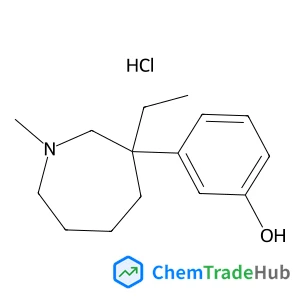
3-(3-Ethyl-1-methyl-3-azepanyl)phenol hydrochloride (1:1)
CAS Number:
59263-76-2
Molecular Formula:
C15H24ClNO


Recommended Suppliers




Disclaimer
This page provides academic journal information for reference and research purposes only. We are not affiliated with any journal publishers and do not handle publication submissions. For publication-related inquiries, please contact the respective journal publishers directly.
If you notice any inaccuracies in the information displayed, please contact us at support@chemtradehub.com. We will promptly review and address your concerns.