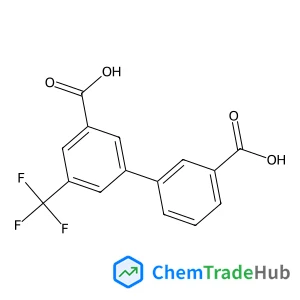
3-(3-Carboxyphenyl)-5-(trifluoromethyl)benzoic acid
CAS Number:
1261930-96-4
Molecular Formula:
C15H9F3O4
Liang Han, Jie Lian, Sheng Liu, Zhongfang Chen, Nikhil Koratkar, Suvranu De
Oxidation is a major cause for the degradation of materials including graphene, where epoxidation (forming the C–O–C bond) is very common. In addition, graphene oxide, in which the epoxy group is one of the two major functional groups (the other is hydroxy), is an important precursor material used for the bulk synthesis of graphene sheets. Information about the mechanical stabilities, non-linear elastic properties, and elastic limits under various strain components is invaluable for application of these nanomaterials. Here, we investigate the mechanical properties of the epoxidized graphene in ordered graphene oxide, namely C6O1, C6O2, and C6O3, representing the carbon : oxygen ratios of 6 : 1, 3 : 1, and 2 : 1, respectively, using first-principles calculations within the framework of density functional theory. We predict a reduction of Young's modulus of graphene by a factor of 20%, 23%, and 27% for C6O1, C6O2, and C6O3, respectively, indicating a monotonic degradation with respect to epoxidation. However, there is no clear trend for Poisson's ratio, implying that the local atomic configurations are dominant over oxygen concentrations in determining the Poisson ratio. Our computed high order elastic constants are good for the design of graphene oxide based flexible transparent electronics.
Francesca Cicogna, Serena Coiai, Paola Rizzarelli, Sabrina Carroccio, Cristian Gambarotti, Ilaria Domenichelli, Chengcheng Yang, Nadka Tz. Dintcheva, Giovanni Filippone, Calogero Pinzino, Elisa Passaglia
DOI: 10.1039/C4PY00641K
Siddharth Chanpuriya, Marc A. Hillmyer, Frank S. Bates
DOI: 10.1039/C4PY00614C
Wenlong Li, Peiyi Wu
DOI: 10.1039/C4PY00593G
Yangqing Tao, Fengkai He, Kaikai Jin, Jiajia Wang, Yuanqiang Wang, Junfeng Zhou, Jing Sun, Qiang Fang
DOI: 10.1039/C7PY00047B
Toyokazu Tsutsuba
DOI: 10.1039/C7PY00100B
Yingda Huang, Jianyun He, Zhanxiong Liu, Guilong Cai, Shaowen Zhang, Xiaofang Li
DOI: 10.1039/C6PY01859A
Shuang Li, Xianyu Deng, Lei Feng, Xincheng Miao, Kuangyi Tang, Qianqian Li, Zhen Li
DOI: 10.1039/C6PY01733A
Juxin He, Luyang Du, Cong Wang, Mingjian Jiang, Linlin Liu, Yueqi Mo, Zengqi Xie, Bing Yang, Yuguang Ma
DOI: 10.1039/C6PY01995A
Bin Li, Xiu-jun Liu, Liang Li, Sheng-hua Zhang, Yi Li, Dian-dong Li, Yong-su Zhen
DOI: 10.1039/C4PY00532E
4-Amino-3-bromophenol (CAS: 74440-80-5) falls under the classification of a haza...
(17beta)-3-Oxoestr-4-en-17-yl acetate should be stored in a cool, dry place away...
2-[(2,2-Diethoxyethyl)disulfanyl]-1,1-diethoxyethane (CAS: 76505-71-0) is a colo...
The market and research for 1-(β-D-ribofuranosyl)-1H-imidazo[4,5-c]pyridin-4-ami...
Waste containing Conjugated Estrogen (CAS: 12126-59-9) should be collected and d...
The market for Bis(2,2,2-trifluoroethyl) (methoxycarbonylmethyl)phosphonate (CAS...
There are several alternatives to 3,4'-Di-O-methylellagic acid (CAS: 57499-59-9)...
2-Chloro-N,N-dimethylpyridin-4-amine (CAS: 59047-70-0) is regulated under the Gl...
Cerium(3+);oxygen(2-);vanadium(5+) (CAS: 13597-19-8) is a complex inorganic comp...
7-Chloro-1-iodoisoquinoline (CAS: 1203579-27-4) is generally considered safe whe...

Physical Chemistry Chemical Physics (PCCP) is an international journal co-owned by 19 physical chemistry and physics societies from around the world. This journal publishes original, cutting-edge research in physical chemistry, chemical physics and biophysical chemistry. To be suitable for publication in PCCP, articles must include significant innovation and/or insight into physical chemistry; this is the most important criterion that reviewers and Editors will judge against when evaluating submissions. The journal has a broad scope and welcomes contributions spanning experiment, theory, computation and data science. Topical coverage includes spectroscopy, dynamics, kinetics, statistical mechanics, thermodynamics, electrochemistry, catalysis, surface science, quantum mechanics, quantum computing and machine learning. Interdisciplinary research areas such as polymers and soft matter, materials, nanoscience, energy, surfaces/interfaces, and biophysical chemistry are welcomed if they demonstrate significant innovation and/or insight into physical chemistry. Joined experimental/theoretical studies are particularly appreciated when complementary and based on up-to-date approaches.