












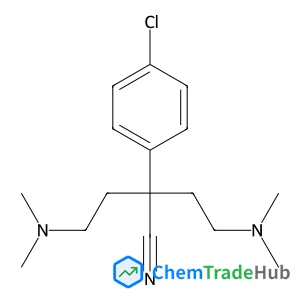
2-(4-Chlorophenyl)-4-(dimethylamino)-2-(2-(dimethylamino)ethyl)butanenitrile
CAS Number:
1246816-57-8
Molecular Formula:
C16H24ClN3
Minoru Hanaya
Electronic interactions between organic materials and inorganic semiconductors play important roles in various electronic and optoelectronic functions and also provide new functions such as optical interfacial charge-transfer (ICT) transitions having the following features. ICT transitions enable the capture of lower-energy photons than HOMO–LUMO gaps or band gaps and allow one-step charge separation without loss of energy. The hybrid material generated by the nucleophilic addition reaction between TiO2 and TCNQ exclusively exhibits strong ICT transitions. In this study, we report that strong organic–metal oxide electronic coupling is caused by the nucleophilic addition reaction, which enhances the ICT transitions. The electronic coupling between TiO2 and TCNQ occurs according to a two-step mechanism. First, the lowest unoccupied molecular orbital (LUMO (π*)) of TCNQ is elevated by the nucleophilic attack of a deprotonated hydroxy group on TiO2 to TCNQ and the electron distribution is moved toward TiO2. By this elevation and redistribution, the LUMO (π*) strongly interacts with the d(t2g) orbitals of a surface Ti atom. From avoided-crossing behavior with a large splitting energy of ca. 0.95 eV, the coupling energy was estimated to be as much as 0.5 eV in the mono-Ti model complex. This strong d–π* electronic coupling leads to strong coupling between complete ICT excited states and partial ICT excited states with a large splitting energy of ca. 0.92 eV, which considerably increases the probabilities of ICT transition. This study clarified the mechanisms of the strong organic–inorganic electronic coupling and the enhancement of ICT absorption in the TiO2–TCNQ hybrid material.
Na Liu, Jince Zhang, Jingyi Wen, Xiaolei You, Dawei Fang
DOI: 10.1039/D2PY00081D
Li-Hong Wang, Xian-Jie Chen, Dong-Nai Ye, Hui Liu, Yan Chen, Ai-Guo Zhong, Chang-Zhi Li, Shi-Yong Liu
DOI: 10.1039/D2PY00139J
Aristea Pavlou, Alexandros Petropoulos, Michael G. Siskos, Akram Hijazi, Frédéric Dumur
DOI: 10.1039/D2PY00753C
Zhi Zhou, Ying Wang, Linlin Zhu, Dai Dang
DOI: 10.1039/D2PY00569G
Shaon Dey, Arpita Roy, Kalipada Manna, Sagar Pal
DOI: 10.1039/D2PY00626J
Jing Chen, Chunyang Bao, Rui Han, Guang-Zhao Li, Zhaoquan Zheng, Yan Wang, Qiang Zhang
DOI: 10.1039/D1PY01711J
Zihnil A. I. Mazrad, May Lai, Thomas P. Davis, Joseph A. Nicolazzo, Meike N. Leiske
DOI: 10.1039/D2PY00649A
Naganatha Patil, Yves Gnanou, Xiaoshuang Feng
DOI: 10.1039/D2PY00442A
This compound is mainly used as an intermediate in the synthesis of antipsychoti...
Waste containing 1-(D-Ribofuranosyl)-1,4-dihydro-3-pyridinecarboxamide (CAS: 191...
2-Methyl-2-propanyl 3-bromo-3-(hydroxymethyl)-1-azetidinecarboxylate (CAS: 20079...
N-(4-Chloro-2-pyridinyl)acetamide (CAS: 245056-66-0) is a chemical compound with...
5-Chloro-2-hydroxybenzoic acid, also known as 5-chlorosalicylic acid, is an arom...
When handling 1,1-Dichloro-1-fluoroethane (CAS: 1717-00-6), it is important to u...
Fmoc-(2S,3R)-3-phenylpyrrolidine-2-carboxylic acid is a white crystalline solid ...
4-Amino-5-bromo-2-pyridinecarboxylic acid is primarily used as a precursor in th...
Handling this compound should be done with personal protective equipment (PPE) i...
When handling 8-bromo-2,2-dimethyl-3,4-dihydro-2H-1,4-benzoxazin-3-one, use prop...

Physical Chemistry Chemical Physics (PCCP) is an international journal co-owned by 19 physical chemistry and physics societies from around the world. This journal publishes original, cutting-edge research in physical chemistry, chemical physics and biophysical chemistry. To be suitable for publication in PCCP, articles must include significant innovation and/or insight into physical chemistry; this is the most important criterion that reviewers and Editors will judge against when evaluating submissions. The journal has a broad scope and welcomes contributions spanning experiment, theory, computation and data science. Topical coverage includes spectroscopy, dynamics, kinetics, statistical mechanics, thermodynamics, electrochemistry, catalysis, surface science, quantum mechanics, quantum computing and machine learning. Interdisciplinary research areas such as polymers and soft matter, materials, nanoscience, energy, surfaces/interfaces, and biophysical chemistry are welcomed if they demonstrate significant innovation and/or insight into physical chemistry. Joined experimental/theoretical studies are particularly appreciated when complementary and based on up-to-date approaches.
![tert-Butyl N-[(2-chloropyridin-4-yl)methyl]carbamate structure](https://static.chemtradehub.com/structs/916/916210-27-0-9f95.webp "tert-Butyl N-[(2-chloropyridin-4-yl)methyl]carbamate structure")
![6-Benzyl-4,5,6,7-tetrahydro-1H-pyrazolo[3,4-c]pyridin-3(2H)-one structure](https://static.chemtradehub.com/structs/909/909187-64-0-f54f.webp "6-Benzyl-4,5,6,7-tetrahydro-1H-pyrazolo[3,4-c]pyridin-3(2H)-one structure")



