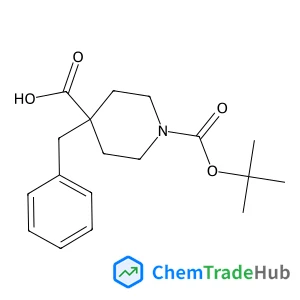
4-Benzyl-1-(tert-butoxycarbonyl)piperidine-4-carboxylic acid
CAS Number:
170838-87-6
Molecular Formula:
C18H25NO4
Manman Yang, Juan Liu, Xing Zhang, Shi Qiao, Hui Huang, Yang Liu, Zhenhui Kang
A C3N4-sensitized TiO2 nanotube array-based photoanode was designed and fabricated via the in situ growth of C3N4 on the surface of TiO2 nanotubes. It shows stable and significantly improved PEC activity for hydrogen generation under visible light irradiation with a hydrogen production rate of about 19.1 μmol h−1 (a Faradaic efficiency of nearly 100%).
Florian Baffie, Muriel Lansalot, Vincent Monteil, Franck D'Agosto
DOI: 10.1039/D2PY00156J
James D. Tinkler, Daniel W. Lester, Jonathan Martinelli, Lorenzo Tei, Stephen J. Butler, Helen Willcock
DOI: 10.1039/D2PY00337F
Petrus F. Kuijpers, Diana Bernin
DOI: 10.1039/D2PY00231K
Vahid Asadi, Jasper van der Gucht, Thomas E. Kodger
DOI: 10.1039/D2PY00841F
Talia A. Shmool, Anna P. Constantinou, Andreas Jirkas, Chen Zhao, Theoni K. Georgiou, Jason P. Hallett
DOI: 10.1039/D2PY00053A
Yuezhou Liu, Baodong Zhao, Bin Chen, Bingbing Shi
DOI: 10.1039/D2PY00476C
Zhi Zhou, Ying Wang, Linlin Zhu, Dai Dang
DOI: 10.1039/D2PY00569G
Minghang Ji, Shengquan Zheng, Chen Zou, Min Chen
DOI: 10.1039/D2PY00886F
Xiacong Zhang, Biyi Xu, Wen Li
DOI: 10.1039/D2PY00118G
Haoxiang Rong, Min Xu, Xiaolin Jiang, Xun Lu
DOI: 10.1039/D2PY00323F
This compound is mainly used as an intermediate in the synthesis of antipsychoti...
Waste containing 1-(D-Ribofuranosyl)-1,4-dihydro-3-pyridinecarboxamide (CAS: 191...
2-Methyl-2-propanyl 3-bromo-3-(hydroxymethyl)-1-azetidinecarboxylate (CAS: 20079...
N-(4-Chloro-2-pyridinyl)acetamide (CAS: 245056-66-0) is a chemical compound with...
5-Chloro-2-hydroxybenzoic acid, also known as 5-chlorosalicylic acid, is an arom...
When handling 1,1-Dichloro-1-fluoroethane (CAS: 1717-00-6), it is important to u...
Fmoc-(2S,3R)-3-phenylpyrrolidine-2-carboxylic acid is a white crystalline solid ...
4-Amino-5-bromo-2-pyridinecarboxylic acid is primarily used as a precursor in th...
Handling this compound should be done with personal protective equipment (PPE) i...
When handling 8-bromo-2,2-dimethyl-3,4-dihydro-2H-1,4-benzoxazin-3-one, use prop...

Physical Chemistry Chemical Physics (PCCP) is an international journal co-owned by 19 physical chemistry and physics societies from around the world. This journal publishes original, cutting-edge research in physical chemistry, chemical physics and biophysical chemistry. To be suitable for publication in PCCP, articles must include significant innovation and/or insight into physical chemistry; this is the most important criterion that reviewers and Editors will judge against when evaluating submissions. The journal has a broad scope and welcomes contributions spanning experiment, theory, computation and data science. Topical coverage includes spectroscopy, dynamics, kinetics, statistical mechanics, thermodynamics, electrochemistry, catalysis, surface science, quantum mechanics, quantum computing and machine learning. Interdisciplinary research areas such as polymers and soft matter, materials, nanoscience, energy, surfaces/interfaces, and biophysical chemistry are welcomed if they demonstrate significant innovation and/or insight into physical chemistry. Joined experimental/theoretical studies are particularly appreciated when complementary and based on up-to-date approaches.