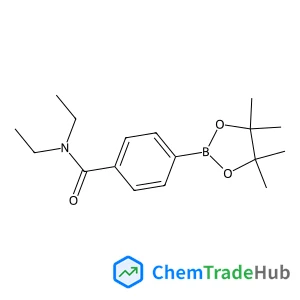
N,N-Diethyl-4-(4,4,5,5-tetramethyl-1,3,2-dioxaborolan-2-yl)benzamide
CAS Number:
325142-99-2
Molecular Formula:
C17H26BNO3
Talia A. Shmool, Anna P. Constantinou, Andreas Jirkas, Chen Zhao, Theoni K. Georgiou, Jason P. Hallett
Amongst the greatest challenges in developing injectable controlled thermoresponsive micellar and hydrogel drug delivery vehicles include tuning the cloud point (CP) and reducing the gelation temperature (Tgel), below 37 °C, without compromising stability and solubility. Here, a unique strategy is employed using ionic liquid (IL) matrices to produce stable micellar and hydrogel delivery vehicles of distinct thermoresponsive properties. Each formulation includes the in-house synthesised polymer OEGMA30020-b-BuMA22-b-DEGMA11 with FITC-IgG. Both micellar-IL and hydrogel-IL formulations exhibit enhanced stability following 120 days of storage under 4 °C compared to in phosphate buffered saline (PBS). Visual tests demonstrate that the CP of the micellar-IL carriers can be finely tuned (31–46 °C). Rheology measurements show that hydrogel strength is significantly increased and Tgel is reduced from 40 °C in PBS to 30 °C with IL. Finally, a unique stabilisation mechanism is proposed, triggered by the synergetic action of the excipients and IL in each system.

Russian Journal of Organic Chemistry

Chemical Communications

Journal of Natural Medicines

Russian Journal of Bioorganic Chemistry

Russian Chemical Bulletin

Nature Medicine

Russian Journal of Coordination Chemistry

Russian Journal of General Chemistry

Journal of Saudi Chemical Society

Journal of Peptide Science
Anastasiia Salnikova, Imad Belabbas, David Lacroix, Joseph Kioseoglou
DOI: 10.1039/C7CP07821H
Andrea Bonvicini, Laure Guilhaudis, Vincent Tognetti, Didier Desmaële, Nathalie Sauvonnet, Hassan Oulyadi, Laurent Joubert
DOI: 10.1039/C7CP07713K
Tapta Kanchan Roy, Vladimir Kopysov, Aleksandr Pereverzev, Jiří Šebek, R. Benny Gerber, Oleg V. Boyarkin
DOI: 10.1039/C8CP03989E
Cezhou Zhao, Chun Zhao, Weitao Su, Yannick J. Dappe, Richard J. Nichols
DOI: 10.1039/C8CP02877J
L. Genovese, M. Soccio, N. Lotti, A. Munari, A. Szymczyk, S. Paszkiewicz, A. Linares, A. Nogales, T. A. Ezquerra
DOI: 10.1039/C8CP01810C
Joonhee Kang, Seung Hyo Noh, Jeemin Hwang, Hoje Chun, Hansung Kim, Byungchan Han
DOI: 10.1039/C8CP03801E
Cangtao Yin, Mica C. Smith, Maodu Chen, Chunlei Xiao, Dongxu Dai, Kaito Takahashi, Wenrui Dong
DOI: 10.1039/C8CP05920A
Denis S. Grebenkov, Ralf Metzler, Gleb Oshanin
DOI: 10.1039/C8CP02043D
Ting Ou, Yuan Feng, Wen-Juan Tian, Li-Juan Zhao, Xiang-Yu Kong, Hong-Guang Xu, Hua-Jin Zhai
DOI: 10.1039/C7CP08512E
Hajime Torii, Hisako Sato
DOI: 10.1039/C8CP02121J
This compound is mainly used as an intermediate in the synthesis of antipsychoti...
Waste containing 1-(D-Ribofuranosyl)-1,4-dihydro-3-pyridinecarboxamide (CAS: 191...
2-Methyl-2-propanyl 3-bromo-3-(hydroxymethyl)-1-azetidinecarboxylate (CAS: 20079...
N-(4-Chloro-2-pyridinyl)acetamide (CAS: 245056-66-0) is a chemical compound with...
5-Chloro-2-hydroxybenzoic acid, also known as 5-chlorosalicylic acid, is an arom...
When handling 1,1-Dichloro-1-fluoroethane (CAS: 1717-00-6), it is important to u...
Fmoc-(2S,3R)-3-phenylpyrrolidine-2-carboxylic acid is a white crystalline solid ...
4-Amino-5-bromo-2-pyridinecarboxylic acid is primarily used as a precursor in th...
Handling this compound should be done with personal protective equipment (PPE) i...
When handling 8-bromo-2,2-dimethyl-3,4-dihydro-2H-1,4-benzoxazin-3-one, use prop...

Polymer Chemistry welcomes submissions in all areas of polymer science that have a strong focus on macromolecular chemistry. Manuscripts may cover a broad range of fields, yet no direct application focus is required.
![Methyl 4-({[(2-methyl-2-propanyl)oxy]carbonyl}amino)bicyclo[2.2.2]octane-1-carboxylate structure](https://static.chemtradehub.com/structs/943/943845-74-7-b7e5.webp "Methyl 4-({[(2-methyl-2-propanyl)oxy]carbonyl}amino)bicyclo[2.2.2]octane-1-carboxylate structure")