












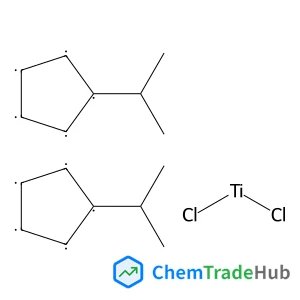
BIS(I-PROPYLCYCLOPENTADIENYL)TITANIUM DICHLORIDE
CAS Number:
12130-65-3
Molecular Formula:
C16H22Cl2Ti
Alexander Genest, Armando Borgna
We studied the C–O cleavage of phenolate and catecholate at step sites of a Ru catalyst using periodic DFT methods at the GGA level. Both C–O scission steps are associated with activation barriers of about 75 kJ mol−1, hence are significantly more facile than the analogous reactions on Ru terraces. With these computational results, we offer an interpretation of recent experiments on the hydrodeoxygenation of guaiacol (2-methoxyphenol) over Ru/C. We hypothesize that the experimentally observed dependency of the product selectivity on the H2 pressure is related to the availability of step sites on a Ru catalyst.
Yan Chen, Xiaoyang Shi, Mingjia Li, Yilun Liu
DOI: 10.1039/C8CP01334A
Manish Kumar Dixit, Mrigendra Dubey
DOI: 10.1039/C8CP04579H
Y. Khabzina, C. Laroche, J. Pérez-Pellitero, D. Farrusseng
DOI: 10.1039/C8CP04042G
Enrico Tapavicza, Travis Thompson, Kenneth Redd, Dan Kim
DOI: 10.1039/C8CP05181J
D. Bloos, R. Marx, P. Lutz, M. Kern, O. Laguta, C. Dietrich, J. van Slageren
DOI: 10.1039/C7CP07443C
Hai-Ru Li, Miao Yan, Qiang Chen, Yue-Wen Mu, Hai-Gang Lu, Yan-Bo Wu, Si-Dian Li
DOI: 10.1039/C8CP01078A
Jingyu Jin, Xiaoyan Li, Jiafeng Geng, Dengwei Jing
DOI: 10.1039/C8CP01838C
Alicja Domaracka, Rudy Delaunay, Arkadiusz Mika, Michael Gatchell, Henning Zettergren, Henrik Cederquist, Patrick Rousseau, Bernd A. Huber
DOI: 10.1039/C8CP01179F
Liang Pu, Zhong Zhang, R. Bruce King, Wesley D. Allen
DOI: 10.1039/C7CP08673C
2-Methylbenzene-1,4-diamine dihydrochloride (CAS: 615-45-2) should be stored in ...
(1S,4S)-2,5-Diazabicyclo[2.2.1]heptane dihydrobromide is generally considered sa...
(6-Chloropyridazin-3-YL)methanamine finds applications in the pharmaceutical ind...
2-Fluoro-3-methylphenol is primarily used in the synthesis of pharmaceuticals, p...
When handling 3-Methoxy-4-nitrobenzonitrile, it is important to wear appropriate...
When handling 1,3-Oxazolo[4,5-b]pyridine-2(3H)-thione (CAS: 211949-57-4), it is ...
4-Ethynylbenzamide (CAS: 90347-86-7) falls under various regulatory guidelines i...
3-(2-Ethylphenyl)-2-thioxo-4-imidazolidinone is primarily used as an intermediat...
(2-Fluoro-6-methoxyphenyl)acetic acid, also known as 4-fluoro-3-methoxybenzoic a...
Market trends for 2-[4-(Hydroxymethyl)phenoxy]ethanol (CAS: 102196-18-9) indicat...

Physical Chemistry Chemical Physics (PCCP) is an international journal co-owned by 19 physical chemistry and physics societies from around the world. This journal publishes original, cutting-edge research in physical chemistry, chemical physics and biophysical chemistry. To be suitable for publication in PCCP, articles must include significant innovation and/or insight into physical chemistry; this is the most important criterion that reviewers and Editors will judge against when evaluating submissions. The journal has a broad scope and welcomes contributions spanning experiment, theory, computation and data science. Topical coverage includes spectroscopy, dynamics, kinetics, statistical mechanics, thermodynamics, electrochemistry, catalysis, surface science, quantum mechanics, quantum computing and machine learning. Interdisciplinary research areas such as polymers and soft matter, materials, nanoscience, energy, surfaces/interfaces, and biophysical chemistry are welcomed if they demonstrate significant innovation and/or insight into physical chemistry. Joined experimental/theoretical studies are particularly appreciated when complementary and based on up-to-date approaches.

![3-[(3R,4R)-3-[(6-aminopyrimidin-4-yl)-methyl-amino]-4-methyl-1-piperidyl]-3-oxo-propanenitrile structure](https://static.chemtradehub.com/structs/164/1640971-60-3-83a4.webp "3-[(3R,4R)-3-[(6-aminopyrimidin-4-yl)-methyl-amino]-4-methyl-1-piperidyl]-3-oxo-propanenitrile structure")
![[1-(5-Methyl-2-pyridinyl)-1H-pyrazol-4-yl]methanol structure](https://static.chemtradehub.com/structs/143/1439822-99-7-6cc9.webp "[1-(5-Methyl-2-pyridinyl)-1H-pyrazol-4-yl]methanol structure")






