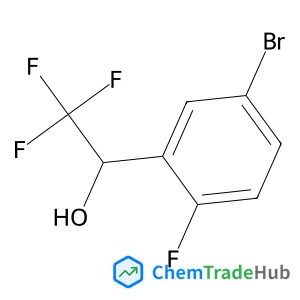
1-(5-Bromo-2-fluorophenyl)-2,2,2-trifluoroethanol
CAS Number:
1039827-16-1
Molecular Formula:
C8H5BrF4O
Wai Kit Tang, Han Zhang, Chi-Kit Siu
The recombination reactions of gas-phase hydrated electrons (H2O)n˙− with CO2 and O2, as well as the charge exchange reaction of CO2˙−(H2O)n with O2, were studied by Fourier transform ion cyclotron resonance (FT-ICR) mass spectrometry in the temperature range T = 80–300 K. Comparison of the rate constants with collision models shows that CO2 reacts with 50% collision efficiency, while O2 reacts considerably slower. Nanocalorimetry yields internally consistent results for the three reactions. Converted to room temperature condensed phase, this yields hydration enthalpies of CO2˙− and O2˙−, ΔHhyd(CO2˙−) = −334 ± 44 kJ mol−1 and ΔHhyd(O2˙−) = −404 ± 28 kJ mol−1. Quantum chemical calculations show that the charge exchange reaction proceeds via a CO4˙− intermediate, which is consistent with a fully ergodic reaction and also with the small efficiency. Ab initio molecular dynamics simulations corroborate this picture and indicate that the CO4˙− intermediate has a lifetime significantly above the ps regime.

Foundations of Chemistry

Physical Chemistry Chemical Physics

Mini-Reviews in Medicinal Chemistry

Journal of Medical Biochemistry

Current Pharmaceutical Biotechnology

Advanced Engineering Materials

Nature Reviews Drug Discovery

Contact Lens & Anterior Eye

Environmental Toxicology and Pharmacology

Molecular Diversity
DOI: 10.1039/D3SU00247K
Shara Ahmed, Nabanita Basu, Catherine E. Nicholson, Simon R. Rutter, John R. Marshall, Justin J. Perry, John R. Dean
DOI: 10.1039/D3FB00101F
Natalia Obrzut, Rob Hickmott, Lily Shure, Kimberly A. Gray
DOI: 10.1039/D3SU00262D
Victor V. Yashin, Fariha Mahmood, Kalaichelvi Saravanamuttu, Anna C. Balazs
DOI: 10.1039/D3LF00156C
Annada Das, S. Biswas, P. K. Nanda, Niloy Chatterjee, Srija Pal, Pubali Dhar, Arun K. Verma, Dipanwita Bhattacharya, Rojison Koshy, Arun K. Das
DOI: 10.1039/D3FB00177F
Sumanjot Kaur, Jingyi Chen
DOI: 10.1039/D3FB00069A
Peiying Fan, Yuhan Zhang, Li Guan, Han Wang, George Zheng Chen
DOI: 10.1039/D3SU00197K
Andrea Angulo, Carolina Elizarraras, Ju Hee Shin, Alexandra van Riel, Toshihiro Akashige, Miguel Modestino
DOI: 10.1039/D3SU00347G
Fumihiko Ogata, Kazuki Sugimura, Noriaki Nagai, Keiji Nishiwaki
DOI: 10.1039/D3SU00342F
2-(2-Chloroacetamido)-3-phenylpropanoic acid (CAS: 7765-11-9) is generally consi...
2-(Benzyloxy)-5-bromobenzoic acid can be handled safely if appropriate precautio...
(4-Methyl-1,2,5-oxadiazol-3-yl)methanamine hydrochloride is a chemical compound ...
2-(5-Hexylthiophen-2-yl)-4,4,5,5-tetramethyl-1,3,2-dioxaborolane (CAS: 917985-54...
While 4-(8-Methyl-9H-1,3-dioxolo[4,5-h][2,3]benzodiazepin-5-yl)benzenamine (CAS:...
The market for tert-butyl 3-hydroxy-4,5,7,8-tetrahydro-2H-pyrazolo[3,4-d]azepine...
Waste containing 3,5-Diamino-1H-pyrazole-4-carbonitrile (CAS: 6844-58-2) should ...
(6-Fluoro-3-pyridinyl)boronic acid can be synthesized through the reaction of 6-...
Dibenzyl carbonimidoylbiscarbamate (CAS: 10065-79-9) finds applications in vario...
The market for (beta,beta,2,3,4,5,6-~2~H_7_)Phenylalanine (CAS: 74228-83-4) is g...
Physical Chemistry Chemical Physics (PCCP) is an international journal co-owned by 19 physical chemistry and physics societies from around the world. This journal publishes original, cutting-edge research in physical chemistry, chemical physics and biophysical chemistry. To be suitable for publication in PCCP, articles must include significant innovation and/or insight into physical chemistry; this is the most important criterion that reviewers and Editors will judge against when evaluating submissions. The journal has a broad scope and welcomes contributions spanning experiment, theory, computation and data science. Topical coverage includes spectroscopy, dynamics, kinetics, statistical mechanics, thermodynamics, electrochemistry, catalysis, surface science, quantum mechanics, quantum computing and machine learning. Interdisciplinary research areas such as polymers and soft matter, materials, nanoscience, energy, surfaces/interfaces, and biophysical chemistry are welcomed if they demonstrate significant innovation and/or insight into physical chemistry. Joined experimental/theoretical studies are particularly appreciated when complementary and based on up-to-date approaches.