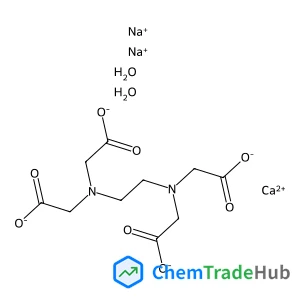
EthylenediaminetetraaceticacidcalciumDisodiumsalthydrate
CAS Number:
23411-34-9
Molecular Formula:
C10H16CaN2Na2O10
Anupam Ghorai, Jahangir Mondal, Rukmani Chandra, Goutam K. Patra
A novel, exceptionally simple and rapid method has been developed for visual detection of L-glutamic acid (Glu) in aqueous solution. The chemosensor employed is easy to prepare and use with an added advantage of cost effectiveness. It exhibits an excellent selectivity and sensitivity towards Glu over other amino acids by changes in both absorption intensity and colour intensity. The chemosensor provides a fast response time, with an LOD of about 7.96 × 10⁻⁷ M suggesting that the chemosensor may be useful as a valuable practical sensor for environmental analyses of glutamic acid.
Shintaro Fujii, Haruna Cho, Yoshifumi Hashikawa, Tomoaki Nishino, Yasujiro Murata, Manabu Kiguchi
DOI: 10.1039/C9CP02469G
Navdeep Goyal, R. K. Kotnala
DOI: 10.1039/C9CP02285F
DOI: 10.1039/C9CP02077B
Xia Wang, Grace Mercure Bakanina Kissanga, E. Li, Qiang Li, Jianzhuang Yao
DOI: 10.1039/C9CP02248A
Sheng-Jie Lu, Li-Shun Wu, Bao-Hua Yin, Feng Lin, Ming-Yong Chao
DOI: 10.1039/C9CP01752F
Yina Salamanca Blanco, Önder Topel, Éva G. Bajnóczi, Olle Björneholm, Ingmar Persson
DOI: 10.1039/C9CP02449B
Peter G. Weidler, Michalis Charilaou, Jörg F. Löffler, Andreas U. Gehring
DOI: 10.1039/C9CP01387C
Man Liu, Peter J. Chimtali, Xue-bin Huang, Ru-bo Zhang
DOI: 10.1039/C9CP00561G
Alexandra E. Raeber, David A. Mazziotti
DOI: 10.1039/C9CP01678C
Matti Javanainen, Hector Martinez-Seara
DOI: 10.1039/C9CP02022E
1H-Indazole-6-carbonitrile finds applications in pharmaceuticals, where it serve...
Waste containing Dioctyl (2E)-2-butenedioate (CAS: 2997-85-5) should be collecte...
Sodium [(1,2-benzoxazol-3-ylmethyl)sulfonyl]azanide is primarily used in pharmac...
Dimethyl 4-(4,4,5,5-tetramethyl-1,3,2-dioxaborolan-2-yl)-2,6-pyridinedicarboxyla...
Waste containing 2-Fluoro-6-hydrazinopyridine (CAS: 80714-39-2) should be manage...
6-Formyl-2-pyridinecarboxylic acid is an organic compound with the molecular for...
Research trends for this compound indicate a focus on its potential applications...
9H-Tribenzo[b,d,f]azepine is typically synthesized via a multi-step process invo...
1-Cyclopropyl-7-ethoxy-6-fluoro-8-methoxy-4-oxo-1,4-dihydro-3-quinolinecarboxyli...
Waste containing Methyl 3-oxo-1,2,3,4-tetrahydro-6-quinoxalinecarboxylate (CAS: ...

Analytical Methods welcomes early applications of new analytical and bioanalytical methods and technology demonstrating the potential for societal impact. We require that methods and technology reported in the journal are sufficiently innovative, robust, accurate, and compared to other available methods for the intended application. Developments with interdisciplinary approaches are particularly welcome. Systems should be proven with suitably complex and analytically challenging samples. We encourage developments within, but not limited to, the following technologies and applications: global health, point-of-care and molecular diagnostics biosensors and bioengineering drug development and pharmaceutical analysis applied microfluidics and nanotechnology omics studies, such as proteomics, metabolomics or glycomics environmental, agricultural and food science neuroscience biochemical and clinical analysis forensic analysis industrial process and method development
![(1S)-1,5-Anhydro-1-[3-(1-benzothiophen-2-ylmethyl)-4-fluorophenyl]-D-glucitol structure](https://static.chemtradehub.com/structs/761/761423-87-4-dbeb.webp "(1S)-1,5-Anhydro-1-[3-(1-benzothiophen-2-ylmethyl)-4-fluorophenyl]-D-glucitol structure")