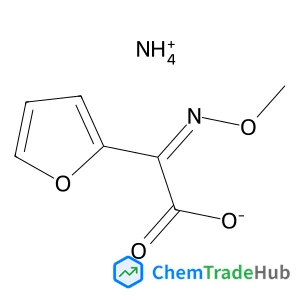
Ammonium (Z)-2-(furan-2-yl)-2-(methoxyimino)acetate
CAS Number:
97148-39-5
Molecular Formula:
C7H10N2O4
Xia Wang, Grace Mercure Bakanina Kissanga, E. Li, Qiang Li, Jianzhuang Yao
Dynamic protein S-palmitoylation catalyzed by S-acyltransferases is one of the fundamental post-translational modifications involved not only in a wide range of vital cellular processes but also in a series of human health and diseases-related issues (such as brain development and behavior, immune response regulation, tumor suppressor, and cancer). Interestingly, human S-acyltransferase has been recognized as a promising drug-target for cancer treatment. Despite the prominent importance, the fundamental catalytic mechanism of S-acyltransferases remains elusive. In this study, we performed extensive simulations and calculations to describe the fundamental catalytic mechanism of autoacylation catalyzed by human S-acyltransferase, revealing a single-step reaction pathway characterized by a loose transition state. The deacylation process with a tight transition state is avoided due to the substantially high free energy barrier. This specific catalytic mechanism is necessary to protect palmitoylated-enzymes from unwanted hydrolysis by water molecules since the accumulated negative charge of the tight transition state cannot be effectively stabilized by the weak hydrogen bond of the oxyanion hole. The activation free energy barrier of the autoacylation catalyzed by human S-acyltransferase was predicted to be 17.8 kcal mol−1, which is in good agreement with the experimentally derived activation free energy barrier (18.5 kcal mol−1) based on the conventional transition state theory, suggesting the validity of the computational results. The mechanistic insights (e.g., detailed catalytic mechanism and the nature of the transition state) are expected to do good not only to rational drug discovery (e.g., design of transition state analogues) toward cancer treatment and the design of engineered S-acyltransferases with desired acyl-CoA specificity but also to future studies on the catalytic mechanisms of other S-acyltransferases.
Guillaume Noirbent, Damien Brunel, Didier Gigmes, Pu Xiao, Frédéric Dumur
DOI: 10.1039/D0PY01197E
Charlène Boussiron, Mickaël Le Bechec, Julia Sabalot, Sylvie Lacombe, Maud Save
DOI: 10.1039/D0PY01128B
Jeroen H. Vrijsen
DOI: 10.1039/D0PY01071E
Andrey V. Shlyakhtin, Vladimir V. Bagrov, Pavel D. Komarov, Andrei V. Churakov
DOI: 10.1039/D0PY01297A
Enjie He, Kai Tu, Jiannan Cheng, Huanjun Lu, Lifen Zhang, Zhenping Cheng, Xiulin Zhu
DOI: 10.1039/D0PY01644F
Yuqing Qiao, Yusen Meng, Ming Yu, Bowu Zhang
DOI: 10.1039/D0PY01566K
Lourdes Mónica Bravo-Anaya, Julien Rosselgong, Ye Xiao, Amélie Vax, Emmanuel Ibarboure, Anna Ruban, Coralie Lebleu, Gilles Joucla, Bertrand Garbay, Elisabeth Garanger, Sébastien Lecommandoux
DOI: 10.1039/D0PY01293A
Sijia Huang, Xun Han, Christopher N. Bowman
DOI: 10.1039/D0PY01050B
Ralf Schweins, Hartmut Komber
DOI: 10.1039/D0PY01045F
1H-Indazole-6-carbonitrile finds applications in pharmaceuticals, where it serve...
Waste containing Dioctyl (2E)-2-butenedioate (CAS: 2997-85-5) should be collecte...
Sodium [(1,2-benzoxazol-3-ylmethyl)sulfonyl]azanide is primarily used in pharmac...
Dimethyl 4-(4,4,5,5-tetramethyl-1,3,2-dioxaborolan-2-yl)-2,6-pyridinedicarboxyla...
Waste containing 2-Fluoro-6-hydrazinopyridine (CAS: 80714-39-2) should be manage...
6-Formyl-2-pyridinecarboxylic acid is an organic compound with the molecular for...
Research trends for this compound indicate a focus on its potential applications...
9H-Tribenzo[b,d,f]azepine is typically synthesized via a multi-step process invo...
1-Cyclopropyl-7-ethoxy-6-fluoro-8-methoxy-4-oxo-1,4-dihydro-3-quinolinecarboxyli...
Waste containing Methyl 3-oxo-1,2,3,4-tetrahydro-6-quinoxalinecarboxylate (CAS: ...

Physical Chemistry Chemical Physics (PCCP) is an international journal co-owned by 19 physical chemistry and physics societies from around the world. This journal publishes original, cutting-edge research in physical chemistry, chemical physics and biophysical chemistry. To be suitable for publication in PCCP, articles must include significant innovation and/or insight into physical chemistry; this is the most important criterion that reviewers and Editors will judge against when evaluating submissions. The journal has a broad scope and welcomes contributions spanning experiment, theory, computation and data science. Topical coverage includes spectroscopy, dynamics, kinetics, statistical mechanics, thermodynamics, electrochemistry, catalysis, surface science, quantum mechanics, quantum computing and machine learning. Interdisciplinary research areas such as polymers and soft matter, materials, nanoscience, energy, surfaces/interfaces, and biophysical chemistry are welcomed if they demonstrate significant innovation and/or insight into physical chemistry. Joined experimental/theoretical studies are particularly appreciated when complementary and based on up-to-date approaches.