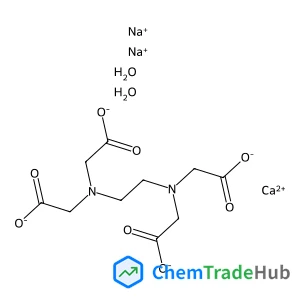
EthylenediaminetetraaceticacidcalciumDisodiumsalthydrate
CAS Number:
23411-34-9
Molecular Formula:
C10H16CaN2Na2O10
Sheng-Jie Lu, Li-Shun Wu, Bao-Hua Yin, Feng Lin, Ming-Yong Chao
The geometrical structures and electronic properties of anionic, neutral, and cationic B3Si11 clusters were investigated by performing ab initio calculations combined with size-selected anion photoelectron spectroscopy. The experimental photoelectron spectrum of the B3Si11− anion is reasonably reproduced by theoretical simulations of two competing isomers. The global minimum of the B3Si11− anion is formed by the fusion of a B3Si7 bicapped tetragonal antiprism to a B3Si4 pentagonal bipyramid by sharing a B3 triangle, while that of neutral B3Si11 has a B3-endohedral sandwich structure composed of a Si5 five-membered ring and a Si6 six-membered ring, and that of the B3Si11+ cation adopts a Si11 tricapped tetragonal antiprism with three face-capping B atoms. It is interesting that a Si5 five-membered ring and a Si6 six-membered ring are stabilized by three B atoms in B3Si11. The three B atoms tend to bond with each other to form a B3 triangle with stronger B–B bonds than B–Si bonds. Moreover, neutral B3Si11 exhibits σ + π double delocalized bonding patterns. Anionic, neutral, and cationic B3Si11 clusters have multiplicity of structural forms and their low-lying isomers show dynamical fluxionality. The bond lengths, bond orders, MO, constant electronic charge density surfaces, and PDOS analyses showed that the three B atoms in B3Si11 have strong bonding interactions.
Shan-Qing Peng, Butian Zhang, Wenhao Fan, Shuifeng Wang, Zhi-Hao Zhang, Yan Liu, Shi-Lu Chen, Mu-Hua Huang
DOI: 10.1039/D0PY00994F
Brian J. Ree, Yoshinobu Mato, Li Xiang, Jehan Kim, Takuya Isono, Toshifumi Satoh
DOI: 10.1039/D0PY01567A
Abhishek U. Shete, Bryan P. Sutherland
DOI: 10.1039/D0PY01310B
Subaru Konishi, Yu Kashiwagi, Go Watanabe, Takuya Katashima, Osamu Urakawa, Akira Harada
DOI: 10.1039/D0PY01347A
Kerem Kaya, Tapas Debsharma, Helmut Schlaad
DOI: 10.1039/D0PY01307B
Chao Liu, Hua-Long Zhang, Wen Xu, Cai-Yuan Pan, Chun-Yan Hong
DOI: 10.1039/D0PY01604G
Sihao Xu, Nathaniel Corrigan, Cyrille Boyer
DOI: 10.1039/D0PY00889C
1H-Indazole-6-carbonitrile finds applications in pharmaceuticals, where it serve...
Waste containing Dioctyl (2E)-2-butenedioate (CAS: 2997-85-5) should be collecte...
Sodium [(1,2-benzoxazol-3-ylmethyl)sulfonyl]azanide is primarily used in pharmac...
Dimethyl 4-(4,4,5,5-tetramethyl-1,3,2-dioxaborolan-2-yl)-2,6-pyridinedicarboxyla...
Waste containing 2-Fluoro-6-hydrazinopyridine (CAS: 80714-39-2) should be manage...
6-Formyl-2-pyridinecarboxylic acid is an organic compound with the molecular for...
Research trends for this compound indicate a focus on its potential applications...
9H-Tribenzo[b,d,f]azepine is typically synthesized via a multi-step process invo...
1-Cyclopropyl-7-ethoxy-6-fluoro-8-methoxy-4-oxo-1,4-dihydro-3-quinolinecarboxyli...
Waste containing Methyl 3-oxo-1,2,3,4-tetrahydro-6-quinoxalinecarboxylate (CAS: ...

Physical Chemistry Chemical Physics (PCCP) is an international journal co-owned by 19 physical chemistry and physics societies from around the world. This journal publishes original, cutting-edge research in physical chemistry, chemical physics and biophysical chemistry. To be suitable for publication in PCCP, articles must include significant innovation and/or insight into physical chemistry; this is the most important criterion that reviewers and Editors will judge against when evaluating submissions. The journal has a broad scope and welcomes contributions spanning experiment, theory, computation and data science. Topical coverage includes spectroscopy, dynamics, kinetics, statistical mechanics, thermodynamics, electrochemistry, catalysis, surface science, quantum mechanics, quantum computing and machine learning. Interdisciplinary research areas such as polymers and soft matter, materials, nanoscience, energy, surfaces/interfaces, and biophysical chemistry are welcomed if they demonstrate significant innovation and/or insight into physical chemistry. Joined experimental/theoretical studies are particularly appreciated when complementary and based on up-to-date approaches.