












Templated polymerizations on solid supports mediated by complementary nucleoside interactions
Literature Information
Publication Date
2015-01-12
DOI
10.1039/C4PY01783H
Impact Factor
5.582
Authors
Margarita Garcia, Kristian Kempe, David M. Haddleton, Afzal Khan, Andrew Marsh
View Original
Abstract
Template-directed radical polymerizations on solid supports are presented, which take advantage of complementary nucleoside interactions in non-polar solvents. The templates are prepared through copper-mediated living radical polymerization allowing control over the length and dispersity of the polymer bound to the support. We report a degree of control over subsequent polymerization of a complementary base pair monomer in the presence of the template not observed in its absence. Templates achieved from uridine, adenosine, cytidine and guanosine substituted methacrylate monomers were successfully prepared. Uridine derived templates were found to provide good fidelity of replication by incorporating mainly adenosine monomer in the final polymer, from a mixture of monomers. The latter was separated from its template and characterized demonstrating the preparation of polymers of approximately half of the template length. A model for the templating process is proposed.
Recommended Journals
Related Literature
Mesoscopic modeling of structural and thermodynamic properties of fluids confined by rough surfaces
Ketzasmin A. Terrón-Mejía, Roberto López-Rendón, Armando Gama Goicochea
2015-09-09
Paper
DOI: 10.1039/C5CP03823E
In situ Raman and surface-enhanced Raman spectroscopy on working electrodes: spectroelectrochemical characterization of water oxidation electrocatalysts
Xavier Sala
2015-02-09
Perspective
DOI: 10.1039/C4CP05053C
Low temperature pollutant trapping and dissociation over two-dimensional tin
Lauren Takahashi, Keisuke Takahashi
2015-07-21
Communication
DOI: 10.1039/C5CP03382A
Dynamic interface tension of a smectic liquid crystal in anionic surfactant solutions
Kirsten Harth, Larissa M. Shepherd, James Honaker, Ralf Stannarius
2015-09-09
Paper
DOI: 10.1039/C5CP04193G
Tip-enhanced Raman spectroscopy of graphene-like and graphitic platelets on ultraflat gold nanoplates
Farshid Pashaee, Faranak Sharifi, Giovanni Fanchini, François Lagugné-Labarthet
2015-02-10
Paper
DOI: 10.1039/C4CP05252H
Strength order and nature of the π-hole bond of cyanuric chloride and 1,3,5-triazine with halide
Hui Wang, Chen Li, Weizhou Wang, Wei Jun Jin
2015-07-07
Paper
DOI: 10.1039/C5CP03076E
An in situ high-temperature scanning electron microscopy study of acanthite–argentite phase transformation in nanocrystalline silver sulfide powder
S. I. Sadovnikov, A. I. Gusev
2015-07-24
Communication
DOI: 10.1039/C5CP02499D
Theoretical study on interactions of fluorinated organomercurials with arene and gold fragments
Sebastián Miranda-Rojas
2015-09-14
Paper
DOI: 10.1039/C5CP04503G
Trends in non-metal doping of the SrTiO3 surface: a hybrid density functional study
Yating Guo, Xiaowei Qiu, Hao Dong, Xin Zhou
2015-07-09
Paper
DOI: 10.1039/C5CP03005F
Ab initio GGA+U study of oxygen evolution and oxygen reduction electrocatalysis on the (001) surfaces of lanthanum transition metal perovskites LaBO3 (B = Cr, Mn, Fe, Co and Ni)
Yueh-Lin Lee, Milind J. Gadre, Dane Morgan
2015-07-15
Paper
DOI: 10.1039/C5CP02834E
You might also like
Compound Q&A
Is 2-(2-chloroacetamido)-3-phenylpropanoic acid (CAS: 7765-11-9) safe?
2-(2-Chloroacetamido)-3-phenylpropanoic acid (CAS: 7765-11-9) is generally consi...
7765-11-92-(2-chloroacetamido...
Compound Q&A
Is 2-(Benzyloxy)-5-bromobenzoic acid (CAS: 62176-31-2) safe?
2-(Benzyloxy)-5-bromobenzoic acid can be handled safely if appropriate precautio...
62176-31-22-(Benzyloxy)-5-brom...
Compound Q&A
What is (4-Methyl-1,2,5-oxadiazol-3-yl)methanamine hydrochloride (CAS: 1159825-48-5)?
(4-Methyl-1,2,5-oxadiazol-3-yl)methanamine hydrochloride is a chemical compound ...
1159825-48-5(4-Methyl-1,2,5-oxad...
Compound Q&A
What is 2-(5-Hexylthiophen-2-yl)-4,4,5,5-tetramethyl-1,3,2-dioxaborolane (CAS: 917985-54-7)?
2-(5-Hexylthiophen-2-yl)-4,4,5,5-tetramethyl-1,3,2-dioxaborolane (CAS: 917985-54...
917985-54-72-(5-Hexylthiophen-2...
Compound Q&A
Are there alternatives to 4-(8-Methyl-9H-1,3-dioxolo[4,5-h][2,3]benzodiazepin-5-yl)benzenamine (CAS: 102771-26-6) in synthesis?
While 4-(8-Methyl-9H-1,3-dioxolo[4,5-h][2,3]benzodiazepin-5-yl)benzenamine (CAS:...
102771-26-64-(8-Methyl-9H-1,3-d...
Compound Q&A
What is the market or research trend for tert-butyl 3-hydroxy-4,5,7,8-tetrahydro-2H-pyrazolo[3,4-d]azepine-6-carboxylate (CAS: 851376-80-2)?
The market for tert-butyl 3-hydroxy-4,5,7,8-tetrahydro-2H-pyrazolo[3,4-d]azepine...
851376-80-2tert-butyl 3-hydroxy...
Compound Q&A
How should waste containing 3,5-Diamino-1H-pyrazole-4-carbonitrile (CAS: 6844-58-2) be handled?
Waste containing 3,5-Diamino-1H-pyrazole-4-carbonitrile (CAS: 6844-58-2) should ...
6844-58-23,5-Diamino-1H-pyraz...
Compound Q&A
How is (6-Fluoro-3-pyridinyl)boronic acid (CAS: 351019-18-6) typically synthesized?
(6-Fluoro-3-pyridinyl)boronic acid can be synthesized through the reaction of 6-...
351019-18-6(6-Fluoro-3-pyridiny...
Compound Q&A
What industries use Dibenzyl carbonimidoylbiscarbamate (CAS: 10065-79-9)?
Dibenzyl carbonimidoylbiscarbamate (CAS: 10065-79-9) finds applications in vario...
10065-79-9Dibenzyl carbonimido...
Compound Q&A
What is the market or research trend for (beta,beta,2,3,4,5,6-~2~H_7_)Phenylalanine (CAS: 74228-83-4)?
The market for (beta,beta,2,3,4,5,6-~2~H_7_)Phenylalanine (CAS: 74228-83-4) is g...
74228-83-4(beta,beta,2,3,4,5,6...
Source Journal
Polymer Chemistry

CiteScore:
8.6
Self-citation Rate:
7.3%
Articles per Year:
457
Polymer Chemistry welcomes submissions in all areas of polymer science that have a strong focus on macromolecular chemistry. Manuscripts may cover a broad range of fields, yet no direct application focus is required.
Recommended Compounds
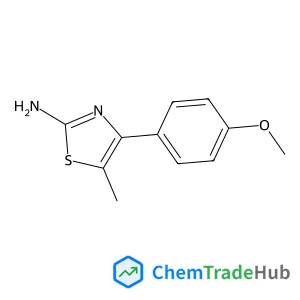
4-(4-Methoxyphenyl)-5-methyl-1,3-thiazol-2-amine
CAS Number:
105512-88-7
Molecular Formula:
C11H12N2OS

Recommended Suppliers







Disclaimer
This page provides academic journal information for reference and research purposes only. We are not affiliated with any journal publishers and do not handle publication submissions. For publication-related inquiries, please contact the respective journal publishers directly.
If you notice any inaccuracies in the information displayed, please contact us at support@chemtradehub.com. We will promptly review and address your concerns.