


Intracellular redox potential-responsive micelles based on polyethylenimine-cystamine-poly(ε-caprolactone) block copolymer for enhanced miR-34a delivery
Literature Information
Publication Date
2014-12-23
DOI
10.1039/C4PY01623H
Impact Factor
5.582
Authors
Hanmei Li, Hao Jiang, Mengnan Zhao, Yao Fu, Xun Sun
View Original
Abstract
An amphiphilic cationic graft polymer polyethylenimine-cystamine-poly(ε-caprolactone) (PSSP) with intracellular redox potential-responsive cleavable ability was synthesized for the first time by coupling poly(ε-caprolactone) (PCL) to polyethylenimine (PEI) via a bio-cleavable disulfide linkage. PSSP based micelles, which can degrade in the intracellular reducing environment, were developed as smart non-viral gene vectors for enhanced miR-34a delivery. The PSSP/miR-34a complexes showed effective and stable miRNA condensation with a narrow particle size of around 120 nm. The gel retardation assay showed that PSSP micelles could protect miRNA from RNase and achieve intracellular release of miRNA in the reducing environment. Compared with PEI-25k, PSSP revealed comparable transfection efficiencies in the B16F10 cell with less cytotoxicity. The B16F10 cell treated with PSSP/miR-34a complexes showed a significantly higher cell apoptosis than the PEI-25k/miR-34a complexes. These encouraging results indicated that PSSP may possess promising potential as a smart non-viral gene vector with low cytotoxicity, intracellular redox potential to trigger miRNA release and high transfection efficiency.
Recommended Journals

Current Opinion in Colloid & Interface Science

Journal of Peptide Science

Journal of Saudi Chemical Society

Russian Journal of Organic Chemistry

Saudi Pharmaceutical Journal

Journal of Natural Medicines

Russian Journal of General Chemistry

Crystallography Reports

Drug Discovery Today

New Journal of Chemistry
Related Literature
An in situ high-temperature scanning electron microscopy study of acanthite–argentite phase transformation in nanocrystalline silver sulfide powder
S. I. Sadovnikov, A. I. Gusev
2015-07-24
Communication
DOI: 10.1039/C5CP02499D
Surface force at the nano-scale: observation of non-monotonic surface tension and disjoining pressure
Mahshid Firouzi, Qibin Li, Kang Peng
2015-07-14
Paper
DOI: 10.1039/C5CP03050A
Mechanistic insights into perovskite photoluminescence enhancement: light curing with oxygen can boost yield thousandfold
Yuxi Tian, Maximilian Peter, Eva Unger, Mohamed Abdellah, Kaibo Zheng, Tõnu Pullerits, Arkady Yartsev, Villy Sundström, Ivan G. Scheblykin
2015-08-27
Paper
DOI: 10.1039/C5CP04410C
Diastereo-specific conformational properties of neutral, protonated and radical cation forms of (1R,2S)-cis- and (1R,2R)-trans-amino-indanol by gas phase spectroscopy
Aude Bouchet, Johanna Klyne, Otto Dopfer
2015-04-09
Paper
DOI: 10.1039/C5CP00576K
A means to an interface: investigating monoethanolamine behavior at an aqueous surface
Laura E. McWilliams, Nicholas A. Valley, Sumi N. Wren, Geraldine L. Richmond
2015-07-22
Paper
DOI: 10.1039/C5CP02931G
A facile one-pot synthesis of blue and red luminescent thiol stabilized gold nanoclusters: a thorough optical and microscopy study
Nabin Kumar Pal, Carola Kryschi
2015-07-08
Paper
DOI: 10.1039/C5CP01773D
SERS activity of Ag decorated nanodiamond and nano-β-SiC, diamond-like-carbon and thermally annealed diamond thin film surfaces
Mohan Kumar Kuntumalla, Vadali Venkata Satya Siva Srikanth, Satyavathi Ravulapalli, Upender Gangadharini, Harish Ojha, Narayana Rao Desai, Chandrahas Bansal
2015-02-05
Paper
DOI: 10.1039/C4CP05236F
The charge/discharge mechanism and electrochemical performance of CuV2O6 as a new anode material for Li-ion batteries
Jianjun Ma, Jicheng Zhang
2015-07-29
Paper
DOI: 10.1039/C5CP03435C
Ab initio GGA+U study of oxygen evolution and oxygen reduction electrocatalysis on the (001) surfaces of lanthanum transition metal perovskites LaBO3 (B = Cr, Mn, Fe, Co and Ni)
Yueh-Lin Lee, Milind J. Gadre, Dane Morgan
2015-07-15
Paper
DOI: 10.1039/C5CP02834E
You might also like
Compound Q&A
Is 2-(2-chloroacetamido)-3-phenylpropanoic acid (CAS: 7765-11-9) safe?
2-(2-Chloroacetamido)-3-phenylpropanoic acid (CAS: 7765-11-9) is generally consi...
7765-11-92-(2-chloroacetamido...
Compound Q&A
Is 2-(Benzyloxy)-5-bromobenzoic acid (CAS: 62176-31-2) safe?
2-(Benzyloxy)-5-bromobenzoic acid can be handled safely if appropriate precautio...
62176-31-22-(Benzyloxy)-5-brom...
Compound Q&A
What is (4-Methyl-1,2,5-oxadiazol-3-yl)methanamine hydrochloride (CAS: 1159825-48-5)?
(4-Methyl-1,2,5-oxadiazol-3-yl)methanamine hydrochloride is a chemical compound ...
1159825-48-5(4-Methyl-1,2,5-oxad...
Compound Q&A
What is 2-(5-Hexylthiophen-2-yl)-4,4,5,5-tetramethyl-1,3,2-dioxaborolane (CAS: 917985-54-7)?
2-(5-Hexylthiophen-2-yl)-4,4,5,5-tetramethyl-1,3,2-dioxaborolane (CAS: 917985-54...
917985-54-72-(5-Hexylthiophen-2...
Compound Q&A
Are there alternatives to 4-(8-Methyl-9H-1,3-dioxolo[4,5-h][2,3]benzodiazepin-5-yl)benzenamine (CAS: 102771-26-6) in synthesis?
While 4-(8-Methyl-9H-1,3-dioxolo[4,5-h][2,3]benzodiazepin-5-yl)benzenamine (CAS:...
102771-26-64-(8-Methyl-9H-1,3-d...
Compound Q&A
What is the market or research trend for tert-butyl 3-hydroxy-4,5,7,8-tetrahydro-2H-pyrazolo[3,4-d]azepine-6-carboxylate (CAS: 851376-80-2)?
The market for tert-butyl 3-hydroxy-4,5,7,8-tetrahydro-2H-pyrazolo[3,4-d]azepine...
851376-80-2tert-butyl 3-hydroxy...
Compound Q&A
How should waste containing 3,5-Diamino-1H-pyrazole-4-carbonitrile (CAS: 6844-58-2) be handled?
Waste containing 3,5-Diamino-1H-pyrazole-4-carbonitrile (CAS: 6844-58-2) should ...
6844-58-23,5-Diamino-1H-pyraz...
Compound Q&A
How is (6-Fluoro-3-pyridinyl)boronic acid (CAS: 351019-18-6) typically synthesized?
(6-Fluoro-3-pyridinyl)boronic acid can be synthesized through the reaction of 6-...
351019-18-6(6-Fluoro-3-pyridiny...
Compound Q&A
What industries use Dibenzyl carbonimidoylbiscarbamate (CAS: 10065-79-9)?
Dibenzyl carbonimidoylbiscarbamate (CAS: 10065-79-9) finds applications in vario...
10065-79-9Dibenzyl carbonimido...
Compound Q&A
What is the market or research trend for (beta,beta,2,3,4,5,6-~2~H_7_)Phenylalanine (CAS: 74228-83-4)?
The market for (beta,beta,2,3,4,5,6-~2~H_7_)Phenylalanine (CAS: 74228-83-4) is g...
74228-83-4(beta,beta,2,3,4,5,6...
Source Journal
Polymer Chemistry

CiteScore:
8.6
Self-citation Rate:
7.3%
Articles per Year:
457
Polymer Chemistry welcomes submissions in all areas of polymer science that have a strong focus on macromolecular chemistry. Manuscripts may cover a broad range of fields, yet no direct application focus is required.
Recommended Compounds
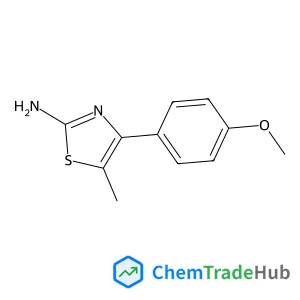
4-(4-Methoxyphenyl)-5-methyl-1,3-thiazol-2-amine
CAS Number:
105512-88-7
Molecular Formula:
C11H12N2OS
Recommended Suppliers





Disclaimer
This page provides academic journal information for reference and research purposes only. We are not affiliated with any journal publishers and do not handle publication submissions. For publication-related inquiries, please contact the respective journal publishers directly.
If you notice any inaccuracies in the information displayed, please contact us at support@chemtradehub.com. We will promptly review and address your concerns.