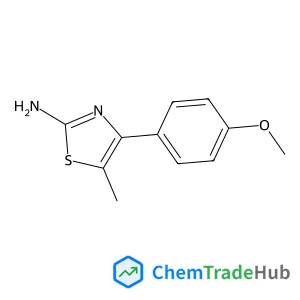
4-(4-Methoxyphenyl)-5-methyl-1,3-thiazol-2-amine
CAS Number:
105512-88-7
Molecular Formula:
C11H12N2OS
Janusz M. Gebicki
Several recent studies have shown that the rates of formation of adduct radicals between carbon-centred radicals and aromatic molecules are virtually diffusion-controlled and reversible. This contrasts with “radical addition”, the well-known multistep reaction in preparative organic chemistry where the rate-determining initial formation of radical adducts is perceived to be several orders of magnitude slower and virtually irreversible. Using pulse radiolysis and spectroscopic analysis, we have now re-examined parts of this complex mechanism. The results have significant implications for biological systems: electron-rich, aromatic structures may act like buffers for radicals, moderating their reactivity resulting in a much slower reaction determining the overall rate of oxidation. In vivo, an organism would gain time for an appropriate antioxidant reaction.

Bioorganic & Medicinal Chemistry Letters

Chinese Journal of Chemistry

Heteroatom Chemistry

Medicinal Chemistry Research

Bioorganic & Medicinal Chemistry

Journal of the Indian Institute of Science

Herald of the Russian Academy of Sciences

Polycyclic Aromatic Compounds

Journal of Asian Natural Products Research

Atomization and Sprays
Mamoru Fujitsuka, Sachiko Tojo, Teruo Shinmyozu, Tetsuro Majima
DOI: 10.1039/B810122A
Na Tian, Zhi-You Zhou, Shi-Gang Sun
DOI: 10.1039/B819751B
Daeseob Shim, Seung-Ho Jung, Eun-Ha Kim, Dong-Myung Yoon, Kun-Hong Lee, Soo-Hwan Jeong
DOI: 10.1039/B816534C
Daniela Pucci, Iolinda Aiello, Alessia Aprea, Anna Bellusci, Alessandra Crispini, Mauro Ghedini
DOI: 10.1039/B818603K
Sumito Tokuji, Yuji Takahashi, Hideyuki Shinmori, Hiroshi Shinokubo, Atsuhiro Osuka
DOI: 10.1039/B819284G
Dae-Wi Yoon, Dustin E. Gross, Vincent M. Lynch, Chang-Hee Lee, Philip C. Bennett, Jonathan L. Sessler
DOI: 10.1039/B818077F
Huan Pang, Feng Gao, Qingyi Lu
DOI: 10.1039/B816670F
Zuofeng Chen, Keith Man-Chung Wong, Vonika Ka-Man Au, Yanbing Zu, Vivian Wing-Wah Yam
DOI: 10.1039/B820400D
Feng Wang, Wataru Ueda
DOI: 10.1039/B817118A
(5-Sulfamoyl-3-pyridinyl)boronic acid is primarily used in chemical synthesis, p...
Benzyl 2-methyl-2-(methylsulfonyl)-4-pentenoate is typically synthesized via est...
When handling 8-Fluoroquinolin-6-ol (CAS: 209353-22-0), it is important to use p...
1,3-Dibromo-5-(2-methyl-2-propanyl)benzene (CAS: 129316-09-2) is a crystalline c...
Ethyl 7-chloro-4-oxo-1-(1,3-thiazol-2-yl)-1,4-dihydro-1,8-naphthyridine-3-carbox...
When handling Delta-7-Avenasterol (CAS: 23290-26-8), it is important to wear app...
Proper handling involves the use of personal protective equipment such as gloves...
When handling 2-Methyl-2-proanyl 4-[(2-aminophenyl)amino]-1-piperidinecarboxylat...
N-Methyl-4-chlorobenzylamine hydrochloride (CAS: 65542-24-7) is a organic compou...
[2-(Dodecyloxy)ethoxy]acetic acid (CAS: 27306-90-7) is generally considered safe...

Physical Chemistry Chemical Physics (PCCP) is an international journal co-owned by 19 physical chemistry and physics societies from around the world. This journal publishes original, cutting-edge research in physical chemistry, chemical physics and biophysical chemistry. To be suitable for publication in PCCP, articles must include significant innovation and/or insight into physical chemistry; this is the most important criterion that reviewers and Editors will judge against when evaluating submissions. The journal has a broad scope and welcomes contributions spanning experiment, theory, computation and data science. Topical coverage includes spectroscopy, dynamics, kinetics, statistical mechanics, thermodynamics, electrochemistry, catalysis, surface science, quantum mechanics, quantum computing and machine learning. Interdisciplinary research areas such as polymers and soft matter, materials, nanoscience, energy, surfaces/interfaces, and biophysical chemistry are welcomed if they demonstrate significant innovation and/or insight into physical chemistry. Joined experimental/theoretical studies are particularly appreciated when complementary and based on up-to-date approaches.
![2-(5-Bromo-1H-pyrrolo[2,3-B]pyridin-3-YL)acetic acid structure](https://static.chemtradehub.com/structs/106/1060795-03-0-0589.webp "2-(5-Bromo-1H-pyrrolo[2,3-B]pyridin-3-YL)acetic acid structure")
![4,10-Dihydroxy-3H-pyrano[3,4,5-kl]xanthen-3-one structure](https://static.chemtradehub.com/structs/125/1259330-61-4-de48.webp "4,10-Dihydroxy-3H-pyrano[3,4,5-kl]xanthen-3-one structure")