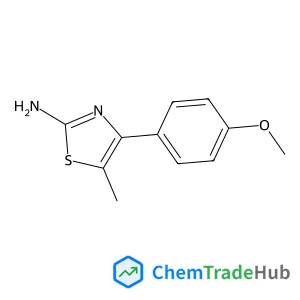
4-(4-Methoxyphenyl)-5-methyl-1,3-thiazol-2-amine
CAS Number:
105512-88-7
Molecular Formula:
C11H12N2OS
Yi Mu, Cai Cheng, Cui-E Hu, Xiao-Lin Zhou
Silicon carbide (SiC) chains and silicon carbide nanotubes (SiCNTs), as promising one-dimensional nanostructures, have potential applications in more controllable nanoelectronic devices. In this paper, we design a completely new hybrid structure with encapsulation of a linear SiC chain inside a SiCNT, using first-principles calculation and the non-equilibrium Green's function formalism to systematically investigate the structural stability and electronic properties, particularly the quantum transport properties. It is found that, due to the nanotube–chain interaction, the stability of this structure is mainly provided by the charge transfer from the hosting tube to the guest chain. Furthermore, the transport properties of the hybrid structure confirm that encapsulation of a SiC chain within a SiCNT can significantly enhance the electronic transport of the component system in a wide range of high voltage. The distance and the unique coupling configuration between the encapsulated system and the electrodes are demonstrated to be other important factors that affect the transport behaviours. We hope that our study of encapsulation may offer a significant starting point for the design of new materials related to low-dimensional SiC nanostructures and possibly open a novel path towards stability and conductivity enhancement.

Main Group Chemistry

Chinese Journal of Chemistry

Electroanalysis

Bioorganic & Medicinal Chemistry Letters

Journal of Asian Natural Products Research

Medicinal Chemistry Research

Critical Reviews in Solid State and Materials Sciences

Bioorganic & Medicinal Chemistry

Atomization and Sprays

Topics in Catalysis
Nolene Byrne, C. Austen Angell
DOI: 10.1039/B817590J
Tai-Shan Hu
DOI: 10.1039/B900342H
Winson M. J. Ma, Marta P. Pereira Morais, François D’Hooge, Jean M. H. van den Elsen, Jonathan P. L. Cox, Tony D. James, John S. Fossey
DOI: 10.1039/B814379J
KaKing Yan, Andrew V. Pawlikowski, Chris Ebert, Aaron D. Sadow
DOI: 10.1039/B818630H
Simona Chessa, Nigel J. Clayden, Manfred Bochmann, Joseph A. Wright
DOI: 10.1039/B821301A
José Luis García Ruano, Alejandro Parra, José Alemán, Francisco Yuste, Virginia M. Mastranzo
DOI: 10.1039/B816846F
Jian-Yong Liu, Eugeny A. Ermilov, Beate Röder, Dennis K. P. Ng
DOI: 10.1039/B821630D
Ritu Kataky, Paula Lopes
DOI: 10.1039/B822685G
Zuofeng Chen, Keith Man-Chung Wong, Vonika Ka-Man Au, Yanbing Zu, Vivian Wing-Wah Yam
DOI: 10.1039/B820400D
Marco Bella, Daniele M. Scarpino Schietroma, Pier Paolo Cusella, Tecla Gasperi, Valerio Visca
DOI: 10.1039/B816550E
(5-Sulfamoyl-3-pyridinyl)boronic acid is primarily used in chemical synthesis, p...
Benzyl 2-methyl-2-(methylsulfonyl)-4-pentenoate is typically synthesized via est...
When handling 8-Fluoroquinolin-6-ol (CAS: 209353-22-0), it is important to use p...
1,3-Dibromo-5-(2-methyl-2-propanyl)benzene (CAS: 129316-09-2) is a crystalline c...
Ethyl 7-chloro-4-oxo-1-(1,3-thiazol-2-yl)-1,4-dihydro-1,8-naphthyridine-3-carbox...
When handling Delta-7-Avenasterol (CAS: 23290-26-8), it is important to wear app...
Proper handling involves the use of personal protective equipment such as gloves...
When handling 2-Methyl-2-proanyl 4-[(2-aminophenyl)amino]-1-piperidinecarboxylat...
N-Methyl-4-chlorobenzylamine hydrochloride (CAS: 65542-24-7) is a organic compou...
[2-(Dodecyloxy)ethoxy]acetic acid (CAS: 27306-90-7) is generally considered safe...

Physical Chemistry Chemical Physics (PCCP) is an international journal co-owned by 19 physical chemistry and physics societies from around the world. This journal publishes original, cutting-edge research in physical chemistry, chemical physics and biophysical chemistry. To be suitable for publication in PCCP, articles must include significant innovation and/or insight into physical chemistry; this is the most important criterion that reviewers and Editors will judge against when evaluating submissions. The journal has a broad scope and welcomes contributions spanning experiment, theory, computation and data science. Topical coverage includes spectroscopy, dynamics, kinetics, statistical mechanics, thermodynamics, electrochemistry, catalysis, surface science, quantum mechanics, quantum computing and machine learning. Interdisciplinary research areas such as polymers and soft matter, materials, nanoscience, energy, surfaces/interfaces, and biophysical chemistry are welcomed if they demonstrate significant innovation and/or insight into physical chemistry. Joined experimental/theoretical studies are particularly appreciated when complementary and based on up-to-date approaches.
![2-(5-Bromo-1H-pyrrolo[2,3-B]pyridin-3-YL)acetic acid structure](https://static.chemtradehub.com/structs/106/1060795-03-0-0589.webp "2-(5-Bromo-1H-pyrrolo[2,3-B]pyridin-3-YL)acetic acid structure")