












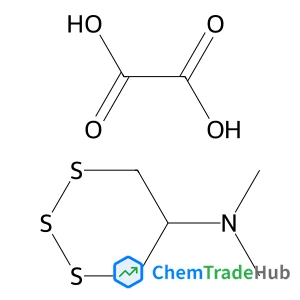
Oxalic acid compound with cyclohexylsulfamothioic O-acid (11)
CAS Number:
31895-22-4
Molecular Formula:
C7H13NO4S3
Sonja Schmidt, Miriam Koldevitz, Janina-Miriam Noy, Peter J. Roth
The multicomponent Passerini reaction of aldehydes, carboxylic acids, and isocyanides is used to produce a series of novel reactive (meth)acrylic and styrenic monomers carrying pendant double bond, (trimethylsilyl protected) triple bond, diene, acetate, or pentafluorophenyl functionality. Dichloromethane and water were compared as solvents in the synthesis of 15 different monomers, with water resulting in significantly higher, up to quantitative, isolated yields with minimal purification. Characterization by 1H, 13C, and 19F NMR spectroscopy, FT-IR spectroscopy and mass spectrometry confirmed the synthesis and high purity of the functional α-acyloxycarboxamide products. The monomers are shown to be well suited for the RAFT-synthesis of well-defined homopolymers, statistical copolymers with methyl methacrylate, poly(ethylene glycol) methyl ether methacrylate, and styrene, statistical copolymers produced from two different Passerini-derived monomers, and AB diblock copolymers. SEC-measured polydispersities were generally low, ĐM ≤ 1.29, and 1H NMR spectroscopy confirmed copolymer molar compositions in good agreement with comonomer feed ratios. We expect this synthetic strategy to provide access to a wide range of novel multifunctional materials and demonstrate preliminary postpolymerization modification of a polystyrene derivative by cleavage of its pendent acetate groups and coupling of the dye Methyl Red to the resulting alcohol groups.
A. Cricenti, R. M. Montereali, E. Nichelatti, S. Scaglione, F. Somma
DOI: 10.1039/B110269A
I. Melián-Cabrera, M. López Granados, J. L. G. Fierro
DOI: 10.1039/B201996E
Nicole Borho, Martin A. Suhm
DOI: 10.1039/B111123J
R. K. Thomas
DOI: 10.1039/B108698G
Robert S. Tranter, Raghu Sivaramakrishnan, Kenneth Brezinsky, Mark D. Allendorf
DOI: 10.1039/B110702J
Geoffrey S. Tyndall, John J. Orlando, Timothy J. Wallington, Michael D. Hurley, Masashi Goto, Masahiro Kawasaki
DOI: 10.1039/B111195G
A. Morresi, M. Ombelli, P. Sassi
DOI: 10.1039/B110225G
Ioan Balint, Zhixiong You, Ken-ichi Aika
DOI: 10.1039/B202056D
C. Morterra, G. Cerrato, S. Ardizzone, C. L. Bianchi, M. Signoretto, F. Pinna
DOI: 10.1039/B110444F
Vesna Najdanovic-Visak, José M. S. S. Esperança, Luís P. N. Rebelo, Manuel Nunes da Ponte, Henrique J. R. Guedes, Kenneth R. Seddon, Jerzy Szydlowski
DOI: 10.1039/B201723G
Waste containing (6-Bromo-2-naphthyl)oxy](dimethyl)(2-methyl-2-propanyl)silane (...
7-Fluoro-4-isoquinolinecarboxylic acid can be synthesized via a multi-step proce...
2,3,5,6-Tetrabromothieno[3,2-b]thiophene is a crystalline compound with a high m...
1-[4-(Benzylamino)-7,8-dihydro-5H-pyrano[4,3-d]pyrimidin-2-yl]-2-methyl-1H-indol...
The market for imidazo[5,1-d]-1,2,3,5-tetrazine-8-carboxylic acid, 3,4-dihydro-3...
3-(Triisopropylsilyl)propiolaldehyde is a synthetic organic compound with the CA...
6-Nitro-2H-1,4-benzoxazin-3(4H)-one (CAS: 81721-87-1) is subject to various regu...
Waste containing (3-Fluorophenyl)(4-{[(2-methyl-2-propanyl)oxy]carbonyl}-1-piper...
N,N'-4,4'-Biphenyldiyldiisonicotinamide is a white crystalline solid with a mole...
6-Bromo-8-fluoro-2-quinazolinol is primarily used in the pharmaceutical industry...

Polymer Chemistry welcomes submissions in all areas of polymer science that have a strong focus on macromolecular chemistry. Manuscripts may cover a broad range of fields, yet no direct application focus is required.
![2,2'-{2,2-Propanediylbis[(2,6-dibromo-4,1-phenylene)oxy]}diethanol structure](https://static.chemtradehub.com/structs/416/4162-45-2-b3d6.webp "2,2'-{2,2-Propanediylbis[(2,6-dibromo-4,1-phenylene)oxy]}diethanol structure")
![2,9-Dichloro-5,12-dihydroquinolino[2,3-b]acridine-7,14-dione structure](https://static.chemtradehub.com/structs/308/3089-17-6-750b.webp "2,9-Dichloro-5,12-dihydroquinolino[2,3-b]acridine-7,14-dione structure")



