












Dual hydrophilic and salt responsive schizophrenic block copolymers – synthesis and study of self-assembly behavior
Literature Information
Publication Date
2014-09-25
DOI
10.1039/C4PY01113A
Impact Factor
5.582
Authors
Vivek Arjunan Vasantha, Satyasankar Jana, Serina Siew-Chen Lee, Chin-Sing Lim, Serena Lay-Ming Teo, Anbanandam Parthiban
View Original
Abstract
A new class of dual hydrophilic diblock copolymers (BCPs) possessing poly(ethylene glycol) (PEG) and zwitterionic polysulfabetaine (PSB) was synthesized by reversible addition–fragmentation chain transfer (RAFT) polymerization. These BCPs formed schizophrenic micelles undergoing core–shell transitions upon changing the medium from deionized water to an electrolyte solution. “Conventional” micelles, i.e. PSB at the core and PEG at the periphery, were formed in deionized water. The micelles “inverted” to form PSB at the shell and PEG at the core in electrolyte solutions. The reversal of core–shell structures was thoroughly studied by 1H-NMR spectroscopic analysis, dynamic light scattering (DLS) and transmission electron microscopic (TEM) techniques. Antifouling evaluation in the sea indicated that BCPs displayed antifouling behaviour to some extent. The dual hydrophilic BCPs reported here are potentially useful as stimuli responsive materials.
Related Literature
Unsaturated binuclear homoleptic nickel carbonyl anions Ni2(CO)n− (n = 4–6) featuring double three-center two-electron Ni–C–Ni bonds
Zhiling Liu, Yan Bai, Ya Li, Jing He, Qingyang Lin, Hua Xie, Zichao Tang
2020-09-29
Paper
DOI: 10.1039/D0CP03883K
On the transition from partial wetting to complete wetting of methanol on graphite
Luisa Prasetyo, Toshihide Horikawa, Naoki Takashima, D. D. Do, D. Nicholson
2019-11-18
Paper
DOI: 10.1039/C9CP05118J
An effective partial charge model for bulk and surface properties of cubic ZrO2, Y2O3 and yttrium-stabilised zirconia
Thomas S. Hofer, Franziska M. Kilchert, Bagas A. Tanjung
2019-11-06
Paper
DOI: 10.1039/C9CP04307A
Can modified DNA base pairs with chalcogen bonding expand the genetic alphabet? A combined quantum chemical and molecular dynamics simulation study
Preetleen Kathuria, Stacey D. Wetmore, Purshotam Sharma
2020-10-05
Paper
DOI: 10.1039/D0CP04921B
A data-driven approach to determine dipole moments of diatomic molecules
Xiangyue Liu, Gerard Meijer, Jesús Pérez-Ríos
2020-08-24
Paper
DOI: 10.1039/D0CP03810E
Computational analysis of the far infrared spectral region of various deuterated varieties of ethylene glycol
Rahma Boussessi, María Luisa Senent
2020-09-28
Paper
DOI: 10.1039/D0CP03315D
Single-molecule kinetic studies of DNA hybridization under extreme pressures
2020-10-05
Paper
DOI: 10.1039/D0CP04035E
In situ anion-doped epitaxial strontium titanate films
O. Pacherova, N. Nepomniashchaia, V. Vetokhina, S. Cichon, T. Kocourek, A. Dejneka
2020-10-08
Paper
DOI: 10.1039/D0CP03644G
Tuning the structure, thermal stability and rheological properties of liquid crystal phases via the addition of silica nanoparticles
Joshua B. Marlow, Thomas M. McCoy, Cat Q. Ho, Liliana de Campo, Robert Knott, Toby D. M. Bell, Rico F. Tabor
2019-11-05
Paper
DOI: 10.1039/C9CP04908H
You might also like
Compound Q&A
What are the main uses of (5-Sulfamoyl-3-pyridinyl)boronic acid (CAS: 951233-61-7)?
(5-Sulfamoyl-3-pyridinyl)boronic acid is primarily used in chemical synthesis, p...
951233-61-7(5-Sulfamoyl-3-pyrid...
Compound Q&A
How is Benzyl 2-methyl-2-(methylsulfonyl)-4-pentenoate (CAS: 1942858-50-5) typically synthesized?
Benzyl 2-methyl-2-(methylsulfonyl)-4-pentenoate is typically synthesized via est...
1942858-50-5Benzyl 2-methyl-2-(m...
Compound Q&A
What precautions should be taken when handling 8-Fluoroquinolin-6-ol (CAS: 209353-22-0)?
When handling 8-Fluoroquinolin-6-ol (CAS: 209353-22-0), it is important to use p...
209353-22-08-Fluoroquinolin-6-o...
Compound Q&A
What are the physical and chemical properties of 1,3-Dibromo-5-(2-methyl-2-propanyl)benzene (CAS: 129316-09-2)?
1,3-Dibromo-5-(2-methyl-2-propanyl)benzene (CAS: 129316-09-2) is a crystalline c...
129316-09-21,3-Dibromo-5-(2-met...
Compound Q&A
What industries use Ethyl 7-chloro-4-oxo-1-(1,3-thiazol-2-yl)-1,4-dihydro-1,8-naphthyridine-3-carboxylate (CAS: 174726-87-5)?
Ethyl 7-chloro-4-oxo-1-(1,3-thiazol-2-yl)-1,4-dihydro-1,8-naphthyridine-3-carbox...
174726-87-5Ethyl 7-chloro-4-oxo...
Compound Q&A
What precautions should be taken when handling Delta-7-Avenasterol (CAS: 23290-26-8)?
When handling Delta-7-Avenasterol (CAS: 23290-26-8), it is important to wear app...
23290-26-8Delta-7-Avenasterol
Compound Q&A
What precautions should be taken when handling N-({(5R)-3-[3-Fluoro-4-(4-morpholinyl)phenyl]-2-oxo-1,3-oxazolidin-5-yl}methyl)acetamide (CAS: 872992-20-6)?
Proper handling involves the use of personal protective equipment such as gloves...
872992-20-6N-({(5R)-3-[3-Fluoro...
Compound Q&A
What precautions should be taken when handling 2-Methyl-2-proanyl 4-[(2-aminophenyl)amino]-1-piperidinecarboxylate (CAS: 79099-00-6)?
When handling 2-Methyl-2-proanyl 4-[(2-aminophenyl)amino]-1-piperidinecarboxylat...
79099-00-62-Methyl-2-propanyl ...
Compound Q&A
What is N-Methyl-4-chlorobenzylamine hydrochloride (CAS: 65542-24-7)?
N-Methyl-4-chlorobenzylamine hydrochloride (CAS: 65542-24-7) is a organic compou...
65542-24-7N-Methyl-4-chloroben...
Compound Q&A
Is [2-(Dodecyloxy)ethoxy]acetic acid (CAS: 27306-90-7) safe?
[2-(Dodecyloxy)ethoxy]acetic acid (CAS: 27306-90-7) is generally considered safe...
27306-90-7[2-(Dodecyloxy)ethox...
Source Journal
Polymer Chemistry

CiteScore:
8.6
Self-citation Rate:
7.3%
Articles per Year:
457
Polymer Chemistry welcomes submissions in all areas of polymer science that have a strong focus on macromolecular chemistry. Manuscripts may cover a broad range of fields, yet no direct application focus is required.
Recommended Compounds
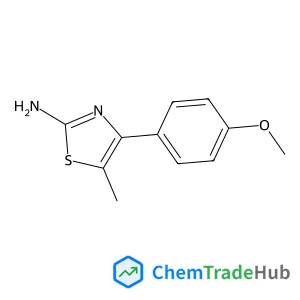
4-(4-Methoxyphenyl)-5-methyl-1,3-thiazol-2-amine
CAS Number:
105512-88-7
Molecular Formula:
C11H12N2OS
Recommended Suppliers





Disclaimer
This page provides academic journal information for reference and research purposes only. We are not affiliated with any journal publishers and do not handle publication submissions. For publication-related inquiries, please contact the respective journal publishers directly.
If you notice any inaccuracies in the information displayed, please contact us at support@chemtradehub.com. We will promptly review and address your concerns.