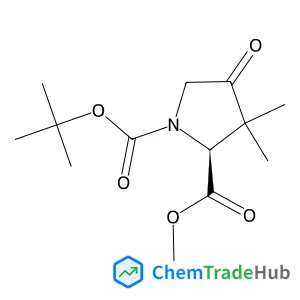
2-Methyl 1-(2-methyl-2-propanyl) (2S)-3,3-dimethyl-4-oxo-1,2-pyrrolidinedicarboxylate
CAS Number:
478698-30-5
Molecular Formula:
C13H21NO5
Hydrostatic pressure can perturb biomolecular function by altering equilibrium structures and folding dynamics. Its influences are particularly important to deep sea organisms, as maximum pressures reach ≈1100 bar at the bottom of the ocean as a result of the rapid increase in hydraulic pressure (1 bar every 10 meters) under water. In this work, DNA hybridization kinetics has been studied at the single molecule level with external, tunable pressure control (Pmax ≈ 1500 bar), realized by incorporating a mechanical hydraulic capillary sample cell into a confocal fluorescence microscope. We find that the DNA hairpin construct promotes unfolding (“denatures”) with increasing pressure by simultaneously decelerating and accelerating the unimolecular rate constants for folding and unfolding, respectively. The single molecule kinetics is then investigated via pressure dependent van’t Hoff analysis to infer changes in the thermodynamic molar volume, which unambiguously reveals that the effective DNA plus solvent volume increases (ΔV0 > 0) along the folding coordinate. Cation effects on the pressure dependent kinetics are also explored as a function of monovalent [Na+]. In addition to stabilizing the overall DNA secondary structure, sodium ions at low concentrations are also found to weaken any pressure dependence for the folding kinetics, but with these effects quickly saturating at physiologically relevant levels of [Na+]. In particular, the magnitudes of the activation volumes for the DNA dehybridization (ΔV‡unfold) are significantly reduced with increasing [Na+], suggesting that sodium cations help DNA adopt a more fold-like transition state configuration.
Sang Ick Lee, Naoto Chatani
DOI: 10.1039/B812466C
Oksana Sereda, Amélie Blanrue, René Wilhelm
DOI: 10.1039/B817991C
Andrew Mills, Kate McDiarmid, Michael McFarlane, Pauline Grosshans
DOI: 10.1039/B900569B
Andrew G. Leach, Rebecca Cann, Simone Tomasi
DOI: 10.1039/B818744D
Masatomo Yashima, Takafumi Komatsu
DOI: 10.1039/B817280C
Isamu Shiina, Hiroki Fukui
DOI: 10.1039/B814375G
Magdalena A. Skopek, Mohamoud A. Mohamoud, Karl S. Ryder, A. Robert Hillman
DOI: 10.1039/B819084D
Dae-Wi Yoon, Dustin E. Gross, Vincent M. Lynch, Chang-Hee Lee, Philip C. Bennett, Jonathan L. Sessler
DOI: 10.1039/B818077F
Ferdinand Gonzaga, Gilbert Yu, Michael A. Brook
DOI: 10.1039/B821788B
(5-Sulfamoyl-3-pyridinyl)boronic acid is primarily used in chemical synthesis, p...
Benzyl 2-methyl-2-(methylsulfonyl)-4-pentenoate is typically synthesized via est...
When handling 8-Fluoroquinolin-6-ol (CAS: 209353-22-0), it is important to use p...
1,3-Dibromo-5-(2-methyl-2-propanyl)benzene (CAS: 129316-09-2) is a crystalline c...
Ethyl 7-chloro-4-oxo-1-(1,3-thiazol-2-yl)-1,4-dihydro-1,8-naphthyridine-3-carbox...
When handling Delta-7-Avenasterol (CAS: 23290-26-8), it is important to wear app...
Proper handling involves the use of personal protective equipment such as gloves...
When handling 2-Methyl-2-proanyl 4-[(2-aminophenyl)amino]-1-piperidinecarboxylat...
N-Methyl-4-chlorobenzylamine hydrochloride (CAS: 65542-24-7) is a organic compou...
[2-(Dodecyloxy)ethoxy]acetic acid (CAS: 27306-90-7) is generally considered safe...

Physical Chemistry Chemical Physics (PCCP) is an international journal co-owned by 19 physical chemistry and physics societies from around the world. This journal publishes original, cutting-edge research in physical chemistry, chemical physics and biophysical chemistry. To be suitable for publication in PCCP, articles must include significant innovation and/or insight into physical chemistry; this is the most important criterion that reviewers and Editors will judge against when evaluating submissions. The journal has a broad scope and welcomes contributions spanning experiment, theory, computation and data science. Topical coverage includes spectroscopy, dynamics, kinetics, statistical mechanics, thermodynamics, electrochemistry, catalysis, surface science, quantum mechanics, quantum computing and machine learning. Interdisciplinary research areas such as polymers and soft matter, materials, nanoscience, energy, surfaces/interfaces, and biophysical chemistry are welcomed if they demonstrate significant innovation and/or insight into physical chemistry. Joined experimental/theoretical studies are particularly appreciated when complementary and based on up-to-date approaches.


![4,10-Dihydroxy-3H-pyrano[3,4,5-kl]xanthen-3-one structure](https://static.chemtradehub.com/structs/125/1259330-61-4-de48.webp "4,10-Dihydroxy-3H-pyrano[3,4,5-kl]xanthen-3-one structure")