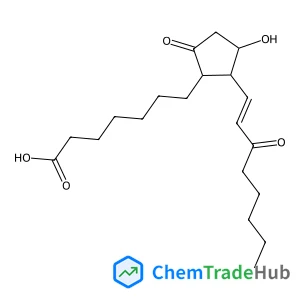
(11alpha,13E)-11-Hydroxy-9,15-dioxoprost-13-en-1-oic acid
CAS Number:
22973-19-9
Molecular Formula:
C20H32O5
A. Balamurugan, Hyung-il Lee
A series of thermoresponsive polymeric photoswitches containing benzylidene oxazolone moieties were successfully prepared. 3-Vinylbenzaldehyde (VBA) and dimethylacrylamide (DMA) were copolymerized by reversible addition–fragmentation chain transfer (RAFT) polymerization to obtain statistical copolymers, poly(3-vinylbenzaldehyde-co-dimethylacrylamide) (PVBA-co-PDMA). The resulting PVBA-co-PDMA copolymers were reacted with hippuric acid to yield the target copolymers, poly(3-vinylbenzylidene oxazolones-co-dimethylacrylamide) (PVBO-co-PDMA). Successful synthesis of the desired copolymers was confirmed by 1H-NMR spectroscopy and gel permeation chromatography (GPC). UV-Vis absorption measurements were employed to study the efficiency of photoisomerization of the benzylidene oxazolone moieties upon irradiation with UV and visible light (365 nm and 650 nm) for various time intervals. Temperature-dependent optical transmission studies (turbidimetry) were also carried out on the aqueous solutions to investigate how the lower critical solution temperature (LCST) values were influenced by photoirradiation. The profiles of optical transmittance suggested that the LCST of the E isomer was higher than that of the Z isomer. The control of LCST by photoirradiation was observed to be repeatable over multiple cycles, demonstrating that photoisomerization is reversible. The LCST values measured by dynamic light scattering (DLS) correlated well with those determined by turbidimetry.
Sara Emanuela Pagnotta
DOI: 10.1039/C2CP22402J
DOI: 10.1039/C2CP23002J
Amitesh Maiti, Arvind Kumar, Robin D. Rogers
DOI: 10.1039/C2CP00010E
Elena Reichert, Reiner Wintringer, Dietrich A. Volmer, Rolf Hempelmann
DOI: 10.1039/C2CP23596J
Lin Tang, Quanmin Guo
DOI: 10.1039/C2CP23871C
Dan Li, Yudai Huang, Neeraj Sharma, Zhixin Chen, Dianzeng Jia
DOI: 10.1039/C2CP24062A
Andrey Yu. Rogachev, Alexander S. Filatov, Alexander V. Zabula, Marina A. Petrukhina
DOI: 10.1039/C2CP23442D
Madhurima Jana, Sanjoy Bandyopadhyay
DOI: 10.1039/C2CP24104H
Patrick Rosa, Laure Vendier, Nicola Casati, Jean-François Létard, Azzedine Bousseksou, Philippe Guionneau, Gábor Molnár
DOI: 10.1039/C2CP23940J
3-Fluoro-2-methylbenzylamine is an organic compound with the CAS number 771573-3...
Tert-butyl 2-(oxetan-3-ylidene)acetate is considered safe for its intended uses ...
Proper personal protective equipment (PPE) such as gloves, goggles, and a lab co...
2-Ethyl-4-methyl-1,3-thiazole is commonly synthesized via the reaction of thiour...
This compound should be stored in a cool, dry place away from direct sunlight an...
L-Lysine Acetate Salt (CAS: 52315-92-1) is subject to various regulatory guideli...
6-Fluoro-3-hydroxy-2-pyrazinecarboxamide (CAS: 259793-96-9) is generally conside...
1,1'-Sulfonylbis(1H-imidazole) is a crystalline solid with a molecular weight of...
4-Methyl-7-nitro-1H-indole-3-carbonitrile (CAS: 289483-82-5) is primarily used i...
Waste containing 5-Bromo-3-indolyl-beta-galactoside (CAS: 97753-82-7) should be ...

Polymer Chemistry welcomes submissions in all areas of polymer science that have a strong focus on macromolecular chemistry. Manuscripts may cover a broad range of fields, yet no direct application focus is required.