












Macromolecular structure evolution toward giant molecules of complex structure: tandem synthesis of asymmetric giant gemini surfactants
Literature Information
Publication Date
2014-03-24
DOI
10.1039/C4PY00107A
Impact Factor
5.582
Authors
Hao Su, Yiwen Li, Kan Yue, Zhao Wang, Pengtao Lu, Xueyan Feng, Xue-Hui Dong, Shuo Zhang, Stephen Z. D. Cheng
View Original
Abstract
Precise control of primary chemical structures, especially those of complex structures, is a prerequisite to understand the structure–property relationships of functional macromolecules. In this article, we report the rational design and tandem synthesis of three asymmetric giant gemini surfactants (AGGSs) of complex macromolecular structures based on polyhedral oligomeric silsesquioxane (POSS). In two cascading processes (typically within 5 hours), AGGSs can be synthesized where the length of the two polymer tails and the identity of the two POSS heads can be independently controlled and systematically varied. It represents a convenient, efficient, and modular way to prepare giant molecules with rigorous structural precision in only a few steps. This study expands the scope of synthetically available giant surfactants and facilitates further structural evolution toward even more complex macromolecules.
Related Literature
Synthesis and post-polymerization modification of poly(pentafluorophenyl methacrylate) brushes
Kemal Arda Günay, Nicolas Schüwer, Harm-Anton Klok
2012-05-02
Paper
DOI: 10.1039/C2PY20162C
Polyethyleneimine functionalized polymer microsphere: a novel delivery vector for cells
Chunying Gao, Han Zhang, Ming Wu, Yang Liu, Yipan Wu, Xinlin Yang, Xizeng Feng
2012-02-23
Paper
DOI: 10.1039/C2PY20012K
Thermally reversible Diels–Alder-based polymerization: an experimental and theoretical assessment
Jiawen Zhou, Nathalie K. Guimard, Andrew J. Inglis, Mansoor Namazian, Ching Y. Lin, Michelle L. Coote, Emmanouil Spyrou, Stefan Hilf, Friedrich Georg Schmidt, Christopher Barner-Kowollik
2011-10-26
Paper
DOI: 10.1039/C1PY00356A
One-step RAFT synthesis of well-defined amphiphilic star polymers and their self-assembly in aqueous solution
Christoph Herfurth, Paula Malo de Molina, Christoph Wieland, Sarah Rogers, Michael Gradzielski
2012-04-26
Paper
DOI: 10.1039/C2PY20126G
Functional galactomannan platform from convenient esterification in imidazolium-based ionic liquids
2011-12-23
Paper
DOI: 10.1039/C2PY00512C
Organoboron star polymersvia arm-first RAFT polymerization: synthesis, luminescent behavior, and aqueous self-assembly
Fei Cheng, Edward M. Bonder, Ami Doshi, Frieder Jäkle
2012-01-03
Communication
DOI: 10.1039/C2PY00556E
Flexible polybenzoxazine thermosets with high glass transition temperatures and low surface free energies
Ching Hsuan Lin, Sheng Lung Chang, Ting Yi Shen, Yu Sin Shih, Hong Tze Lin, Chih Feng Wang
2012-01-30
Paper
DOI: 10.1039/C2PY00449F
The unexpected behaviour of epoxidised macromonomers derived from catalytic chain transfer during ring opening copolymerisation
Bas G. P. van Ravensteijn, Robbert Duchateau, Johan P. A. Heuts
2012-05-25
Paper
DOI: 10.1039/C2PY20195J
Synthesis of cyclic amphiphilic homopolymers and their potential application as polymeric micelles
Boyd A. Laurent, Scott M. Grayson
2011-10-19
Paper
DOI: 10.1039/C1PY00378J
You might also like
Compound Q&A
Are there alternatives to 1-(4-Chlorophenyl)-N-hydroxymethanimine (CAS: 3848-36-0) in synthesis?
When considering alternatives to 1-(4-Chlorophenyl)-N-hydroxymethanimine (CAS: 3...
3848-36-01-(4-Chlorophenyl)-N...
Compound Q&A
How should (1R,9S,10S,12S,14E,16S,19R,20R,21S,22R)-3,9,21-Trihydroxy-5,10,12,14,16,20,22-heptamethyl-23,24-dioxatetracyclo[17.3.1.1~6,9~.0~2,7~]tetracosa-2,5,7,14-tetraen-4-one (CAS: 183202-73-5) be stored?
This compound should be stored in a cool, dry place away from direct sunlight. I...
183202-73-5(1R,9S,10S,12S,14E,1...
Compound Q&A
How is 3-(4-Bromophenyl)-5-(2-fluorophenyl)-1,2,4-oxadiazole (CAS: 419553-16-5) typically synthesized?
3-(4-Bromophenyl)-5-(2-fluorophenyl)-1,2,4-oxadiazole is synthesized through a m...
419553-16-53-(4-Bromophenyl)-5-...
Compound Q&A
How is 5-Chloro-2-(4-chlorophenyl)-4-methyl-6-[3-(1-piperidinyl)propoxy]pyrimidine (CAS: 1639220-19-1) typically synthesized?
5-Chloro-2-(4-chlorophenyl)-4-methyl-6-[3-(1-piperidinyl)propoxy]pyrimidine (CAS...
1639220-19-15-Chloro-2-(4-chloro...
Compound Q&A
What industries use 2-Chloro-4-(difluoromethoxy)pyridine (CAS: 1206978-15-5)?
2-Chloro-4-(difluoromethoxy)pyridine is used in the pharmaceutical industry for ...
1206978-15-52-Chloro-4-(difluoro...
Compound Q&A
What regulatory guidelines apply to 3-Chloro-6-methylpyridazine (CAS: 1121-79-5)?
3-Chloro-6-methylpyridazine (CAS: 1121-79-5) is classified under the Globally Ha...
1121-79-53-Chloro-6-methylpyr...
Compound Q&A
Are there alternatives to Methyl 4,5-dimethyl-2-nitrobenzoate in synthesis?
Several alternatives can be used in the synthesis of Methyl 4,5-dimethyl-2-nitro...
90922-74-0Methyl 4,5-dimethyl-...
Compound Q&A
Are there alternatives to (2E,2'E)-3,3'-(1,4-Phenylene)bisacrylaldehyde in synthesis?
Alternatives to (2E,2'E)-3,3'-(1,4-Phenylene)bisacrylaldehyde include other acry...
63405-68-5(2E,2'E)-3,3'-(1,4-P...
Compound Q&A
What is 3-Amino-5-chloropyridin-2-ol hydrochloride (CAS: 1261906-29-9)?
3-Amino-5-chloropyridin-2-ol hydrochloride is an organic compound with the CAS n...
1261906-29-93-Amino-5-chloropyri...
Compound Q&A
What precautions should be taken when handling 6,7-Difluoro-2,3-dihydro-4H-chromen-4-one (CAS: 1092349-93-3)?
When handling 6,7-Difluoro-2,3-dihydro-4H-chromen-4-one, it is essential to wear...
1092349-93-36,7-Difluoro-2,3-dih...
Source Journal
Polymer Chemistry

CiteScore:
8.6
Self-citation Rate:
7.3%
Articles per Year:
457
Polymer Chemistry welcomes submissions in all areas of polymer science that have a strong focus on macromolecular chemistry. Manuscripts may cover a broad range of fields, yet no direct application focus is required.
Recommended Compounds
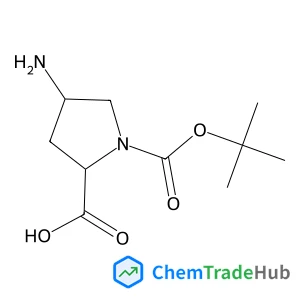
(2R,4R)-1-Boc-4-Aminopyrrolidine-2-carboxylic acid
CAS Number:
132622-98-1
Molecular Formula:
C10H18N2O4
Recommended Suppliers




Disclaimer
This page provides academic journal information for reference and research purposes only. We are not affiliated with any journal publishers and do not handle publication submissions. For publication-related inquiries, please contact the respective journal publishers directly.
If you notice any inaccuracies in the information displayed, please contact us at support@chemtradehub.com. We will promptly review and address your concerns.