












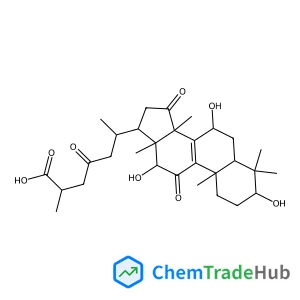
(3beta,7beta,12beta)-3,7,12-Trihydroxy-11,15,23-trioxolanost-8-en-26-oic acid
CAS Number:
98665-22-6
Molecular Formula:
C30H44O8
Mochen Li, Huaihe Song, Xiaohong Chen, Jisheng Zhou, Zhaokun Ma
A novel and effective route for preparing phenol formaldehyde resin grafted reduced graphene oxide (rGO-g-PF) electrode materials with highly enhanced electrochemical properties is reported. In order to prepare rGO-g-PF, hydroxymethyl-terminated PF is initially grafted to graphene oxide (GO) via esterification reaction. Subsequently, the grafted GO is reduced by the carbonization process under an inert gas atmosphere. The covalent linkage, morphology, thermal stability and electrochemical properties of rGO-g-PF are systematically investigated by Fourier transform infrared spectroscopy, scanning electron microscopy, thermal gravimetric analysis, differential scanning calorimetry and a variety of electrochemical testing techniques. In the constructed architecture, the amorphous carbon shell can inhibit the co-intercalation of solvated lithium ion and avoid partial exfoliation of the graphene layers, thus effectively reducing the irreversible capacity and preserving the structural integrity. Meanwhile, the carbon coating layer leading to a decreased thickness of SEI film can improve the conductivity of electrode materials. As a result, the rGO-g-PF electrode exhibits impressive high cycling stability at various large current densities (376.5 mA h g−1 at 50 mA g−1 for 250 cycles, 337.8 mA h g−1 at 200 mA g−1 and 267.8 mA h g−1 at 1 A g−1 for 200 cycles), in combination with high rate capability.
Tânia F. G. G. Cova, Sandra C. C. Nunes, Alberto A. C. C. Pais
DOI: 10.1039/C6CP08081B
Ignacio Fdez. Galván, Daniel Roca-Sanjuán, Erick L. Bastos, Wilhelm J. Baader, Roland Lindh
DOI: 10.1039/C6CP08154A
G. W. Driver, Y. Huang, A. Laaksonen, T. Sparrman, Y.-L. Wang, P.-O. Westlund
DOI: 10.1039/C6CP05801A
Yuanjun Lu, Bryan E. G. Lucier, Yue Zhang, Anmin Zheng, Yining Huang
DOI: 10.1039/C7CP00199A
Matías E. Aguirre, S. Municoy, M. A. Grela, A. J. Colussi
DOI: 10.1039/C6CP06829D
Dannie J. G. P. van Osch, Laura J. B. M. Kollau, Sari Asikainen, Marisa A. A. Rocha
DOI: 10.1039/C6CP07499E
P. Modak, Ashok K. Verma
DOI: 10.1039/C6CP07805B
Hua-Bin Sun, Ying-Xian Zhou, Lu-Lu Zhang, Xue-Lin Yang, Xing-Zhong Cao, Hanu Arave, Hui Fang, Gan Liang
DOI: 10.1039/C6CP07760A
M. Ziatdinov, H. Lim, S. Fujii, K. Kusakabe, M. Kiguchi, T. Enoki, Y. Kim
DOI: 10.1039/C6CP08352H
When handling 4-(2-Furylmethyl)thiomorpholine 1,1-dioxide (CAS: 79206-94-3), it ...
When handling 4-Chloro-N-[2-(4-morpholinyl)ethyl]benzamide (CAS: 71320-77-9), it...
Waste containing this compound (CAS: 62921-74-8) should be handled according to ...
Waste containing (S)-Methyl 2-amino-3-cyclohexylpropanoate should be collected i...
This compound can be synthesized using a multi-step process involving the conjug...
There are several alternatives to (2E)-3-(3,4-Dichlorophenyl)acrylic acid in syn...
Ethyl 6-(2-nitrophenyl)imidazo[2,1-b][1,3]thiazole-3-carboxylate (CAS: 925437-84...
Waste containing 2-(1,3-Thiazol-2-yl)ethanamine (CAS: 18453-07-1) should be coll...
Methyl 5-iodo-2-methylbenzoate can be synthesized through the iodination of meth...
5-Chloro[1,2,4]triazolo[1,5-a]pyridine is commonly synthesized via the condensat...

Physical Chemistry Chemical Physics (PCCP) is an international journal co-owned by 19 physical chemistry and physics societies from around the world. This journal publishes original, cutting-edge research in physical chemistry, chemical physics and biophysical chemistry. To be suitable for publication in PCCP, articles must include significant innovation and/or insight into physical chemistry; this is the most important criterion that reviewers and Editors will judge against when evaluating submissions. The journal has a broad scope and welcomes contributions spanning experiment, theory, computation and data science. Topical coverage includes spectroscopy, dynamics, kinetics, statistical mechanics, thermodynamics, electrochemistry, catalysis, surface science, quantum mechanics, quantum computing and machine learning. Interdisciplinary research areas such as polymers and soft matter, materials, nanoscience, energy, surfaces/interfaces, and biophysical chemistry are welcomed if they demonstrate significant innovation and/or insight into physical chemistry. Joined experimental/theoretical studies are particularly appreciated when complementary and based on up-to-date approaches.
![1-Naphthalenesulfonic acid, 2-[(2-hydroxy-1-naphthalenyl)azo]-, bariumsalt (2:1) structure](https://static.chemtradehub.com/structs/110/1103-38-4-0b33.webp "1-Naphthalenesulfonic acid, 2-[(2-hydroxy-1-naphthalenyl)azo]-, bariumsalt (2:1) structure")





