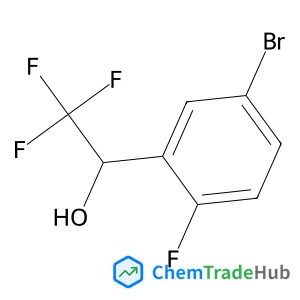
1-(5-Bromo-2-fluorophenyl)-2,2,2-trifluoroethanol
CAS Number:
1039827-16-1
Molecular Formula:
C8H5BrF4O
J. Laisney, H. J. Shepherd, L. Rechignat, G. Molnár, E. Rivière, M.-L. Boillot
We investigated the effect of an externally applied pressure on the iron(III) Schiff-base compound [Fe(3-OMeSalEen)2]PF6 (H-3-OMeSalEen, condensation product of 3-methoxy-substituted salicylaldehyde and N-ethylethylenediamine), which at ambient pressure displays a thermal spin transition with a 3 K wide hysteresis loop centered at 164 K. Raman spectrometry revealed the occurrence of a complete spin-state switching process for a pressure of P1/2 = 8–9 kbar at room temperature. The evolution of lattice parameters as a function of pressure was followed by X-ray diffraction measurements on single crystals, highlighting the important microscopic aspects at the origin of the pressure-induced transition, i.e. an anisotropic response and a high compressibility of the HS molecular lattice. Variable temperature magnetic susceptibility measurements at different applied pressures revealed the smoothening of the spin transition curves and a linear increase of the transition temperatures by ca. 16.4 (1.0) K kbar−1, in good agreement with the Clausius–Clapeyron law. The non-negligible influence of the pressure transmitting oils on the intrinsic transition properties was also evidenced and attributed to mechanical interactions between the particles and the solidified matrix.
Hao Long, Jinshuai Song, Hai-Chao Xu
DOI: 10.1039/C8QO00803E
Hideaki Takano
DOI: 10.1039/C4QO00355A
Yan-Jie Xiong, Shao-Qing Shi, Wen-Juan Hao, Shu-Jiang Tu, Bo Jiang
DOI: 10.1039/C8QO00950C
Resul Ozdemir, Sangyun Park, İbrahim Deneme, Yonghan Park, Yunus Zorlu, Kevser Harmandar, Choongik Kim, Hakan Usta
DOI: 10.1039/C8QO00856F
Xiao-Jie Shang, Dong Liu, Zhong-Quan Liu
DOI: 10.1039/C8QO00847G
Thomas Lebleu, Jacques Maddaluno, Julien Legros
DOI: 10.1039/C4QO00342J
Wei-Lei Zhou, Xuan Zhao, Yong Chen
DOI: 10.1039/C8QO00790J
Lin Wang, Chuan Wang
DOI: 10.1039/C8QO01044G
Kangrong Yan, Zhi-Xi Liu, Xue Li, Jiehuan Chen, Hongzheng Chen, Chang-Zhi Li
DOI: 10.1039/C8QO00788H
2-(2-Chloroacetamido)-3-phenylpropanoic acid (CAS: 7765-11-9) is generally consi...
2-(Benzyloxy)-5-bromobenzoic acid can be handled safely if appropriate precautio...
(4-Methyl-1,2,5-oxadiazol-3-yl)methanamine hydrochloride is a chemical compound ...
2-(5-Hexylthiophen-2-yl)-4,4,5,5-tetramethyl-1,3,2-dioxaborolane (CAS: 917985-54...
While 4-(8-Methyl-9H-1,3-dioxolo[4,5-h][2,3]benzodiazepin-5-yl)benzenamine (CAS:...
The market for tert-butyl 3-hydroxy-4,5,7,8-tetrahydro-2H-pyrazolo[3,4-d]azepine...
Waste containing 3,5-Diamino-1H-pyrazole-4-carbonitrile (CAS: 6844-58-2) should ...
(6-Fluoro-3-pyridinyl)boronic acid can be synthesized through the reaction of 6-...
Dibenzyl carbonimidoylbiscarbamate (CAS: 10065-79-9) finds applications in vario...
The market for (beta,beta,2,3,4,5,6-~2~H_7_)Phenylalanine (CAS: 74228-83-4) is g...

Physical Chemistry Chemical Physics (PCCP) is an international journal co-owned by 19 physical chemistry and physics societies from around the world. This journal publishes original, cutting-edge research in physical chemistry, chemical physics and biophysical chemistry. To be suitable for publication in PCCP, articles must include significant innovation and/or insight into physical chemistry; this is the most important criterion that reviewers and Editors will judge against when evaluating submissions. The journal has a broad scope and welcomes contributions spanning experiment, theory, computation and data science. Topical coverage includes spectroscopy, dynamics, kinetics, statistical mechanics, thermodynamics, electrochemistry, catalysis, surface science, quantum mechanics, quantum computing and machine learning. Interdisciplinary research areas such as polymers and soft matter, materials, nanoscience, energy, surfaces/interfaces, and biophysical chemistry are welcomed if they demonstrate significant innovation and/or insight into physical chemistry. Joined experimental/theoretical studies are particularly appreciated when complementary and based on up-to-date approaches.
![(1S)-1,5-Anhydro-2-O-alpha-L-arabinopyranosyl-1-[5-hydroxy-7-({6-O-[3-(4-hydroxy-3-methoxyphenyl)propanoyl]-beta-D-glucopyranosyl}oxy)-2-(4-hydroxyphenyl)-4-oxo-4H-chromen-6-yl]-D-glucitol structure](https://static.chemtradehub.com/structs/225/2252345-81-4-bcff.webp "(1S)-1,5-Anhydro-2-O-alpha-L-arabinopyranosyl-1-[5-hydroxy-7-({6-O-[3-(4-hydroxy-3-methoxyphenyl)propanoyl]-beta-D-glucopyranosyl}oxy)-2-(4-hydroxyphenyl)-4-oxo-4H-chromen-6-yl]-D-glucitol structure")