












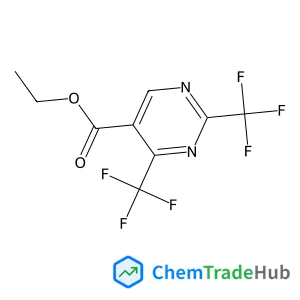
Ethyl 2,4-bis(trifluoromethyl)-5-pyrimidinecarboxylate
CAS Number:
188781-15-9
Molecular Formula:
C9H6F6N2O2
Kanagasabai Balamurugan, Prathab Baskar, Ravva Mahesh Kumar, Sumitesh Das, Venkatesan Subramanian
The present work utilizes classical molecular dynamics simulations to investigate the covalent functionalization of carbon nanotubes (CNTs) and their interaction with ethylene glycol (EG) and water molecules. The MD simulation reveals the dispersion of functionalized carbon nanotubes and the prevention of aggregation in aqueous medium. Further, residue-wise radial distribution function (RRDF) and atomic radial distribution function (ARDF) calculations illustrate the extent of interaction of –OH and –COOH functionalized CNTs with water molecules and the non-functionalized CNT surface with EG. As the presence of the number of functionalized nanotubes increases, enhancement in the propensity for the interaction with water molecules can be observed. However, the same trend decreases for the interaction of EG molecules. In addition, the ONIOM (M06-2X/6-31+G**:AM1) calculations have also been carried out on model systems to quantitatively determine the interaction energy (IE). It is found from these calculations that the relative enhancement in the interaction of water molecules with functionalized CNTs is highly favorable when compared to the interaction of EG.
Xiuyun Wang, Jie Zhang, Yuanan Wei, Tianyu Xing, Tingting Cao, Shuo Wu, Fenghui Zhu
DOI: 10.1039/C9AN02398D
Claudio Zuliani, Fu Siong Ng, Andrea Alenda, Amir Eftekhar, Nicholas S. Peters, Christofer Toumazou
DOI: 10.1039/C6AN00639F
Kamonwad Ngamchuea, Christopher Batchelor-McAuley, Philip J. Cowen, Clare Williams, Luís Moreira Gonçalves, Richard G. Compton
DOI: 10.1039/C6AN01139J
Zhigang Sui, Yichu Shan, Lihua Zhang, Yukui Zhang
DOI: 10.1039/C6AN00892E
Wei-Wei Zhao, Jing-Juan Xu, Hong-Yuan Chen
DOI: 10.1039/C6AN01123C
Klaus Koren, Peter Ø. Jensen
DOI: 10.1039/C6AN00864J
Zhiwei Li
DOI: 10.1039/C9AN02495F
Hong Xie, Kaiyue Duan, Muyin Xue, Yongling Du, Chunming Wang
DOI: 10.1039/C6AN00545D
Yao Lei, Fei Qiu, Jian-Mei Yang, Mao Liu, Qing-Mei Ge, Hang Cong, Zhu Tao
DOI: 10.1039/C9AN02156F
When handling lithium chloride hydrate (1:1:1) (CAS: 16712-20-2), it is importan...
4-(4H-1,2,4-Triazol-4-yl)piperidine is generally considered safe for use in phar...
Waste containing 1,3-Thiazole-2-carboxamide (CAS: 16733-85-0) should be collecte...
5-(Difluoromethyl)-2-fluorobenzonitrile (CAS: 934175-58-3) is subject to regulat...
Methyl 3-acetamido-2-thiophenecarboxylate can be synthesized by the reaction of ...
4-Isoquinolinecarbonitrile is a chemical compound with the CAS number 34846-65-6...
Store Methyl 1H-1,2,3-triazole-4-carboxylate (CAS: 877309-59-6) in a cool, dry p...
6-Bromo[1,3]thiazolo[5,4-b]pyridin-2-amine (CAS: 1160791-13-8) is subject to the...
(2S,3S)-2-Ammonio-3-(3,4-dihydroxyphenyl)-3-hydroxypropanoate (CAS: 23651-95-8) ...
7-Bromo-3-methyl-3,4-dihydroquinazolin-4-one is a solid with a crystalline form....

Physical Chemistry Chemical Physics (PCCP) is an international journal co-owned by 19 physical chemistry and physics societies from around the world. This journal publishes original, cutting-edge research in physical chemistry, chemical physics and biophysical chemistry. To be suitable for publication in PCCP, articles must include significant innovation and/or insight into physical chemistry; this is the most important criterion that reviewers and Editors will judge against when evaluating submissions. The journal has a broad scope and welcomes contributions spanning experiment, theory, computation and data science. Topical coverage includes spectroscopy, dynamics, kinetics, statistical mechanics, thermodynamics, electrochemistry, catalysis, surface science, quantum mechanics, quantum computing and machine learning. Interdisciplinary research areas such as polymers and soft matter, materials, nanoscience, energy, surfaces/interfaces, and biophysical chemistry are welcomed if they demonstrate significant innovation and/or insight into physical chemistry. Joined experimental/theoretical studies are particularly appreciated when complementary and based on up-to-date approaches.
![(1R,5R)-3-{[(2-Methyl-2-propanyl)oxy]carbonyl}-3-azabicyclo[3.1.0]hexane-1-carboxylic acid structure](https://static.chemtradehub.com/structs/116/1165450-63-4-bfe1.webp "(1R,5R)-3-{[(2-Methyl-2-propanyl)oxy]carbonyl}-3-azabicyclo[3.1.0]hexane-1-carboxylic acid structure")
![N-[2-(2-Pyridinyl)ethyl]-1-propanamine structure](https://static.chemtradehub.com/structs/554/55496-57-6-22b4.webp "N-[2-(2-Pyridinyl)ethyl]-1-propanamine structure")
![8-Bromo-6-fluoro[1,2,4]triazolo[1,5-a]pyridin-2-amine structure](https://static.chemtradehub.com/structs/125/1257705-51-3-9f4a.webp "8-Bromo-6-fluoro[1,2,4]triazolo[1,5-a]pyridin-2-amine structure")
![6-(Benzyloxy)-8-(2-bromoacetyl)-2H-benzo[b][1,4]oxazin-3(4H)-one structure](https://static.chemtradehub.com/structs/926/926319-53-1-2287.webp "6-(Benzyloxy)-8-(2-bromoacetyl)-2H-benzo[b][1,4]oxazin-3(4H)-one structure")






