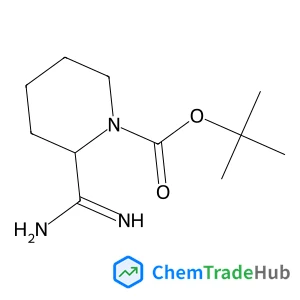
2-Methyl-2-propanyl 2-carbamimidoyl-1-piperidinecarboxylate
CAS Number:
1258640-98-0
Molecular Formula:
C11H21N3O2
T. Inakhunbi Chanu, Thangavelu Muthukumar, Periakaruppan T. Manoharan
Nanocomposites of gold nanoparticles and semiconductor ZnO with wurtzite structure, made by solution combustion synthesis (SCS), as a function of the Zn/fuel ratio with polyethylene glycol (PEG) as fuel exhibit the presence of both nanoparticles and clusters. Atomic gold clusters present on the surface of ZnO nanorods which can be identified by XPS and SEM are easily monitored and characterized by positive ion MALDI experiments as mostly odd numbered clusters, Au3 to Au11 in decreasing amounts. Low concentrations of the fuel produce AuClO and nanoparticles (NPs), with no clusters. Au–ZnO nanocomposites at all [Au] exhibit single blue shifted plasmon absorption and corresponding photoluminescence (PL). Increasing particle size prefers surface plasmon resonance (SPR) scattering of metal that could lead to PL enhancement; however, available ZnO surface in the Au–ZnO composite becomes more important than the particle size of the composite with higher [Au]. The catalytic activity of these Au–ZnO nanocomposites tested on 4-nitrophenol clearly revealed the presence of an intermediate with both NPs and clusters playing different roles. An in vitro study of cytotoxicity on MCF-7 cell lines revealed that these gold nanostructures have turned out to be powerful nanoagents for destruction of cancer cells even with small amounts of gold particles/clusters. The nanorods of ZnO, known to be nontoxic to normal cells, play a lesser role in the anticancer activity of these Au–ZnO nanocomposites.
José Barluenga, María Marco-Arias, Francisco González-Bobes, Alfredo Ballesteros, José M. González
DOI: 10.1039/B411227J
Takayuki Suzuki, Tatsuya Kato, Hiraku Shinozaki
DOI: 10.1039/B407342H
Chi-Fung Choi, Po-Ting Tsang, Jian-Dong Huang, Elaine Y. M. Chan, Wing-Hung Ko, Wing-Ping Fong, Dennis K. P. Ng
DOI: 10.1039/B405868B
Roger W. Alder, Leila Chaker, François P. V. Paolini
DOI: 10.1039/B409112D
Guang Yang, Raphael G. Raptis
DOI: 10.1039/B404269G
Anthony R. Chianese, Brian M. Zeglis, Robert H. Crabtree
DOI: 10.1039/B409672J
Eiji Hosono, Shinobu Fujihara
DOI: 10.1039/B408495K
Ana Galet, M. Carmen Muñoz, Víctor Martínez, José Antonio Real
DOI: 10.1039/B409974E
S. Bordiga, C. Lamberti, G. Ricchiardi, L. Regli, F. Bonino, A. Damin, K.-P. Lillerud, M. Bjorgen, A. Zecchina
DOI: 10.1039/B407246D
Mangesh T. Bore, Hien N. Pham, Timothy L. Ward, Abhaya K. Datye
DOI: 10.1039/B407575G
Waste containing 6-Chloro-5-(2'-hydroxy-3'-methoxy-4-biphenylyl)-3-(3-methoxyphe...
(3alpha,5alpha)-3-Hydroxypregnane-11,20-dione is primarily used in the pharmaceu...
The market for 4-Amino-6-chloro-2-pyridinecarboxylic acid (CAS: 546141-56-4) is ...
Alternatives to (2-Benzoylethyl)trimethylammonium chloride (CAS: 24472-88-6) in ...
N-[4-Nitro-3-(trifluoromethyl)phenyl]acetamide (CAS: 393-12-4) is generally safe...
Alternative reagents such as other phosphates or similar functional groups can b...
There are alternatives to N,N'-Bis(3-aminopropyl)-1,3-propanediamine (CAS: 4605-...
When handling Aluminium trihexadecanoate, it is important to use appropriate per...
(1,1-Dioxido-3-oxo-1,2-benzothiazol-2(3H)-yl)acetic acid is a chemical compound ...
Several alternatives to 5,5-dimethyloxolan-2-one (CAS: 3123-97-5) can be used in...

Physical Chemistry Chemical Physics (PCCP) is an international journal co-owned by 19 physical chemistry and physics societies from around the world. This journal publishes original, cutting-edge research in physical chemistry, chemical physics and biophysical chemistry. To be suitable for publication in PCCP, articles must include significant innovation and/or insight into physical chemistry; this is the most important criterion that reviewers and Editors will judge against when evaluating submissions. The journal has a broad scope and welcomes contributions spanning experiment, theory, computation and data science. Topical coverage includes spectroscopy, dynamics, kinetics, statistical mechanics, thermodynamics, electrochemistry, catalysis, surface science, quantum mechanics, quantum computing and machine learning. Interdisciplinary research areas such as polymers and soft matter, materials, nanoscience, energy, surfaces/interfaces, and biophysical chemistry are welcomed if they demonstrate significant innovation and/or insight into physical chemistry. Joined experimental/theoretical studies are particularly appreciated when complementary and based on up-to-date approaches.