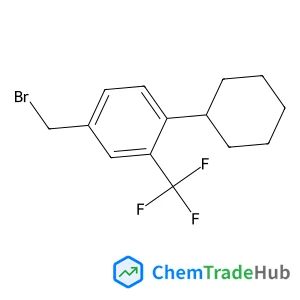
4-(Bromomethyl)-1-cyclohexyl-2-(trifluoromethyl)benzene
CAS Number:
800381-60-6
Molecular Formula:
C14H16BrF3
M. A. Gonzalez, E. Sanz, C. McBride, J. L. F. Abascal, C. Vega, C. Valeriani
The aim of this work is to evaluate nucleation free-energy barriers using molecular dynamics (MD). More specifically, we use a combination of Hybrid Monte Carlo (HMC) and an Umbrella Sampling scheme, and compute the crystallisation barrier of NaCl from its melt. Firstly the convergence and performance of HMC for different time-steps and the number of MD steps within a HMC cycle are assessed. The calculated potential energies and densities converge regardless of the chosen time-step. However the acceptance ratio of the Metropolis step within the HMC scheme strongly depends on the time-step and affects the performance. It is shown that the acceptance ratio is close to 100% for time-steps of the order of those commonly used in molecular dynamics runs. We then explore the results obtained with a “non-Metropolised” version of HMC where the MD trajectories are always accepted (omitting the Metropolis criteria) and conclude that they are satisfactory for time-steps below 5 fs. Next, HMC is combined with Umbrella Sampling (HMC/US) to compute the nucleation free-energy for both the standard and the “non-Metropolised” HMC (using a small time-step) and in both cases find excellent agreement with the reported values. To conclude, we explore approximations to the HMC/US technique implementing HMC with isothermal–isobaric MD trajectories. The computed nucleation free-energy curve is coincident, within the statistical error, with previous calculations.
Zhichao Pei, Björn Ingemarsson, Teodor Aastrup, Olof Ramström
DOI: 10.1039/C6AN00735J
D. Ogończyk, M. Opallo
DOI: 10.1039/C6AN00752J
Shixuan Yang, Zhihua Song, Jinhua Li, Qiaocui Shi, Huiyan You, Huitao Liu, Min Lv, Lingxin Chen
DOI: 10.1039/C9AN02127B
Juntao Zhang, Haibo Wang, Fan Xia
DOI: 10.1039/C6AN00594B
Xiaoya Ma
DOI: 10.1039/C9AN02271F
Ai-Li Sun, Qing-An Qi
DOI: 10.1039/C6AN00696E
Soham Samanta, Barun Kumar Datta, Madhurima Boral, Abhijit Nandan, Gopal Das
DOI: 10.1039/C6AN00657D
Szymon Bocian, Katarzyna Krzemińska, Bogusław Buszewski
DOI: 10.1039/C6AN00139D
When handling lithium chloride hydrate (1:1:1) (CAS: 16712-20-2), it is importan...
4-(4H-1,2,4-Triazol-4-yl)piperidine is generally considered safe for use in phar...
Waste containing 1,3-Thiazole-2-carboxamide (CAS: 16733-85-0) should be collecte...
5-(Difluoromethyl)-2-fluorobenzonitrile (CAS: 934175-58-3) is subject to regulat...
Methyl 3-acetamido-2-thiophenecarboxylate can be synthesized by the reaction of ...
4-Isoquinolinecarbonitrile is a chemical compound with the CAS number 34846-65-6...
Store Methyl 1H-1,2,3-triazole-4-carboxylate (CAS: 877309-59-6) in a cool, dry p...
6-Bromo[1,3]thiazolo[5,4-b]pyridin-2-amine (CAS: 1160791-13-8) is subject to the...
(2S,3S)-2-Ammonio-3-(3,4-dihydroxyphenyl)-3-hydroxypropanoate (CAS: 23651-95-8) ...
7-Bromo-3-methyl-3,4-dihydroquinazolin-4-one is a solid with a crystalline form....

Physical Chemistry Chemical Physics (PCCP) is an international journal co-owned by 19 physical chemistry and physics societies from around the world. This journal publishes original, cutting-edge research in physical chemistry, chemical physics and biophysical chemistry. To be suitable for publication in PCCP, articles must include significant innovation and/or insight into physical chemistry; this is the most important criterion that reviewers and Editors will judge against when evaluating submissions. The journal has a broad scope and welcomes contributions spanning experiment, theory, computation and data science. Topical coverage includes spectroscopy, dynamics, kinetics, statistical mechanics, thermodynamics, electrochemistry, catalysis, surface science, quantum mechanics, quantum computing and machine learning. Interdisciplinary research areas such as polymers and soft matter, materials, nanoscience, energy, surfaces/interfaces, and biophysical chemistry are welcomed if they demonstrate significant innovation and/or insight into physical chemistry. Joined experimental/theoretical studies are particularly appreciated when complementary and based on up-to-date approaches.
![8-Bromo-6-fluoro[1,2,4]triazolo[1,5-a]pyridin-2-amine structure](https://static.chemtradehub.com/structs/125/1257705-51-3-9f4a.webp "8-Bromo-6-fluoro[1,2,4]triazolo[1,5-a]pyridin-2-amine structure")