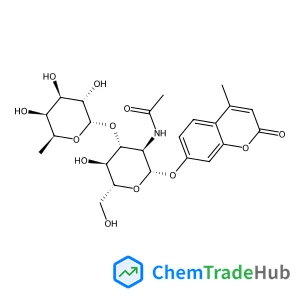
4-Methyl-2-oxo-2H-chromen-7-yl 2-acetamido-2-deoxy-3-O-(6-deoxy-alpha-L-galactopyranosyl)-beta-D-glucopyranoside
CAS Number:
383160-12-1
Molecular Formula:
C24H31NO12
Shixuan Yang, Zhihua Song, Jinhua Li, Qiaocui Shi, Huiyan You, Huitao Liu, Min Lv, Lingxin Chen
A twin enrichment method based on offline dispersive liquid–liquid microextraction (DLLME) coupled with online field-amplified sample injection (FASI) was developed for the simultaneous determination of four sulfonamide (SA) antibiotics, including sulfamethazine (SMZ), sulfamerazine (SMR), sulfadizine (SDZ) and sulfacetamide (SFA), in different environmental waters, followed by capillary electrophoresis (CE). Various parameters that affected the separation performance of CE and the enrichment efficiencies of DLLME and FASI were optimized in detail, and excellent CE separation was attained within 6 min. The DLLME-FASI-CE offered high sensitivity enrichment factors of 206, 166, 185 and 150 for SMZ, SMR, SDZ and SFA, respectively. Highly sensitive detection was realized with low limits of detection (LODs), which ranged from 2.0–23.0, 2.2–26.0 and 4.3–63.0 ng mL−1 in tap water, lake water and seawater, respectively, as well as limits of quantification (LOQs) within 6.0–63.0, 7.4–96.0 and 14.0–201.0 ng mL−1, respectively. Satisfactory recoveries in the range of 91–108% were obtained with the three spiked environmental water samples, and the relative standard deviations were from 1.09–7.45%. The simple effective twin enrichment method provided promising perspective for CE determination of SAs in complicated aqueous matrices, with rapidity, sensitivity, and accuracy.

Critical Reviews in Solid State and Materials Sciences

Journal of Asian Natural Products Research

Cellulose

Electroanalysis

Colloid Journal

Biocatalysis and Biotransformation

Bioorganic & Medicinal Chemistry Letters

Herald of the Russian Academy of Sciences

Journal of the Indian Institute of Science

Polycyclic Aromatic Compounds
Aratikumari Suresh Prasad
DOI: 10.1039/D3NJ04852G
Yuqiang Wu, Mengtao Sun
DOI: 10.1039/D3NH00402C
Yecheol Rho, Soonyong So
DOI: 10.1039/D3TA04760A
De-Liang Bao, Mingquan Xu, Ao-Wen Li, Wu Zhou
DOI: 10.1039/D3NH00433C
Kaiyuan Tang, Zilu Liu, Zhijing Zhang, Shufan Duan, Hui Wang, Hui Yang, Dongliang Yang, Wenpei Fan
DOI: 10.1039/D3NH00388D
Yanyan Liu, Shuyue Wang, Minghao Sun, Min Ling, Shaodong Zhou, Chengdu Liang
DOI: 10.1039/D3TA05203F
DOI: 10.1039/D3NH90048G
Xin-Long Li, Dong-Liang Cheng, Kai-Kai Niu, Hui Liu, Sheng-Sheng Yu, Yue-Bo Wang, Ling-Bao Xing
DOI: 10.1039/D3TA05523J
Yanyan Li, Edwin Yue Bun Pun
DOI: 10.1039/D3TA04964G
When handling lithium chloride hydrate (1:1:1) (CAS: 16712-20-2), it is importan...
4-(4H-1,2,4-Triazol-4-yl)piperidine is generally considered safe for use in phar...
Waste containing 1,3-Thiazole-2-carboxamide (CAS: 16733-85-0) should be collecte...
5-(Difluoromethyl)-2-fluorobenzonitrile (CAS: 934175-58-3) is subject to regulat...
Methyl 3-acetamido-2-thiophenecarboxylate can be synthesized by the reaction of ...
4-Isoquinolinecarbonitrile is a chemical compound with the CAS number 34846-65-6...
Store Methyl 1H-1,2,3-triazole-4-carboxylate (CAS: 877309-59-6) in a cool, dry p...
6-Bromo[1,3]thiazolo[5,4-b]pyridin-2-amine (CAS: 1160791-13-8) is subject to the...
(2S,3S)-2-Ammonio-3-(3,4-dihydroxyphenyl)-3-hydroxypropanoate (CAS: 23651-95-8) ...
7-Bromo-3-methyl-3,4-dihydroquinazolin-4-one is a solid with a crystalline form....

Analyst publishes analytical and bioanalytical research that reports premier fundamental discoveries and inventions, and the applications of those discoveries, unconfined by traditional discipline barriers.
![(1R,5R)-3-{[(2-Methyl-2-propanyl)oxy]carbonyl}-3-azabicyclo[3.1.0]hexane-1-carboxylic acid structure](https://static.chemtradehub.com/structs/116/1165450-63-4-bfe1.webp "(1R,5R)-3-{[(2-Methyl-2-propanyl)oxy]carbonyl}-3-azabicyclo[3.1.0]hexane-1-carboxylic acid structure")
![[(2R)-6,6-Dimethyl-2-morpholinyl]methanol hydrochloride (1:1) structure](https://static.chemtradehub.com/structs/141/1416444-88-6-e06a.webp "[(2R)-6,6-Dimethyl-2-morpholinyl]methanol hydrochloride (1:1) structure")