













Improving the photocatalytic activity and anti-photocorrosion of semiconductor ZnO by coupling with versatile carbon
Literature Information
Publication Date
2014-07-01
DOI
10.1039/C4CP02189D
Impact Factor
3.676
Authors
View Original
Abstract
Coupling ZnO with carbon materials using a suitable integration method to form ZnO–carbon composites has been established as a promising strategy to ameliorate the photocatalytic performance of semiconductor ZnO. In this perspective article, we describe the recent advances and current status of enhancing the photocatalytic activity and anti-photocorrosion of semiconductor ZnO by coupling with versatile carbon materials, e.g., C60, carbon nanotube, graphene and other carbon materials. The primary roles of carbon materials in boosting the photoactivity and photostability of ZnO have been outlined and illustrated with some selected typical examples. In particular, the three main kinds of mechanisms with regard to anti-photocorrosion of ZnO by coupling with carbon have been demonstrated. Finally, we give a concise perspective on this important research area and specifically propose further research opportunities in optimizing the photocatalytic performance of ZnO–carbon composites and widening the scope of their potential photocatalytic applications.
Related Literature
Bis(dioxaborine) compounds with large two-photon cross sections, and their use in the photodeposition of silver
Marcus Halik, Cara Grasso, Francesco Stellacci, Stephen Barlow, Jean-Luc Brédas
2003-05-21
Communication
DOI: 10.1039/B303135G
Boron–nitrogenmacrocycles: a new generation of calix[3]arenes
Victor Barba, Herbert Höpfl, Norberto Farfán, Rosa Santillan, Hiram I. Beltran, Luis S. Zamudio-Rivera
2004-10-26
Communication
DOI: 10.1039/B410148K
A novel route to the fluorinated diimines: carbon monoxide-promoted reductive homocoupling of fluorinated imidoyl iodides in the presence of a palladium catalyst
Hideki Amii, Mitsuhiro Kohda, Motoharu Seo, Kenji Uneyama
2003-06-18
Communication
DOI: 10.1039/B303040G
Observation of DNA transport through a single carbon nanotube channel using fluorescence microscopy
Takashi Ito, Li Sun, Richard M. Crooks
2003-05-29
Communication
DOI: 10.1039/B302511J
[Fe(sal2-trien)][Ni(dmit)2]: towards switchable spin crossover molecular conductors
Stéphane Dorbes, Lydie Valade, José A. Real, Christophe Faulmann
2004-11-16
Communication
DOI: 10.1039/B412182A
C2 C70F38 is aromatic, contains three planar hexagons, and has equatorial addends
Peter B. Hitchcock, Anthony G. Avent, Natalia Martsinovich, Pavel A. Troshin, Roger Taylor
2004-11-19
Communication
DOI: 10.1039/B412599A
The first unequivocally ferromagnetically coupled squarato complex: origin of the ferromagnetism in an interlocked 3D Fe(ii) system
Sanjit Konar, Montserrat Corbella, Ennio Zangrando, Joan Ribas, Nirmalendu Ray Chaudhuri
2003-05-16
Communication
DOI: 10.1039/B302076B
“Polar patch” proteases as glycopeptiligases
Katie J. Doores, Benjamin G. Davis
2004-12-03
Communication
DOI: 10.1039/B412030B
The first high oxidation state manganese–calcium cluster: relevance to the water oxidizing complex of photosynthesis
Abhudaya Mishra, Wolfgang Wernsdorfer, Khalil A. Abboud, George Christou
2004-11-25
Communication
DOI: 10.1039/B413680B
You might also like
Compound Q&A
What are the main uses of (3.beta.)-3-Hydroxy-N,N-dimethyl-chol-5-en-24-amide (CAS: 79066-03-8)?
(3.beta.)-3-Hydroxy-N,N-dimethyl-chol-5-en-24-amide (CAS: 79066-03-8) is primari...
79066-03-8(3.beta.)-3-Hydroxy-...
Compound Q&A
What regulatory guidelines apply to 5-(aminomethyl)-2-methoxyphenol (CAS: 89702-89-6)?
5-(Aminomethyl)-2-methoxyphenol (CAS: 89702-89-6) is classified under GHS as a s...
89702-89-65-(aminomethyl)-2-me...
Compound Q&A
What is Thieno[2,3-c]pyridin-7(6H)-one (CAS: 28981-13-7)?
Thieno[2,3-c]pyridin-7(6H)-one (CAS: 28981-13-7) is a heterocyclic organic compo...
28981-13-7Thieno[2,3-c]pyridin...
Compound Q&A
Is 1-[(6-Methoxy-3-pyridinyl)methyl]-4-piperidinamine dihydrochloride (CAS: 1185311-28-7) safe?
1-[(6-Methoxy-3-pyridinyl)methyl]-4-piperidinamine dihydrochloride is generally ...
1185311-28-71-[(6-Methoxy-3-pyri...
Compound Q&A
What regulatory guidelines apply to [(2E)-3-Phenyl-2-propen-1-yl]phosphonic acid (CAS: 146404-58-2)?
[(2E)-3-Phenyl-2-propen-1-yl]phosphonic acid (CAS: 146404-58-2) is regulated und...
146404-58-2[(2E)-3-Phenyl-2-pro...
Compound Q&A
What regulatory guidelines apply to 6-Bromo-7-methoxyquinoline (CAS: 1620515-86-7)?
6-Bromo-7-methoxyquinoline (CAS: 1620515-86-7) falls under the scope of the Glob...
1620515-86-76-Bromo-7-methoxyqui...
Compound Q&A
What industries use (2R)-1-(1-Benzofuran-2-yl)-N-propyl-2-pentanamine (CAS: 260550-89-8)?
This compound is primarily used in the pharmaceutical industry for the developme...
260550-89-8(2R)-1-(1-Benzofuran...
Compound Q&A
What are the main uses of 1-Ethyl-7-[2-methyl-6-(4H-1,2,4-triazol-3-yl)-3-pyridinyl]-3,5-dihydropyrazino[2,3-b]pyrazin-2(1H)-one (CAS: 1228013-15-7)?
1-Ethyl-7-[2-methyl-6-(4H-1,2,4-triazol-3-yl)-3-pyridinyl]-3,5-dihydropyrazino[2...
1228013-15-71-Ethyl-7-[2-methyl-...
Compound Q&A
Are there alternatives to {5-(Acryloylamino)-2-[(dimethylamino)methyl]phenyl}boronic acid (CAS: 1217500-78-1) in synthesis?
Alternative reagents such as 2-[(dimethylamino)methyl]phenylboronic acid or rela...
1217500-78-1{5-(Acryloylamino)-2...
Compound Q&A
What is 3-(Piperidin-4-yloxy)pyridine (CAS: 310881-48-2)?
3-(Piperidin-4-yloxy)pyridine (CAS: 310881-48-2) is an organic compound with the...
310881-48-23-(Piperidin-4-yloxy...
Source Journal
Physical Chemistry Chemical Physics

CiteScore:
5.5
Self-citation Rate:
10.3%
Articles per Year:
3036
Physical Chemistry Chemical Physics (PCCP) is an international journal co-owned by 19 physical chemistry and physics societies from around the world. This journal publishes original, cutting-edge research in physical chemistry, chemical physics and biophysical chemistry. To be suitable for publication in PCCP, articles must include significant innovation and/or insight into physical chemistry; this is the most important criterion that reviewers and Editors will judge against when evaluating submissions. The journal has a broad scope and welcomes contributions spanning experiment, theory, computation and data science. Topical coverage includes spectroscopy, dynamics, kinetics, statistical mechanics, thermodynamics, electrochemistry, catalysis, surface science, quantum mechanics, quantum computing and machine learning. Interdisciplinary research areas such as polymers and soft matter, materials, nanoscience, energy, surfaces/interfaces, and biophysical chemistry are welcomed if they demonstrate significant innovation and/or insight into physical chemistry. Joined experimental/theoretical studies are particularly appreciated when complementary and based on up-to-date approaches.
Recommended Compounds

(4aS,10aS)-7-Isopropyl-1,4a-dimethyl-5,8-dioxo-3,4,4a,5,8,9,10,10a-octahydro-2-phenanthrenecarboxylic acid
CAS Number:
142950-86-5
Molecular Formula:
C20H24O4
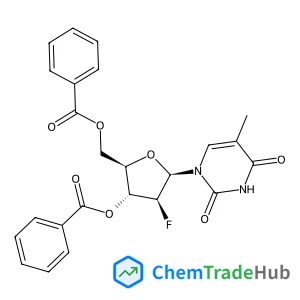
1-(3',5'-Di-O-benzoyl-2'-deoxy-2'-fluoro-b-D-arabinofuranosyl)thymine
CAS Number:
97614-47-6
Molecular Formula:
C24H21FN2O7
![5,7-Dihydroxy-3-(4-hydroxyphenyl)-6-[(1R,6R)-3-methyl-6-prop-1-en-2-ylcyclohex-2-en-1-yl]chromen-4-one structure](https://static.chemtradehub.com/structs/191/1914963-20-4-2b05.webp "5,7-Dihydroxy-3-(4-hydroxyphenyl)-6-[(1R,6R)-3-methyl-6-prop-1-en-2-ylcyclohex-2-en-1-yl]chromen-4-one structure")
5,7-Dihydroxy-3-(4-hydroxyphenyl)-6-[(1R,6R)-3-methyl-6-prop-1-en-2-ylcyclohex-2-en-1-yl]chromen-4-one
CAS Number:
1914963-20-4
Molecular Formula:
C25H24O5
Recommended Suppliers



Disclaimer
This page provides academic journal information for reference and research purposes only. We are not affiliated with any journal publishers and do not handle publication submissions. For publication-related inquiries, please contact the respective journal publishers directly.
If you notice any inaccuracies in the information displayed, please contact us at support@chemtradehub.com. We will promptly review and address your concerns.