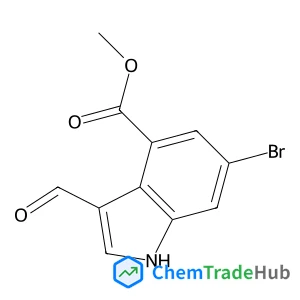
methyl 6-bromo-3-formyl-1H-indole-4-carboxylate
CAS Number:
1353636-63-1
Molecular Formula:
C11H8BrNO3
The first page of this article is displayed as the abstract.
Melepurath Deepa, Arvind Awadhia, Shweta Bhandari
DOI: 10.1039/B900091G
Shawn D. Wettig, Rubena Deubry, Javed Akbar, Tranum Kaur, Haitang Wang, Tatiana Sheinin, Jamie W. Joseph, Roderick A. Slavcev
DOI: 10.1039/B923817D
Iker del Rosal, Torsten Gutmann, Laurent Maron, Franck Jolibois, Bruno Chaudret, Bernadeta Walaszek, Hans-Heinrich Limbach, Romuald Poteau, Gerd Buntkowsky
DOI: 10.1039/B822150B
Tanja Pott, Philippe Méléard
DOI: 10.1039/B901582E
Bastian Noller, Markus Margraf, Christian Schröter, Thomas Schultz, Ingo Fischer
DOI: 10.1039/B901765H
Karina Mathisen, David G. Nicholson
DOI: 10.1039/B902491C
Haiqing Liang, Zhenyu Li, Jinlong Yang
DOI: 10.1039/B923012B
Inga Razmute-Razmė, Zenonas Kuodis, Olegas Eicher-Lorka, Gediminas Niaura
DOI: 10.1039/B921291D
Gérald Chaplais, Angélique Simon-Masseron, Claude Lecomte, Delphine Bazer-Bachi, Nicolas Bats, Joël Patarin
DOI: 10.1039/B822163D
Shabbir Muhammad, Hongliang Xu, Muhammad Ramzan Saeed Ashraf Janjua, Zhongmin Su
DOI: 10.1039/B924241D
(3.beta.)-3-Hydroxy-N,N-dimethyl-chol-5-en-24-amide (CAS: 79066-03-8) is primari...
5-(Aminomethyl)-2-methoxyphenol (CAS: 89702-89-6) is classified under GHS as a s...
Thieno[2,3-c]pyridin-7(6H)-one (CAS: 28981-13-7) is a heterocyclic organic compo...
1-[(6-Methoxy-3-pyridinyl)methyl]-4-piperidinamine dihydrochloride is generally ...
[(2E)-3-Phenyl-2-propen-1-yl]phosphonic acid (CAS: 146404-58-2) is regulated und...
6-Bromo-7-methoxyquinoline (CAS: 1620515-86-7) falls under the scope of the Glob...
This compound is primarily used in the pharmaceutical industry for the developme...
1-Ethyl-7-[2-methyl-6-(4H-1,2,4-triazol-3-yl)-3-pyridinyl]-3,5-dihydropyrazino[2...
Alternative reagents such as 2-[(dimethylamino)methyl]phenylboronic acid or rela...
3-(Piperidin-4-yloxy)pyridine (CAS: 310881-48-2) is an organic compound with the...

ChemComm publishes urgent research which is of outstanding significance and interest to experts in the field, while also appealing to the journal’s broad chemistry readership. Our communication format is ideally suited to short, urgent studies that are of such importance that they require accelerated publication. Our scope covers all topics in chemistry, and research at the interface of chemistry and other disciplines (such as materials science, nanoscience, physics, engineering and biology) where there is a significant novelty in the chemistry aspects. Major topic areas covered include: Analytical Chemistry Catalysis Chemical Biology and medicinal chemistry Computational Chemistry and Machine Learning Energy and sustainable chemistry Environmental Chemistry Green Chemistry Inorganic Chemistry Materials Chemistry Nanoscience Organic Chemistry Physical Chemistry Polymer Chemistry Supramolecular Chemistry
![N-[(6-Bromo-3-pyridinyl)methyl]ethanamine structure](https://static.chemtradehub.com/structs/120/120740-05-8-ca55.webp "N-[(6-Bromo-3-pyridinyl)methyl]ethanamine structure")
amine structure](https://static.chemtradehub.com/structs/629/62924-61-2-0728.webp "[(2-chlorophenyl)methyl](ethyl)amine structure")