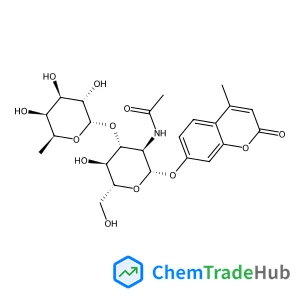
4-Methyl-2-oxo-2H-chromen-7-yl 2-acetamido-2-deoxy-3-O-(6-deoxy-alpha-L-galactopyranosyl)-beta-D-glucopyranoside
CAS Number:
383160-12-1
Molecular Formula:
C24H31NO12
Yusuf V. Kaneti, Zhengjie Zhang, Jeffrey Yue, Quadir M. D. Zakaria, Chuyang Chen, Xuchuan Jiang, Aibing Yu
The sensitivity of a metal oxide gas sensor is strongly dependent on the nature of the crystal surface exposed to the gas species. In this study, two types of zinc oxide (ZnO) nanostructures: nanoplates and nanorods with exposed (0001) and (100) crystal surfaces, respectively, were synthesized through facile solvothermal methods. The gas-sensing results show that sensitivity of the ZnO nanoplates toward ethanol is two times higher than that of the ZnO nanorods, at an optimum operating temperature of 300 °C. This could be attributed to the higher surface area and the exposed (0001) crystal surfaces. DFT (Density Functional Theory) simulations were carried out to study the adsorption of ethanol on the ZnO crystal planes such as (0001), (100), and (110) with adsorbed O− ions. The results reveal that the exposed (0001) planes of the ZnO nanoplates promote better ethanol adsorption by interacting with the surface oxygen p (O2p) orbitals and stretching the O–H bond to lower the adsorption energy, leading to the sensitivity enhancement of the nanoplates. These findings will be useful for the fabrication of metal oxide nanostructures with specifically exposed crystal surfaces for improved gas-sensing and/or catalytic performance.
DOI: 10.1039/D3TA05044K
Jun Luo, Danyang Zhang, Pengfei Tang, Nan Wang, Shuai Zhao, Lingyi Kong
DOI: 10.1039/D3NP00022B
Kaiyuan Tang, Zilu Liu, Zhijing Zhang, Shufan Duan, Hui Wang, Hui Yang, Dongliang Yang, Wenpei Fan
DOI: 10.1039/D3NH00388D
Arun Richard Chandrasekaran
DOI: 10.1039/D3NH90040A
Amit Nain, Yu-Ting Tseng, Akash Gupta, Yu-Feng Lin, Sangili Arumugam, Yu-Fen Huang
DOI: 10.1039/D3NH00275F
Isaac Holmes-Gentle, Franky E. Bedoya-Lora, Lorenzo Aimone, Sophia Haussener
DOI: 10.1039/D3TA05257E
DOI: 10.1039/D3NH00282A
Linmeng Wang, Zhiyuan Liu, Rushuo Li, Ping Yang, Wei Wang, Xiangdong Xue, Shihao Feng, Lingjing Yu, Ge Wang
DOI: 10.1039/D3TA04806C
When handling lithium chloride hydrate (1:1:1) (CAS: 16712-20-2), it is importan...
4-(4H-1,2,4-Triazol-4-yl)piperidine is generally considered safe for use in phar...
Waste containing 1,3-Thiazole-2-carboxamide (CAS: 16733-85-0) should be collecte...
5-(Difluoromethyl)-2-fluorobenzonitrile (CAS: 934175-58-3) is subject to regulat...
Methyl 3-acetamido-2-thiophenecarboxylate can be synthesized by the reaction of ...
4-Isoquinolinecarbonitrile is a chemical compound with the CAS number 34846-65-6...
Store Methyl 1H-1,2,3-triazole-4-carboxylate (CAS: 877309-59-6) in a cool, dry p...
6-Bromo[1,3]thiazolo[5,4-b]pyridin-2-amine (CAS: 1160791-13-8) is subject to the...
(2S,3S)-2-Ammonio-3-(3,4-dihydroxyphenyl)-3-hydroxypropanoate (CAS: 23651-95-8) ...
7-Bromo-3-methyl-3,4-dihydroquinazolin-4-one is a solid with a crystalline form....

Physical Chemistry Chemical Physics (PCCP) is an international journal co-owned by 19 physical chemistry and physics societies from around the world. This journal publishes original, cutting-edge research in physical chemistry, chemical physics and biophysical chemistry. To be suitable for publication in PCCP, articles must include significant innovation and/or insight into physical chemistry; this is the most important criterion that reviewers and Editors will judge against when evaluating submissions. The journal has a broad scope and welcomes contributions spanning experiment, theory, computation and data science. Topical coverage includes spectroscopy, dynamics, kinetics, statistical mechanics, thermodynamics, electrochemistry, catalysis, surface science, quantum mechanics, quantum computing and machine learning. Interdisciplinary research areas such as polymers and soft matter, materials, nanoscience, energy, surfaces/interfaces, and biophysical chemistry are welcomed if they demonstrate significant innovation and/or insight into physical chemistry. Joined experimental/theoretical studies are particularly appreciated when complementary and based on up-to-date approaches.
![8-Bromo-6-fluoro[1,2,4]triazolo[1,5-a]pyridin-2-amine structure](https://static.chemtradehub.com/structs/125/1257705-51-3-9f4a.webp "8-Bromo-6-fluoro[1,2,4]triazolo[1,5-a]pyridin-2-amine structure")