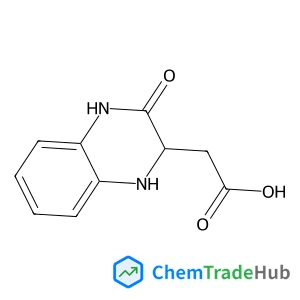
(3-Oxo-1,2,3,4-tetrahydro-2-quinoxalinyl)acetic acid
CAS Number:
136584-14-0
Molecular Formula:
C10H10N2O3
Chen Ling, Fuminori Mizuno
The Na-ion battery has recently gained a lot of interest as a low-cost alternative to the current Li-ion battery technology. Its feasibility strongly depends on the development of suitable electrode materials. In the present work we propose a novel anode candidate, boron-doped graphene, for the Na-ion battery. Our first-principles calculations demonstrate that the sodiation of boron-doped graphene well preserves its structural integrity. The 2D-BC3 anode has the average sodiation voltage of 0.44 V in an appropriate range to avoid the safety concerns caused by the formation of dendritic deposits. The capacity of the 2D-BC3 anode reaches ∼2.04 times that of the graphite anode in a Li-ion battery and ∼2.52 times that of hard carbon in a Na-ion battery. The high electronic mobility and Na mobility on boron-doped graphene indicates that it has a high potential to reach good rate performance. These suggest the promising potential of boron-doped graphene to serve as an anode for a rechargeable Na-ion battery.

Advanced Engineering Materials

Green Chemistry

Physical Chemistry Chemical Physics

Journal of Enzyme inhibition and Medicinal Chemistry

Environmental Toxicology and Pharmacology

Photochemical & Photobiological Sciences

Mini-Reviews in Medicinal Chemistry

Faraday Discussions

Nature Reviews Drug Discovery

Journal of Medical Biochemistry
Antony Cyril Arulrajan, Christophe Renault, Stanley C. S. Lai
DOI: 10.1039/C8CP01835A
Radhika L. Moore, Jason P. Mann, Alejandro Montoya, Brian S. Haynes
DOI: 10.1039/C7CP07754H
Yongfang Li, Dunyou Wang
DOI: 10.1039/C8CP01201F
Mantas Šimėnas, Aneta Ciupa, Gediminas Usevičius, Kęstutis Aidas, Daniel Klose, Gunnar Jeschke, Mirosław Mączka, Georg Völkel, Andreas Pöppl, Jūras Banys
DOI: 10.1039/C8CP01426D
Lesheng Li, Yosuke Kanai
DOI: 10.1039/C7CP07247C
N. C. Michenfelder, H. A. Ernst, C. Schweigert, M. Olzmann, A.-N. Unterreiner
DOI: 10.1039/C7CP07774B
DOI: 10.1039/C8CP01029C
Andrei S. Batsanov, Andrew P. Monkman, Martin R. Bryce
DOI: 10.1039/C8CP01636D
Morten Lund Rasmussen, Hamid Hashemi, Hao Wu, Peter Glarborg, Matteo Pelucchi, Tiziano Faravelli, Paul Marshall
DOI: 10.1039/C7CP07552A
Yanchen Han, Shengjie Ling, Zeming Qi, Zhengzhong Shao, Xin Chen
DOI: 10.1039/C8CP00802G
This compound is mainly used as an intermediate in the synthesis of antipsychoti...
Waste containing 1-(D-Ribofuranosyl)-1,4-dihydro-3-pyridinecarboxamide (CAS: 191...
2-Methyl-2-propanyl 3-bromo-3-(hydroxymethyl)-1-azetidinecarboxylate (CAS: 20079...
N-(4-Chloro-2-pyridinyl)acetamide (CAS: 245056-66-0) is a chemical compound with...
5-Chloro-2-hydroxybenzoic acid, also known as 5-chlorosalicylic acid, is an arom...
When handling 1,1-Dichloro-1-fluoroethane (CAS: 1717-00-6), it is important to u...
Fmoc-(2S,3R)-3-phenylpyrrolidine-2-carboxylic acid is a white crystalline solid ...
4-Amino-5-bromo-2-pyridinecarboxylic acid is primarily used as a precursor in th...
Handling this compound should be done with personal protective equipment (PPE) i...
When handling 8-bromo-2,2-dimethyl-3,4-dihydro-2H-1,4-benzoxazin-3-one, use prop...
Physical Chemistry Chemical Physics (PCCP) is an international journal co-owned by 19 physical chemistry and physics societies from around the world. This journal publishes original, cutting-edge research in physical chemistry, chemical physics and biophysical chemistry. To be suitable for publication in PCCP, articles must include significant innovation and/or insight into physical chemistry; this is the most important criterion that reviewers and Editors will judge against when evaluating submissions. The journal has a broad scope and welcomes contributions spanning experiment, theory, computation and data science. Topical coverage includes spectroscopy, dynamics, kinetics, statistical mechanics, thermodynamics, electrochemistry, catalysis, surface science, quantum mechanics, quantum computing and machine learning. Interdisciplinary research areas such as polymers and soft matter, materials, nanoscience, energy, surfaces/interfaces, and biophysical chemistry are welcomed if they demonstrate significant innovation and/or insight into physical chemistry. Joined experimental/theoretical studies are particularly appreciated when complementary and based on up-to-date approaches.
![5-Methyl-4,5,6,7-tetrahydropyrazolo[1,5-a]pyrazin-2-amine structure](https://static.chemtradehub.com/structs/122/1227210-33-4-8d64.webp "5-Methyl-4,5,6,7-tetrahydropyrazolo[1,5-a]pyrazin-2-amine structure")
![2,6-Bis({(2R)-2-[hydroxy(diphenyl)methyl]-1-pyrrolidinyl}methyl)-4-methylphenol structure](https://static.chemtradehub.com/structs/877/877395-58-9-70bf.webp "2,6-Bis({(2R)-2-[hydroxy(diphenyl)methyl]-1-pyrrolidinyl}methyl)-4-methylphenol structure")