












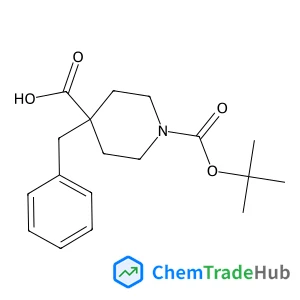
4-Benzyl-1-(tert-butoxycarbonyl)piperidine-4-carboxylic acid
CAS Number:
170838-87-6
Molecular Formula:
C18H25NO4
Yongfang Li, Dunyou Wang
Recent studies have improved our understanding of the mechanism and dynamics of the bimolecular nucleophilic substitution (SN2) reaction at the carbon center. Nonetheless, the SN2 reaction at the nitrogen center has received scarce attention and is less understood. Herein, we propose a new reaction mechanism for the SN2 reaction at the nitrogen center in the F− + NH2Cl reaction using ab initio molecular dynamics calculations. The newly proposed mechanism involves the rotation of NHCl with one proton of NH2Cl abstracted by the nucleophile, followed by the classical backside-attack process. The double-inversion mechanism revealed recently for the SN2 reaction at the carbon center is also observed for the title reaction at the nitrogen center. In contrast to the F− + CH3Cl reaction with a proton abstraction-induced first inversion transition state, the F− + NH2Cl reaction is a hydrogen bond-induced inversion. This newly proposed reaction mechanism opens a reaction channel to avoid the proton abstraction mechanism at low collision energy. The double-inversion mechanism of the title reaction with a negative first-inversion transition relative to the energy of the reactants is expected to have larger contribution to the reaction rate than the F− + CH3Cl reaction with a positive first-inversion transition state.
Padmalochan Panda, R. Ramaseshan, Madhusmita Sahoo, Nanda Gopala Krishna, A. K. Yadav, S. N. Jha, D. Bhattacharyya
DOI: 10.1039/C8CP01686K
Daiki Asakawa, Hidenori Takahashi, Shinichi Iwamoto, Koichi Tanaka
DOI: 10.1039/C8CP00733K
Xiaojiao Zhang, Yang Liu, Wenchuan Lai, Zaoming Wang, Wang Xu, Xiangyang Liu
DOI: 10.1039/C8CP00642C
Joseph Czekner, Craig A. Taatjes, David L. Osborn, Giovanni Meloni
DOI: 10.1039/C7CP08221E
H. Tarábková, Z. Zelinger, P. Janda
DOI: 10.1039/C7CP08018B
Li Shen, Xuemin Wang, Heyuan Liu, Xiyou Li
DOI: 10.1039/C7CP08313K
B. Molina, J. R. Soto, J. J. Castro
DOI: 10.1039/C8CP00494C
Xuduo Bai
DOI: 10.1039/C7CP07887K
This compound is mainly used as an intermediate in the synthesis of antipsychoti...
Waste containing 1-(D-Ribofuranosyl)-1,4-dihydro-3-pyridinecarboxamide (CAS: 191...
2-Methyl-2-propanyl 3-bromo-3-(hydroxymethyl)-1-azetidinecarboxylate (CAS: 20079...
N-(4-Chloro-2-pyridinyl)acetamide (CAS: 245056-66-0) is a chemical compound with...
5-Chloro-2-hydroxybenzoic acid, also known as 5-chlorosalicylic acid, is an arom...
When handling 1,1-Dichloro-1-fluoroethane (CAS: 1717-00-6), it is important to u...
Fmoc-(2S,3R)-3-phenylpyrrolidine-2-carboxylic acid is a white crystalline solid ...
4-Amino-5-bromo-2-pyridinecarboxylic acid is primarily used as a precursor in th...
Handling this compound should be done with personal protective equipment (PPE) i...
When handling 8-bromo-2,2-dimethyl-3,4-dihydro-2H-1,4-benzoxazin-3-one, use prop...

Physical Chemistry Chemical Physics (PCCP) is an international journal co-owned by 19 physical chemistry and physics societies from around the world. This journal publishes original, cutting-edge research in physical chemistry, chemical physics and biophysical chemistry. To be suitable for publication in PCCP, articles must include significant innovation and/or insight into physical chemistry; this is the most important criterion that reviewers and Editors will judge against when evaluating submissions. The journal has a broad scope and welcomes contributions spanning experiment, theory, computation and data science. Topical coverage includes spectroscopy, dynamics, kinetics, statistical mechanics, thermodynamics, electrochemistry, catalysis, surface science, quantum mechanics, quantum computing and machine learning. Interdisciplinary research areas such as polymers and soft matter, materials, nanoscience, energy, surfaces/interfaces, and biophysical chemistry are welcomed if they demonstrate significant innovation and/or insight into physical chemistry. Joined experimental/theoretical studies are particularly appreciated when complementary and based on up-to-date approaches.
![6-Benzyl-4,5,6,7-tetrahydro-1H-pyrazolo[3,4-c]pyridin-3(2H)-one structure](https://static.chemtradehub.com/structs/909/909187-64-0-f54f.webp "6-Benzyl-4,5,6,7-tetrahydro-1H-pyrazolo[3,4-c]pyridin-3(2H)-one structure")
![2,6-Di(thiophen-2-yl)dithieno[3,2-b:2',3'-d]thiophene structure](https://static.chemtradehub.com/structs/910/910788-24-8-5b70.webp "2,6-Di(thiophen-2-yl)dithieno[3,2-b:2',3'-d]thiophene structure")

![tert-Butyl N-[(2-chloropyridin-4-yl)methyl]carbamate structure](https://static.chemtradehub.com/structs/916/916210-27-0-9f95.webp "tert-Butyl N-[(2-chloropyridin-4-yl)methyl]carbamate structure")



