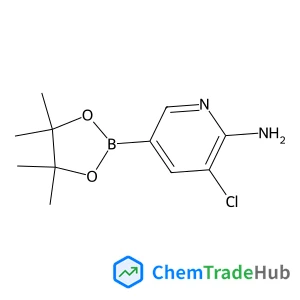
3-Chloro-5-(4,4,5,5-tetramethyl-1,3,2-dioxaborolan-2-yl)-2-pyridinamine
CAS Number:
1032758-99-8
Molecular Formula:
C11H16BClN2O2
Ashok Kumar Baral, Sumaletha Narayanan, Farshid Ramezanipour, Venkataraman Thangadurai
The fundamental electrical transport properties including ionic conductivity, dielectric constants, loss tangent, and relaxation time constants of Li-excess garnet-type cubic (space group Iad) Li5+2xLa3Ta2−xYxO12 (x = 0.25, 0.5 and 0.75) have been studied in the temperature range of −50 to 50 °C using electrochemical AC impedance spectroscopy. A correlation has been established between the excess Li content and the Li+ ion migration pathways. The loss tangent (tan δ) for all samples exhibits a relaxation peak corresponding to the dielectric loss because of dipolar rotations due to Li+ migration. Comparing the modulus analysis of Li-excess garnets with fluorite-type oxygen ion conductors, we propose the local migration of Li+ ions between octahedral sites around the “immobile” Li+ ions in tetrahedral (24d) sites. In the samples with x = 0.25 and 0.5, Li+ ions seem to jump from one octahedral (96h) site to another bypassing the tetrahedral (24d) site between them (path A), both in local and long-range order migration processes, with activation energies of ∼0.69 and 0.54 eV, respectively. For the x = 0.75 member, Li+ ions exhibit mainly long-range order migration, with an activation energy of 0.34 eV, where the Li hopping between two octahedral sites occurs through the edge which is shared between the two LiO6 octahedra and a LiO4 tetrahedron (path B). The present AC impedance analysis is consistent with the ab initio theoretical analysis of Li-excess garnets that showed two conduction paths (A and B) for Li ion conduction with different activation energies.
J. Samuel Arey
DOI: 10.1039/D0CP00582G
Stéphane Pasquiers, Nicole Blin-Simiand, Lionel Magne, Nguyen-Thi Van-Oanh, Sébastien Thomas
DOI: 10.1039/C9CP06958E
Mahendra Bhujel, David L. Marshall, Alan T. Maccarone, Benjamin I. McKinnon, Adam J. Trevitt, Gabriel da Silva, Stephen J. Blanksby, Berwyck L. J. Poad
DOI: 10.1039/D0CP01498B
Nagaprasad Reddy Samala, Ilya Grinberg
DOI: 10.1039/D0CP04478D
Eugenii Ya. Misochko, Alexander V. Akimov, Denis V. Korchagin, Yulia S. Ganushevich, Egor A. Melnikov, Vasili A. Miluykov
DOI: 10.1039/D0CP05254J
Tiantian Zhang, Longjiu Cheng, Jianguo Zhang, Kun Wang
DOI: 10.1039/D0CP00050G
Le Li, Xuhua Li, Yiming Tang, Zenghui Lao, Jiangtao Lei, Guanghong Wei
DOI: 10.1039/C9CP06671C
Angelo Giussani, Mercedes Rubio, Daniel Roca-Sanjuán
DOI: 10.1039/D0CP04571C
Mengjian Wu, Zhaoxia Wu, Shangwu Ding, Zhong Chen, Xiaohong Cui
DOI: 10.1039/D0CP00429D
This compound is mainly used as an intermediate in the synthesis of antipsychoti...
Waste containing 1-(D-Ribofuranosyl)-1,4-dihydro-3-pyridinecarboxamide (CAS: 191...
2-Methyl-2-propanyl 3-bromo-3-(hydroxymethyl)-1-azetidinecarboxylate (CAS: 20079...
N-(4-Chloro-2-pyridinyl)acetamide (CAS: 245056-66-0) is a chemical compound with...
5-Chloro-2-hydroxybenzoic acid, also known as 5-chlorosalicylic acid, is an arom...
When handling 1,1-Dichloro-1-fluoroethane (CAS: 1717-00-6), it is important to u...
Fmoc-(2S,3R)-3-phenylpyrrolidine-2-carboxylic acid is a white crystalline solid ...
4-Amino-5-bromo-2-pyridinecarboxylic acid is primarily used as a precursor in th...
Handling this compound should be done with personal protective equipment (PPE) i...
When handling 8-bromo-2,2-dimethyl-3,4-dihydro-2H-1,4-benzoxazin-3-one, use prop...

Physical Chemistry Chemical Physics (PCCP) is an international journal co-owned by 19 physical chemistry and physics societies from around the world. This journal publishes original, cutting-edge research in physical chemistry, chemical physics and biophysical chemistry. To be suitable for publication in PCCP, articles must include significant innovation and/or insight into physical chemistry; this is the most important criterion that reviewers and Editors will judge against when evaluating submissions. The journal has a broad scope and welcomes contributions spanning experiment, theory, computation and data science. Topical coverage includes spectroscopy, dynamics, kinetics, statistical mechanics, thermodynamics, electrochemistry, catalysis, surface science, quantum mechanics, quantum computing and machine learning. Interdisciplinary research areas such as polymers and soft matter, materials, nanoscience, energy, surfaces/interfaces, and biophysical chemistry are welcomed if they demonstrate significant innovation and/or insight into physical chemistry. Joined experimental/theoretical studies are particularly appreciated when complementary and based on up-to-date approaches.
![2,6-Di(thiophen-2-yl)dithieno[3,2-b:2',3'-d]thiophene structure](https://static.chemtradehub.com/structs/910/910788-24-8-5b70.webp "2,6-Di(thiophen-2-yl)dithieno[3,2-b:2',3'-d]thiophene structure")