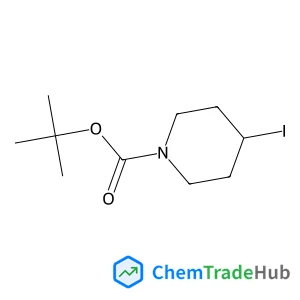
2-Methyl-2-propanyl 4-iodo-1-piperidinecarboxylate
CAS Number:
301673-14-3
Molecular Formula:
C10H18INO2
Jun Hyuk Heo, Hui Hun Cho
We report the development of surfactant free-gold nanoparticle (AuNP)–DNA complexes that remained stable in solutions with extremely high ionic strength, using seawater as a model solution. Although the stability of AuNPs can be increased to a certain degree by functionalizing negatively charged DNA strands on their surfaces, they still have limited stability in highly concentrated salt solutions. However, we found that AuNPs functionalized with poly-T bases have exceptional stability in high ionic strength solutions. For example, AuNPs functionalized with a 5T spacer remained highly stable in seawater, with no color change and no red-shift in absorbance spectra for up to 9 days. Using this surprising property of poly-T spacers, we prepared highly stable AuNP–DNA complexes containing random sequences by introducing 5T spacers on the random sequenced DNA strand. The random sequenced AuNP–DNA complexes remained stable in seawater, several molar concentrations of monovalent metal ion solutions (6.1 M Na+ or 4.8 M K+), and millimolar concentrations of diverse divalent metal ions. In addition, the highly stable AuNP–DNA complex maintained biological activity in seawater, which was demonstrated by complementary reaction and aptamer based biosensing. These results provide important insight into NP use for various applications under harsh biological and environmental conditions.
Aimo Rautiainen, Marina Lindblad, Leif B. Backman, Riikka L. Puurunen
DOI: 10.1039/B201168A
Helena C. Junqueira, Divinomar Severino, Luis G. Dias, Marcos S. Gugliotti, Mauricio S. Baptista
DOI: 10.1039/B109753A
Nicole Borho, Martin A. Suhm
DOI: 10.1039/B111123J
Wolfgang E. S. Unger, Erhard Kemnitz, Sven L. M. Schroeder
DOI: 10.1039/B110792E
J. H. Merkin
DOI: 10.1039/B110364B
O. Diwald, M. Sterrer, E. Knözinger
DOI: 10.1039/B110334B
Geoffrey S. Tyndall, John J. Orlando, Timothy J. Wallington, Michael D. Hurley, Masashi Goto, Masahiro Kawasaki
DOI: 10.1039/B111195G
B. Luerßen, J. Janek, S. Günther, M. Kiskinova, R. Imbihl
DOI: 10.1039/B109893D
DOI: 10.1039/B204334N
Vesna Najdanovic-Visak, José M. S. S. Esperança, Luís P. N. Rebelo, Manuel Nunes da Ponte, Henrique J. R. Guedes, Kenneth R. Seddon, Jerzy Szydlowski
DOI: 10.1039/B201723G
Waste containing (6-Bromo-2-naphthyl)oxy](dimethyl)(2-methyl-2-propanyl)silane (...
7-Fluoro-4-isoquinolinecarboxylic acid can be synthesized via a multi-step proce...
2,3,5,6-Tetrabromothieno[3,2-b]thiophene is a crystalline compound with a high m...
1-[4-(Benzylamino)-7,8-dihydro-5H-pyrano[4,3-d]pyrimidin-2-yl]-2-methyl-1H-indol...
The market for imidazo[5,1-d]-1,2,3,5-tetrazine-8-carboxylic acid, 3,4-dihydro-3...
3-(Triisopropylsilyl)propiolaldehyde is a synthetic organic compound with the CA...
6-Nitro-2H-1,4-benzoxazin-3(4H)-one (CAS: 81721-87-1) is subject to various regu...
Waste containing (3-Fluorophenyl)(4-{[(2-methyl-2-propanyl)oxy]carbonyl}-1-piper...
N,N'-4,4'-Biphenyldiyldiisonicotinamide is a white crystalline solid with a mole...
6-Bromo-8-fluoro-2-quinazolinol is primarily used in the pharmaceutical industry...

Analyst publishes analytical and bioanalytical research that reports premier fundamental discoveries and inventions, and the applications of those discoveries, unconfined by traditional discipline barriers.
![5-Bromoimidazo[1,2-a]pyridine structure](https://static.chemtradehub.com/structs/692/69214-09-1-d8e2.webp "5-Bromoimidazo[1,2-a]pyridine structure")