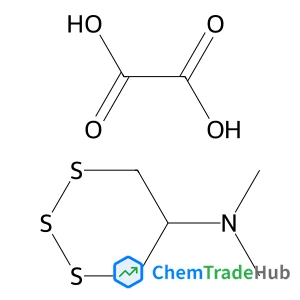
Oxalic acid compound with cyclohexylsulfamothioic O-acid (11)
CAS Number:
31895-22-4
Molecular Formula:
C7H13NO4S3
Insup Jung, Ho Bin Seo, Ji-eun Lee, Byoung Chan Kim, Man Bock Gu
The use of genetically engineered bioluminescent bacteria, in which bioluminescence is induced by different modes of toxic action, represents an alternative to acute toxicity tests using living aquatic organisms (plants, vertebrates, or invertebrates) in an aqueous environment. A number of these bacterial strains have been developed, but there have been no attempts to develop a hand-held type of biosensor for monitoring or identification of toxicity. We report a facile dip-stick type biosensor using genetically engineered bioluminescent bacteria as a new platform for classification and identification of toxicity in water environments. This dip-stick type biosensor is composed of eight different optically color-coded functional alginate beads that each encapsulates a different bioluminescent bacterial strain and its corresponding fluorescent microbead. These color-coded microbeads exhibit easy identification of encapsulated microbeads, since each microbead has a different color code depending on the bioluminescent bacterial strain contained and improved cell-stability compared to liquid culture. This dip-stick type biosensor can discriminate different modes of toxic actions (i.e. DNA damage, oxidative damage, cell-membrane damage, or protein damage) of sample water tested by simply dipping the stick into the water samples. It was found that each color-coded microbead emitted distinct bioluminescence, and each dip-stick type biosensor showed different bioluminescence patterns within 2 hours, depending on the toxic chemicals contained in LB medium, tap water, or river water samples. This dip-stick type biosensor can, therefore, be widely and practically used in checking toxicity of water in the environment primarily in situ, possibly indicating the status of biodiversity.
J. H. Merkin
DOI: 10.1039/B110364B
Wolfgang Ranke, Yvonne Joseph
DOI: 10.1039/B200363E
Vesna Najdanovic-Visak, José M. S. S. Esperança, Luís P. N. Rebelo, Manuel Nunes da Ponte, Henrique J. R. Guedes, Kenneth R. Seddon, Jerzy Szydlowski
DOI: 10.1039/B201723G
G. Margaritondo, D. Talley, J. S. Sanghera, I. D. Aggarwal, N. H. Tolk
DOI: 10.1039/B109279K
J. D. Barr, A. J. Bell, D. O. Konn, J. Murrell, C. M. Timperley, M. J. Waters, P. Watts
DOI: 10.1039/B111192M
DOI: 10.1039/B110787A
B. Luerßen, J. Janek, S. Günther, M. Kiskinova, R. Imbihl
DOI: 10.1039/B109893D
Vincenza Crupi, A. Josè Dianoux, Domenico Majolino, Placido Migliardo, Valentina Venuti
DOI: 10.1039/B200115M
Aimo Rautiainen, Marina Lindblad, Leif B. Backman, Riikka L. Puurunen
DOI: 10.1039/B201168A
Waste containing (6-Bromo-2-naphthyl)oxy](dimethyl)(2-methyl-2-propanyl)silane (...
7-Fluoro-4-isoquinolinecarboxylic acid can be synthesized via a multi-step proce...
2,3,5,6-Tetrabromothieno[3,2-b]thiophene is a crystalline compound with a high m...
1-[4-(Benzylamino)-7,8-dihydro-5H-pyrano[4,3-d]pyrimidin-2-yl]-2-methyl-1H-indol...
The market for imidazo[5,1-d]-1,2,3,5-tetrazine-8-carboxylic acid, 3,4-dihydro-3...
3-(Triisopropylsilyl)propiolaldehyde is a synthetic organic compound with the CA...
6-Nitro-2H-1,4-benzoxazin-3(4H)-one (CAS: 81721-87-1) is subject to various regu...
Waste containing (3-Fluorophenyl)(4-{[(2-methyl-2-propanyl)oxy]carbonyl}-1-piper...
N,N'-4,4'-Biphenyldiyldiisonicotinamide is a white crystalline solid with a mole...
6-Bromo-8-fluoro-2-quinazolinol is primarily used in the pharmaceutical industry...

Analyst publishes analytical and bioanalytical research that reports premier fundamental discoveries and inventions, and the applications of those discoveries, unconfined by traditional discipline barriers.