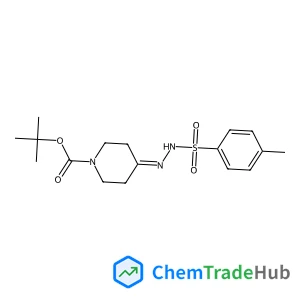
tert-Butyl 4-(2-(p-Tolylsulfonyl)hydrazono)piperidine-1-carboxylate
CAS Number:
1046478-89-0
Molecular Formula:
C17H25N3O4S
Daniel Bauer, Beatrice Andrae, Patrick Gaß, Danjano Trenz, Sabine Becker, Stefan Kubik
Synthetic strategies are described to prepare acyclic cucurbituril derivatives with two different types of appended functional groups, one that mediates water solubility and another one that allows further functionalisation. The syntheses started with the coupling of a 1,4-disubstituted naphthalene derivative containing one 2-chloroethoxy and one 3-sulfonatopropoxy group to a suitable tetrameric glycoluril-derived precursor. This reaction afforded two regioisomers, differing in the relative orientation of the peripheral substituents, which could be separated in a straightforward fashion and structurally characterised. Both isomers were then converted into the corresponding diazides and diamines that served to append further residues by, respectively, copper(I)-catalysed azide–alkyne cycloaddition or amide formation. Binding studies showed that the functionalised dianionic acyclic cucurbiturils thus obtained possess a notable cation affinity in water, albeit a lower one than an analogue with four peripheral negatively charged substituents. This work constitutes the basis for the development of water-soluble acyclic cucurbiturils whose applications could potentially go beyond the use as receptors.
Myriam Pire, Cédric Lorthioir, Evdokia K. Oikonomou, Sophie Norvez, Ilias Iliopoulos, Benoît Le Rossignol, Ludwik Leibler
DOI: 10.1039/C2PY00591C
Fei Cheng, Edward M. Bonder, Ami Doshi, Frieder Jäkle
DOI: 10.1039/C2PY00556E
Meysam Rahmat, Hossein Ghiasi, Pascal Hubert
DOI: 10.1039/C2PY00532H
Wei-Hsun Hu, Kai-Wei Huang, Shiao-Wei Kuo
DOI: 10.1039/C2PY20090B
Christophe Detrembleur, Yasmine Piette, Marie Hurtgen, Christine Jérôme, Jacques Lalevée, Antoine Debuigne
DOI: 10.1039/C1PY00443C
Hongkun Li, Jian Wang, Jing Zhi Sun, Rongrong Hu, Anjun Qin
DOI: 10.1039/C2PY00586G
When considering alternatives to 1-(4-Chlorophenyl)-N-hydroxymethanimine (CAS: 3...
This compound should be stored in a cool, dry place away from direct sunlight. I...
3-(4-Bromophenyl)-5-(2-fluorophenyl)-1,2,4-oxadiazole is synthesized through a m...
5-Chloro-2-(4-chlorophenyl)-4-methyl-6-[3-(1-piperidinyl)propoxy]pyrimidine (CAS...
2-Chloro-4-(difluoromethoxy)pyridine is used in the pharmaceutical industry for ...
3-Chloro-6-methylpyridazine (CAS: 1121-79-5) is classified under the Globally Ha...
Several alternatives can be used in the synthesis of Methyl 4,5-dimethyl-2-nitro...
Alternatives to (2E,2'E)-3,3'-(1,4-Phenylene)bisacrylaldehyde include other acry...
3-Amino-5-chloropyridin-2-ol hydrochloride is an organic compound with the CAS n...
When handling 6,7-Difluoro-2,3-dihydro-4H-chromen-4-one, it is essential to wear...

Organic Chemistry Frontiers publishes high-quality research from across organic chemistry. Emphases are placed on studies that make significant contributions to the field of organic chemistry by reporting either new or significantly improved protocols or methodologies. Topics include, but are not limited to the following: Organic synthesis Development of synthetic methodologies Catalysis Natural products Functional organic materials Supramolecular and macromolecular chemistry Physical and computational organic chemistry
![2-{[(1R,2S)-2-Aminocyclohexyl]amino}-4-{[3-(2H-1,2,3-triazol-2-yl)phenyl]amino}-5-pyrimidinecarboxamide structure](https://static.chemtradehub.com/structs/137/1370261-96-3-40df.webp "2-{[(1R,2S)-2-Aminocyclohexyl]amino}-4-{[3-(2H-1,2,3-triazol-2-yl)phenyl]amino}-5-pyrimidinecarboxamide structure")