












Practical polymerization of functionalized lactones and carbonates with Sn(OTf)2 in metal catalysed ring-opening polymerization methods
Literature Information
Publication Date
2013-02-11
DOI
10.1039/C3PY21119C
Impact Factor
5.582
Authors
David M. Stevens, Harry A. Watson, Marc-Andre LeBlanc, Ray Y. Wang, Joanne Chou, Westley S. Bauer, Eva Harth
View Original
Abstract
We report the synthesis of functionalized polycarbonates and polyesters employing stannous(II) trifluoromethane sulfonate [Sn(OTf)2] in homo and copolymerizations with monomers of the valerolactone family such as valerolactone and α-allyl-valerolactone using ring-opening polymerization (ROP) techniques and 5-methyl-5-allyloxycarbonyl-1,3-dioxane-2-one (MAC) and 5-methyl-5-ethyloxycarbonyl-1,3-dioxane-2-one (MEC). Practical reaction and work up conditions were established which circumvented the typically high polydispersities associated with Sn catalysts. Monomer concentration was found to be critical to incorporate challenging monomers such as α-allyl-valerolactone in the desired monomer ratios. Moreover, carbonate polymerizations were well controlled and facilitated products with narrow polydispersities. Bulk conditions for the polycarbonate polymerization were found to be preferential compared to traditional solution conditions. Additionally, the incorporation of α-allyl-valerolactone into polyester copolymers varied with monomer concentration, and highest incorporation was achieved using more dilute conditions.
Related Literature
Reactions of acrolein, crotonaldehyde and pivalaldehyde with Cl atoms: structure–activity relationship and comparison with OH and NO3 reactions
Maria Ullerstam, Evert Ljungström, Sarka Langer
2001-02-27
Paper
DOI: 10.1039/B007244N
Pd and Ag dimers and tetramers adsorbed at the MgO(001) surface: a density functional study
Paper
DOI: 10.1039/A904813H
ATR-IR spectroscopic studies of the formation of sulfuric acid and sulfuric acid monohydrate films
Paper
DOI: 10.1039/A904544I
A kinetic study of catalytic methanol decomposition over nickel supported on silica
Yasuyuki Matsumura, Naoki Tode
2001-03-13
Paper
DOI: 10.1039/B008854O
Rate constants for H and OH attack on propanone, butanone and pentan-3-one at 753 K, and the oxidation chemistry of the radicals formed
R. S. Tranter, R. W. Walker
2001-03-13
Paper
DOI: 10.1039/B009378P
Gas and liquid phase sorption studies of lindane on NaY and MCM-41 molecular sieves
Paper
DOI: 10.1039/A905033G
Flow-driven instabilities in the Belousov–Zhabotinsky reaction: Modelling and experiments
R. Tóth, A. Papp, V. Gáspár, J. H. Merkin, S. K. Scott, A. F. Taylor
2001-02-26
Paper
DOI: 10.1039/B009379N
You might also like
Compound Q&A
What are the main uses of 4-Nitrophenyl phosphate disodium salt hexahydrate (CAS: 333338-18-4)?
4-Nitrophenyl phosphate disodium salt hexahydrate is primarily used as a substra...
333338-18-44-Nitrophenyl phosph...
Compound Q&A
What are the main uses of 2-(Trifluoromethyl)-1,3-oxazole-4-carboxylic Acid (CAS: 1060816-01-4)?
2-(Trifluoromethyl)-1,3-oxazole-4-carboxylic Acid (CAS: 1060816-01-4) is widely ...
1060816-01-42-(Trifluoromethyl)-...
Compound Q&A
How should 2-Fluoro-4-biphenylcarboxylic acid (CAS: 137045-30-8) be stored?
2-Fluoro-4-biphenylcarboxylic acid should be stored in a cool, dry place at room...
137045-30-82-Fluoro-4-biphenylc...
Compound Q&A
What industries use Prednisolone-21-Carboxylic Acid (CAS: 61549-70-0)?
Prednisolone-21-Carboxylic Acid is primarily used in the pharmaceutical industry...
61549-70-0Prednisolone-21-Carb...
Compound Q&A
How should 4-(Hydrazinomethyl)-1,2,3-benzenetriol (CAS: 3614-72-0) be stored?
4-(Hydrazinomethyl)-1,2,3-benzenetriol (CAS: 3614-72-0) should be stored in a co...
3614-72-04-(Hydrazinomethyl)-...
Compound Q&A
What industries use 4-Amino-1-methyl-1H-pyrazole-5-carboxylic acid hydrochloride (CAS: 92534-70-8)?
4-Amino-1-methyl-1H-pyrazole-5-carboxylic acid hydrochloride (CAS: 92534-70-8) i...
92534-70-84-Amino-1-methyl-1H-...
Compound Q&A
What regulatory guidelines apply to dehydropachymic acid (CAS: 77012-31-8)?
Dehydropachymic acid (CAS: 77012-31-8) is regulated by various agencies. It fall...
77012-31-8Dehydropachymic acid
Compound Q&A
What is the market or research trend for 6-[(2,2-Dimethylpropanoyl)amino]nicotinic acid (CAS: 898561-66-5)?
The market and research trends for 6-[(2,2-Dimethylpropanoyl)amino]nicotinic aci...
898561-66-56-[(2,2-Dimethylprop...
Compound Q&A
How should 1,10-Phenanthroline-2,9-dicarbaldehyde (CAS: 57709-62-3) be stored?
1,10-Phenanthroline-2,9-dicarbaldehyde should be stored in a cool, dry place awa...
57709-62-31,10-Phenanthroline-...
Compound Q&A
How is 5-Carbamoyl-11-oxo-10,11-dihydro-5H-dibenzo[b,f]azepin-10-yl acetate (CAS: 113952-21-9) typically synthesized?
5-Carbamoyl-11-oxo-10,11-dihydro-5H-dibenzo[b,f]azepin-10-yl acetate can be synt...
113952-21-95-Carbamoyl-11-oxo-1...
Source Journal
Polymer Chemistry

CiteScore:
8.6
Self-citation Rate:
7.3%
Articles per Year:
457
Polymer Chemistry welcomes submissions in all areas of polymer science that have a strong focus on macromolecular chemistry. Manuscripts may cover a broad range of fields, yet no direct application focus is required.
Recommended Compounds
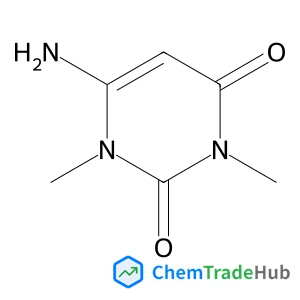
6-amino-1,3-dimethyl-1,2,3,4-tetrahydropyrimidine-2,4-dione
CAS Number:
6642-31-5
Molecular Formula:
C6H9N3O2
Recommended Suppliers





Disclaimer
This page provides academic journal information for reference and research purposes only. We are not affiliated with any journal publishers and do not handle publication submissions. For publication-related inquiries, please contact the respective journal publishers directly.
If you notice any inaccuracies in the information displayed, please contact us at support@chemtradehub.com. We will promptly review and address your concerns.