












pH-responsive high internal phase emulsions stabilized by core cross-linked star (CCS) polymers
Literature Information
Publication Date
2013-06-04
DOI
10.1039/C3PY00488K
Impact Factor
5.582
Authors
Qijing Chen, Xueteng Cao, Hao Liu, Wei Zhou, Lianjie Qin, Zesheng An
View Original
Abstract
Well-defined core cross-linked star (CCS) polymers of poly(N,N-dimethylaminoethyl methacrylate) (PDMAEMA) were prepared via cross-linking copolymerization in an aqueous-based dispersion polymerization system, mediated by reversible addition–fragmentation chain transfer (RAFT) polymerization. The synthesized CCS polymers were characterized by nuclear magnetic resonance (NMR) spectroscopy, gel permeation chromatography (GPC), dynamic light scattering (DLS), and conductivity and zeta potential measurements. The use of PDMAEMA CCS polymers as effective emulsifiers for oil-in-water emulsions was investigated. Interfacial tension measurements showed that the CCS polymer reduced the interfacial tension between water and oil in a pH-dependent manner. Gelled high internal phase emulsions (HIPEs) were formed at high oil fractions (80–89 vol%) and over a wide range of pH values (2–12). The HIPEs were characterized by conductivity, confocal laser scanning microscopy (CLSM) and rheology. The emulsion properties in terms of oil droplet size, long-term stability and rheology were pH-dependent. Complete demulsification of HIPEs was easily realized 2 min after the addition of base. The CCS-stabilized HIPEs were used as templates to prepare porous hydrophilic polymers by polymerizing the monomers in the continuous aqueous phase. The study presented herein reveals that responsive CCS polymers can be used as effective stabilizers for the formation of responsive HIPEs, which have a wide range of applications.
Related Literature
Quantification of surface species present on a nickel/alumina methane reformingcatalyst
Ian P. Silverwood, Neil G. Hamilton, Christian J. Laycock, John Z. Staniforth, R. Mark Ormerod, Christopher D. Frost, Stewart F. Parker, David Lennon
2010-02-24
Communication
DOI: 10.1039/B919977B
Experimental and theoretical characterization of molecular complexes formed between OCS and XY molecules (X, Y = F, Cl and Br) and their role in photochemical matrix reactions
A. Lorena Picone, Helge Willner, Anthony J. Downs, Rosana M. Romano
2009-11-12
Paper
DOI: 10.1039/B914862K
One-step covalent microcontact printing approach to produce patterns of lactate oxidase
E. Casero, M. D. Petit-Domínguez, A. M. Parra-Alfambra, M. J. Gismera, F. Pariente, E. Lorenzo, L. Vázquez
2010-01-27
Paper
DOI: 10.1039/B922805E
Kinetics of bulk polymerisation and Gompertz's law
Michael Schmitt, Rainer Schulze-Pillot, Rolf Hempelmann
2010-10-29
Paper
DOI: 10.1039/C0CP00447B
Electronic state spectroscopy of methyl formate probed by high resolution VUV photoabsorption, He(i)photoelectron spectroscopy and ab initio calculations
Y. Nunes, G. Martins, N. J. Mason, D. Duflot, S. V. Hoffmann, J. Delwiche, M.-J. Hubin-Franskin
2010-08-19
Paper
DOI: 10.1039/C0CP00051E
Solving the spectroscopic phase: imaging excited wave packets and extracting excited state potentials from fluorescence data
Xuan Li, Cian Menzel-Jones, David Avisar
2010-11-10
Paper
DOI: 10.1039/C0CP01417F
Guiding the time-evolution of a molecule: optical control by computer
Graham A. Worth, Cristina Sanz Sanz
2010-11-04
Perspective
DOI: 10.1039/C0CP01740J
High-resolution solid-state 13C μMAS NMR with long coherence life times
Suresh K. Vasa, Hans Janssen, Ernst R. H. Van Eck, Arno P. M. Kentgens
2010-11-12
Communication
DOI: 10.1039/C0CP01929A
Improving electrochemical performance of polyaniline by introducing carbon aerogel as filler
Fei Xu, Gengdong Zheng, Yeru Liang, Zhenghui Li
2010-02-10
Paper
DOI: 10.1039/B917677B
First-principles investigations of Ti-substituted hydroxyapatite electronic structure
2009-11-10
Paper
DOI: 10.1039/B915171K
You might also like
Compound Q&A
What are the main uses of 4-Nitrophenyl phosphate disodium salt hexahydrate (CAS: 333338-18-4)?
4-Nitrophenyl phosphate disodium salt hexahydrate is primarily used as a substra...
333338-18-44-Nitrophenyl phosph...
Compound Q&A
What are the main uses of 2-(Trifluoromethyl)-1,3-oxazole-4-carboxylic Acid (CAS: 1060816-01-4)?
2-(Trifluoromethyl)-1,3-oxazole-4-carboxylic Acid (CAS: 1060816-01-4) is widely ...
1060816-01-42-(Trifluoromethyl)-...
Compound Q&A
How should 2-Fluoro-4-biphenylcarboxylic acid (CAS: 137045-30-8) be stored?
2-Fluoro-4-biphenylcarboxylic acid should be stored in a cool, dry place at room...
137045-30-82-Fluoro-4-biphenylc...
Compound Q&A
What industries use Prednisolone-21-Carboxylic Acid (CAS: 61549-70-0)?
Prednisolone-21-Carboxylic Acid is primarily used in the pharmaceutical industry...
61549-70-0Prednisolone-21-Carb...
Compound Q&A
How should 4-(Hydrazinomethyl)-1,2,3-benzenetriol (CAS: 3614-72-0) be stored?
4-(Hydrazinomethyl)-1,2,3-benzenetriol (CAS: 3614-72-0) should be stored in a co...
3614-72-04-(Hydrazinomethyl)-...
Compound Q&A
What industries use 4-Amino-1-methyl-1H-pyrazole-5-carboxylic acid hydrochloride (CAS: 92534-70-8)?
4-Amino-1-methyl-1H-pyrazole-5-carboxylic acid hydrochloride (CAS: 92534-70-8) i...
92534-70-84-Amino-1-methyl-1H-...
Compound Q&A
What regulatory guidelines apply to dehydropachymic acid (CAS: 77012-31-8)?
Dehydropachymic acid (CAS: 77012-31-8) is regulated by various agencies. It fall...
77012-31-8Dehydropachymic acid
Compound Q&A
What is the market or research trend for 6-[(2,2-Dimethylpropanoyl)amino]nicotinic acid (CAS: 898561-66-5)?
The market and research trends for 6-[(2,2-Dimethylpropanoyl)amino]nicotinic aci...
898561-66-56-[(2,2-Dimethylprop...
Compound Q&A
How should 1,10-Phenanthroline-2,9-dicarbaldehyde (CAS: 57709-62-3) be stored?
1,10-Phenanthroline-2,9-dicarbaldehyde should be stored in a cool, dry place awa...
57709-62-31,10-Phenanthroline-...
Compound Q&A
How is 5-Carbamoyl-11-oxo-10,11-dihydro-5H-dibenzo[b,f]azepin-10-yl acetate (CAS: 113952-21-9) typically synthesized?
5-Carbamoyl-11-oxo-10,11-dihydro-5H-dibenzo[b,f]azepin-10-yl acetate can be synt...
113952-21-95-Carbamoyl-11-oxo-1...
Source Journal
Polymer Chemistry

CiteScore:
8.6
Self-citation Rate:
7.3%
Articles per Year:
457
Polymer Chemistry welcomes submissions in all areas of polymer science that have a strong focus on macromolecular chemistry. Manuscripts may cover a broad range of fields, yet no direct application focus is required.
Recommended Compounds
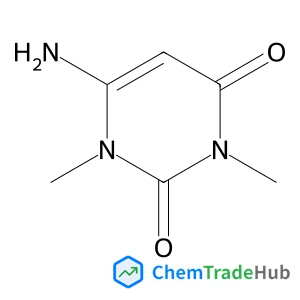
6-amino-1,3-dimethyl-1,2,3,4-tetrahydropyrimidine-2,4-dione
CAS Number:
6642-31-5
Molecular Formula:
C6H9N3O2


Recommended Suppliers



Disclaimer
This page provides academic journal information for reference and research purposes only. We are not affiliated with any journal publishers and do not handle publication submissions. For publication-related inquiries, please contact the respective journal publishers directly.
If you notice any inaccuracies in the information displayed, please contact us at support@chemtradehub.com. We will promptly review and address your concerns.