












Benzodithiophene bridged dimeric perylene diimide amphiphiles as efficient solution-processed non-fullerene small molecules
Literature Information
Publication Date
2013-06-06
DOI
10.1039/C3PY00457K
Impact Factor
5.582
Authors
Bo Jiang, Xin Zhang, Chuanlang Zhan, Zhenhuan Lu, Jianhua Huang, Xunlei Ding, Shenggui He, Jiannian Yao
View Original
Abstract
Two amphiphilic and highly twisting perylene diimide (PDI) dimers, Bis-PDI-BDT-EG, were synthesized by using 4,8-bis(2-(2-ethylhexylthienyl) benzo[1,2-b:4,5-b′]dithiophene (BDT-T) and 4,8-bis(2-ethylhexyloxy) BDT (BDT-O) as covalent bridges at the 7,7′-positions, while at the 1,1′-positions, they were functionalized with weakly solvophobic 2-methoxylethoxyl (EG) units. The subtle structural differences between BDT-O and BDT-T lead to distinct aggregation abilities: with respect to the over-strong aggregation ability of the BDT-O bridged dimer 2, the BDT-T bridged dimer 1 shows largely reduced aggregation ability and is solution-processable in the commonly used organic solvent. The highly twisted conformation between the PDI–BDT–PDI planes produced steric-pairing effects, which directed ordered packing of dimer 1. When dimer 1 was blended with P3HT in a weight D/A ratio of 1 : 2.5, the electron mobility (μe) was 3.4 × 10⁻⁵ cm2 V−1 s−1 and the best PCE was 1.72%. Slowing the solvent evaporation speed benefited the packing order of the PDI dimer, and the μe value was slightly increased to 6.0 × 10⁻⁵ cm2 V−1 s−1. The best PCE was improved up to 1.87%. The μe was further increased up to 3.4 × 10⁻⁴ cm2 V−1 s−1 when the D/A ratio was decreased down to 1 : 2.2 and the best PCE of 1.95% was achieved. Solid absorption spectra and XRD data of the blended films supported the improvement of the packing order of the PDI dimer by slowing the solvent annealing speed. AFM images supported the largely reduced aggregation ability of dimer 1 when blended with P3HT. The observed phase size of 35 nm is formed under the slow solvent annealing speed and a D/A ratio of 1 : 2.2. Our results revealed that the amphiphilic nature of the bridged aromatic unit reduces the aggregation ability and facilitates the ordered packing of the PDI units, contributing to the improvement of efficiency.
Related Literature
Constructing accurate interaction potentials to describe the microsolvation of protonated methane by helium atoms
Felix Uhl, Harald Forbert, Dominik Marx
2017-03-03
Paper
DOI: 10.1039/C7CP00652G
CO2 electroreduction performance of a single transition metal atom supported on porphyrin-like graphene: a computational study
Zhongxu Wang
2017-08-08
Paper
DOI: 10.1039/C7CP04299J
Low temperature conductivity and ion dynamics in silver iodide–silver metaphosphate glasses
2017-07-18
Paper
DOI: 10.1039/C7CP03695G
Photomanipulation of the anchoring strength using a spontaneously adsorbed layer of azo dendrimers
Hajnalka Nádasi, Ralf Stannarius, Alexey Eremin, Ken Ishikawa, Osamu Haba, Koichiro Yonetake, Hideo Takezoe, Fumito Araoka
2017-03-02
Paper
DOI: 10.1039/C6CP08461C
Non-covalent interactions in anisole–(CO2)n (n = 1, 2) complexes
Jan Řezáč, Dana Natchigallová, Pavel Hobza
2017-08-07
Paper
DOI: 10.1039/C7CP03763E
Tunable phenol remediation from wastewater using SWCNT-based, sub-nanometer porous membranes: reactive molecular dynamics simulations and DFT calculations
F. Moradi, M. Darvish Ganji, Y. Sarrafi
2017-02-23
Paper
DOI: 10.1039/C6CP08525C
Surface fouling as a mechanism for chemotaxis in isotropic catalytic swimmers
2017-09-05
Paper
DOI: 10.1039/C7CP05102F
Tailoring the physical properties of the mixtures of ionic liquids: a microscopic point of view
O. Palumbo, M. A. Navarra, J.-B. Brubach, P. Roy, A. Paolone
2017-02-27
Paper
DOI: 10.1039/C7CP00850C
Emergence of novel hydrogen chlorides under high pressure
Gilles Frapper
2017-03-01
Paper
DOI: 10.1039/C6CP08708F
Thermal compaction of the intrinsically disordered protein tau: entropic, structural, and hydrophobic factors
Anna Battisti, Gabriele Ciasca, Alessandro Grottesi, Alexander Tenenbaum
2017-02-23
Paper
DOI: 10.1039/C6CP07683A
You might also like
Compound Q&A
Is 6-(3-Fluorophenyl)picolinic acid (CAS: 887982-40-3) safe?
6-(3-Fluorophenyl)picolinic acid is generally considered safe for laboratory use...
887982-40-36-(3-Fluorophenyl)pi...
Compound Q&A
What industries use (3R)-3-Pyrrolidinol (CAS: 2799-21-5)?
(3R)-3-Pyrrolidinol is used in the pharmaceutical industry as a precursor for dr...
2799-21-5(3R)-3-Pyrrolidinol
Compound Q&A
What precautions should be taken when handling (4R,5R)-4,5-Diethoxycarbonyl-2,2-dimethyldioxolane (CAS: 59779-75-8)?
When handling (4R,5R)-4,5-Diethoxycarbonyl-2,2-dimethyldioxolane (CAS: 59779-75-...
59779-75-8(4R,5R)-4,5-Diethoxy...
Compound Q&A
How is 1-(6-Chloroimidazo[1,2-b]pyridazin-3-yl)ethanone (CAS: 90734-71-7) typically synthesized?
1-(6-Chloroimidazo[1,2-b]pyridazin-3-yl)ethanone is often synthesized via a mult...
90734-71-71-(6-Chloroimidazo[1...
Compound Q&A
What is the market or research trend for N-Ethyl-3,4-dimethylbenzylamine (CAS: 39180-83-1)?
The market for N-Ethyl-3,4-dimethylbenzylamine (CAS: 39180-83-1) remains steady,...
39180-83-1N-Ethyl-3,4-dimethyl...
Compound Q&A
What is Tert-butyl 3-(pyrrolidin-1-yl)azetidine-1-carboxylate (CAS: 1019008-21-9)?
Tert-butyl 3-(pyrrolidin-1-yl)azetidine-1-carboxylate is a chemical compound wit...
1019008-21-9Tert-butyl 3-(pyrrol...
Compound Q&A
What regulatory guidelines apply to 1-Bromo-3-chloro-2,4-dimethoxybenzene (CAS: 1228956-93-1)?
1-Bromo-3-chloro-2,4-dimethoxybenzene (CAS: 1228956-93-1) falls under the classi...
1228956-93-11-Bromo-3-chloro-2,4...
Compound Q&A
Is 8-Bromo-2-methyl-3,4-dihydroisoquinolin-1(2H)-one (CAS: 1368622-07-4) safe?
The safety of 8-Bromo-2-methyl-3,4-dihydroisoquinolin-1(2H)-one (CAS: 1368622-07...
1368622-07-48-Bromo-2-methyl-3,4...
Compound Q&A
Is Benzyl [(3S)-2,6-dioxo-3-piperidinyl]carbamate (CAS: 22785-43-9) safe?
Benzyl [(3S)-2,6-dioxo-3-piperidinyl]carbamate is generally safe when handled wi...
22785-43-9Benzyl [(3S)-2,6-dio...
Compound Q&A
How should 1-{[4-(4,4,5,5-Tetramethyl-1,3,2-dioxaborolan-2-yl)phenyl]sulfonyl}pyrrolidine (CAS: 928657-21-0) be stored?
1-{[4-(4,4,5,5-Tetramethyl-1,3,2-dioxaborolan-2-yl)phenyl]sulfonyl}pyrrolidine s...
928657-21-01-{[4-(4,4,5,5-Tetra...
Source Journal
Polymer Chemistry

CiteScore:
8.6
Self-citation Rate:
7.3%
Articles per Year:
457
Polymer Chemistry welcomes submissions in all areas of polymer science that have a strong focus on macromolecular chemistry. Manuscripts may cover a broad range of fields, yet no direct application focus is required.
Recommended Compounds
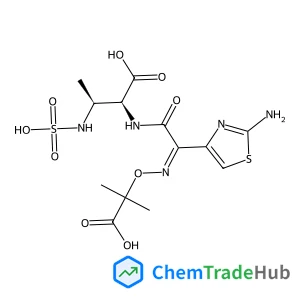
Aztreonam USP Related Compound A (Open-ring Aztreonam)
CAS Number:
87500-74-1
Molecular Formula:
C13H19N5O9S2
Recommended Suppliers





Disclaimer
This page provides academic journal information for reference and research purposes only. We are not affiliated with any journal publishers and do not handle publication submissions. For publication-related inquiries, please contact the respective journal publishers directly.
If you notice any inaccuracies in the information displayed, please contact us at support@chemtradehub.com. We will promptly review and address your concerns.