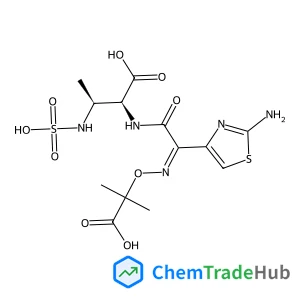
Aztreonam USP Related Compound A (Open-ring Aztreonam)
CAS Number:
87500-74-1
Molecular Formula:
C13H19N5O9S2
Hajnalka Nádasi, Ralf Stannarius, Alexey Eremin, Ken Ishikawa, Osamu Haba, Koichiro Yonetake, Hideo Takezoe, Fumito Araoka
We systematically studied the photoinduced anchoring transition in a nematic liquid crystal containing azo dendrimers. Because the azo dendrimers in the trans-isomer state were spontaneously adsorbed at substrate surfaces, which was confirmed by optical second-harmonic generation (SHG), a homeotropic orientation was established at the first stage. Ultraviolet (UV) light irradiation triggered a transition into a planar state which was accompanied by a suppression of the SH generation. The monotonic decrease of the effective scalar order parameter with increasing UV light intensity was determined by polarized attenuated total reflection infrared (ATR-IR) spectroscopy. The variation of anchoring strength and extrapolation length was evaluated by observing the Fréedericksz transition as a function of UV light intensity at a certain visible (VIS) light intensity. Such a photoinduced variation can be interpreted as a variation of the anchoring strength depending on the trans/cis ratio at the surfaces based on a modified Rapini-Papoular model. Thus, this system provides the opportunity for a controlled change in the anchoring strength.
Graeme Moad, Ming Chen, Matthias Häussler, Almar Postma, Ezio Rizzardo, San H. Thang
DOI: 10.1039/C0PY00179A
Toshio Itahara, Takahiro Tsuchida, Mayumi Morimoto
DOI: 10.1039/C0PY00068J
Qingli Hao, Wu Lei, Mingzhu Xia, Fengyun Wang, Xujie Yang
DOI: 10.1039/C1PY00008J
Ken Cham-Fai Leung, Kwun-Ngai Lau
DOI: 10.1039/B9PY00380K
Anish Cyriac, Sang Hwan Lee, Bun Yeoul Lee
DOI: 10.1039/C0PY00365D
Hideki Matsubara, Hiroyasu Kataoka, Hajime Ohtani
DOI: 10.1039/C0PY00026D
Dominik Konkolewicz, Angus Gray-Weale, Sébastien Perrier
DOI: 10.1039/C0PY00064G
Nicola Vinson, Yanzi Gou, C. Remzi Becer, David M. Haddleton, Matthew I. Gibson
DOI: 10.1039/C0PY00260G
Andrew J. Inglis, Christopher Barner-Kowollik
DOI: 10.1039/C0PY00189A
DOI: 10.1039/C0PY00162G
6-(3-Fluorophenyl)picolinic acid is generally considered safe for laboratory use...
(3R)-3-Pyrrolidinol is used in the pharmaceutical industry as a precursor for dr...
When handling (4R,5R)-4,5-Diethoxycarbonyl-2,2-dimethyldioxolane (CAS: 59779-75-...
1-(6-Chloroimidazo[1,2-b]pyridazin-3-yl)ethanone is often synthesized via a mult...
The market for N-Ethyl-3,4-dimethylbenzylamine (CAS: 39180-83-1) remains steady,...
Tert-butyl 3-(pyrrolidin-1-yl)azetidine-1-carboxylate is a chemical compound wit...
1-Bromo-3-chloro-2,4-dimethoxybenzene (CAS: 1228956-93-1) falls under the classi...
The safety of 8-Bromo-2-methyl-3,4-dihydroisoquinolin-1(2H)-one (CAS: 1368622-07...
Benzyl [(3S)-2,6-dioxo-3-piperidinyl]carbamate is generally safe when handled wi...
1-{[4-(4,4,5,5-Tetramethyl-1,3,2-dioxaborolan-2-yl)phenyl]sulfonyl}pyrrolidine s...

Physical Chemistry Chemical Physics (PCCP) is an international journal co-owned by 19 physical chemistry and physics societies from around the world. This journal publishes original, cutting-edge research in physical chemistry, chemical physics and biophysical chemistry. To be suitable for publication in PCCP, articles must include significant innovation and/or insight into physical chemistry; this is the most important criterion that reviewers and Editors will judge against when evaluating submissions. The journal has a broad scope and welcomes contributions spanning experiment, theory, computation and data science. Topical coverage includes spectroscopy, dynamics, kinetics, statistical mechanics, thermodynamics, electrochemistry, catalysis, surface science, quantum mechanics, quantum computing and machine learning. Interdisciplinary research areas such as polymers and soft matter, materials, nanoscience, energy, surfaces/interfaces, and biophysical chemistry are welcomed if they demonstrate significant innovation and/or insight into physical chemistry. Joined experimental/theoretical studies are particularly appreciated when complementary and based on up-to-date approaches.