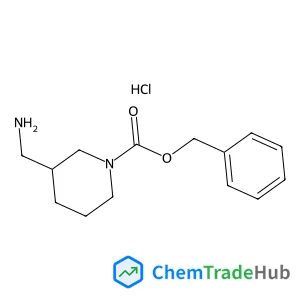
Benzyl 3-(aminomethyl)piperidine-1-carboxylate hydrochloride
CAS Number:
1186663-23-9
Molecular Formula:
C14H21ClN2O2
Stefan Naumann, Friedrich Georg Schmidt, Roman Schowner, Wolfgang Frey
Various carbon dioxide-protected N-heterocyclic carbenes (NHCs) have been investigated with regard to their ability to act as thermally latent initiators for the polymerization of methyl methacrylate (MMA). Such CO2-protected NHCs, while completely inactive at room temperature, deliver poly(methyl methacrylate) (PMMA) in high yields upon heating and thus represent truly latent pre-catalysts. Polymerizations were conducted in the bulk, semi-bulk and in solution. Especially tetrahydropyrimidinium-2-carboxylates as well as 1,3-di(tert-butyl)imidazolium-2-carboxylate, both in combination with dimethylsulfoxide (DMSO), were identified as suitable pre-catalysts for the polymerization of MMA. With 1,3-di(tert-butyl)imidazolium-2-carboxylate in toluene, polydispersity indices (PDIs) as low as 1.3 and number-average molecular weights (Mn) of 500 000 g mol−1 could be realized. Tetrahydropyrimidinium-2-carboxylates in conjunction with DMSO resulted in lower molecular weights. Notably, isolated polymer yields up to 96% were possible in some cases, though yields proved to be sensitive to the structure of the initiators used. In principle, at least two different polymerization mechanisms are active. In the presence of DMF or DMSO, the formation of a solvent anion (e.g., DMSO−), which then reacts with the monomer, is proposed. What follows is that only highly basic NHCs work well under these conditions. In contrast, the polymerization of MMA in toluene or in the bulk is probably governed by the nucleophilicity of the NHC, rendering unsaturated, less basic NHCs more applicable. Both mechanisms are discussed.
Laura Muñoz-Senovilla, Gregory Tricot, Francisco Muñoz
DOI: 10.1039/C7CP04171C
Martin Schilling, Sylvain Brimaud, R. Jürgen Behm
DOI: 10.1039/C7CP03961A
Febdian Rusydi
DOI: 10.1039/C7CP02390A
Yanan Xie, Weizhen Yu, Juan Wang, Yifei Wu, Shuo Niu, Wenyao Guo, Tsungwu Lin, Lidong Shao
DOI: 10.1039/C7CP04540A
Joscha Hoche, Hans-Christian Schmitt, Alexander Humeniuk, Ingo Fischer, Roland Mitrić, Merle I. S. Röhr
DOI: 10.1039/C7CP03990E
G. R. Darling, M. Forster, C. Lin, N. Liu, R. Raval, A. Hodgson
DOI: 10.1039/C7CP00622E
Yani Zhao, Marek Cieplak
DOI: 10.1039/C7CP03829A
Yvonne Gründer, Christopher A. Lucas
DOI: 10.1039/C7CP00244K
Sen Wang, Peng Sun, Rongrong Zhang, Ang Lu, Maili Liu, Lina Zhang
DOI: 10.1039/C6CP08744B
Felix Uhl, Harald Forbert, Dominik Marx
DOI: 10.1039/C7CP00652G
6-(3-Fluorophenyl)picolinic acid is generally considered safe for laboratory use...
(3R)-3-Pyrrolidinol is used in the pharmaceutical industry as a precursor for dr...
When handling (4R,5R)-4,5-Diethoxycarbonyl-2,2-dimethyldioxolane (CAS: 59779-75-...
1-(6-Chloroimidazo[1,2-b]pyridazin-3-yl)ethanone is often synthesized via a mult...
The market for N-Ethyl-3,4-dimethylbenzylamine (CAS: 39180-83-1) remains steady,...
Tert-butyl 3-(pyrrolidin-1-yl)azetidine-1-carboxylate is a chemical compound wit...
1-Bromo-3-chloro-2,4-dimethoxybenzene (CAS: 1228956-93-1) falls under the classi...
The safety of 8-Bromo-2-methyl-3,4-dihydroisoquinolin-1(2H)-one (CAS: 1368622-07...
Benzyl [(3S)-2,6-dioxo-3-piperidinyl]carbamate is generally safe when handled wi...
1-{[4-(4,4,5,5-Tetramethyl-1,3,2-dioxaborolan-2-yl)phenyl]sulfonyl}pyrrolidine s...

Polymer Chemistry welcomes submissions in all areas of polymer science that have a strong focus on macromolecular chemistry. Manuscripts may cover a broad range of fields, yet no direct application focus is required.