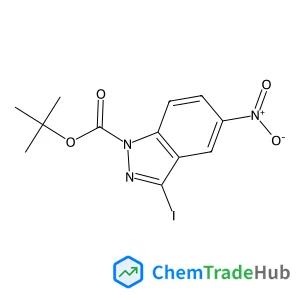
Tert-butyl 3-iodo-5-nitro-1H-indazole-1-carboxylate
CAS Number:
459133-69-8
Molecular Formula:
C12H12IN3O4
Qiaohong Peng, Khalid Mahmood, Ying Wu, Leli Wang, Yanyan Liang, Jianan Shen, Zhengping Liu
Biodegradable copolymers of L-lactic acid and ε-caprolactone [P(LLA-CL)s] were prepared in sulfonic acid-functionalized Brønsted acidic ionic liquids (SFBAILs) with very different anions and cations. SFBAILs work as both solvents and catalysts. The copolymerization process was proved to be a combination of polycondensation and simultaneous transesterification after a fast ring-opening polymerization of ε-caprolactone through a kinetic study. Copolymers with different monomer ratios were obtained. We found that the anions rather than the cations of SFBAILs have a great impact on the polymerizations. In addition, SFBAILs can be simply recovered by phase separation and recycled without decreasing the efficiency.
Jeffrey J. Black, Thomas Murphy, Rob Atkin, Andrew Dolan, Leigh Aldous
DOI: 10.1039/C6CP02255C
Chiu Tung Cheng, Kevin R. Wilson
DOI: 10.1039/C5CP03791C
Sami Emre Küçük, Timur Biktagirov, Deniz Sezer
DOI: 10.1039/C5CP04405G
Catarina M. S. S. Neves, Jesus Lemus, Jorge F. B. Pereira, Mara G. Freire, João A. P. Coutinho
DOI: 10.1039/C6CP04023C
Djemel Hamdane, Christophe Velours, David Cornu, Magali Nicaise, Murielle Lombard, Marc Fontecave
DOI: 10.1039/C6CP03635J
Jennifer M. Elward, B. Christopher Rinderspacher
DOI: 10.1039/C5CP02177D
Michèle Chevalier, Claudine Crépin
DOI: 10.1039/C6CP02796B
Lars Borchardt, Winfried Nickel, Mirian Casco, Irena Senkovska, Volodymyr Bon, Dirk Wallacher, Nico Grimm, Simon Krause, Joaquín Silvestre-Albero
DOI: 10.1039/C6CP03993F
Camila S. Monteiro, Daniele C. Ferreira, Gustavo A. M. Sáfar, Rafael N. Gontijo, Cristiano Fantini, Dayse C. S. Martins, Ynara M. Idemori, Maurício V. B. Pinheiro, Klaus Krambrock
DOI: 10.1039/C6CP03366K
L. Vereecken, W. J. Bloss
DOI: 10.1039/C5CP03862F
When handling 4-Methyl-6-(trifluoromethyl)quinoline (CAS: 40716-16-3), safety go...
4-(3,5-Difluorophenyl)aniline is an aromatic organic compound with the CAS numbe...
5-{[4-(Trifluoromethyl)phenyl]sulfanyl}-1,2,3-thiadiazole-4-carboxylic acid can ...
The market for 4-Benzylaniline hydrochloride (CAS: 6317-57-3) is steadily growin...
[3-(Diethylsulfamoyl)phenyl]boronic acid is generally considered safe when handl...
3-Bromo-2,5-dimethoxyaniline is mainly used in the pharmaceutical and chemical i...
N-Methyl-1-(5-methyl-1H-indol-3-yl)methanamine (CAS: 915922-67-7) is subject to ...
This compound is primarily used in the pharmaceutical industry for the synthesis...
2-Methyl-2-propanyl [(1S,3R)-3-aminocyclohexyl]carbamate (CAS: 1298101-47-9) sho...
Ethyl 2-bromo-4,4,4-trifluorobutanoate (CAS: 367-33-9) is utilized in the pharma...

Green Chemistry provides a unique forum for the publication of innovative research on the development of alternative green and sustainable technologies. The scope of Green Chemistry is based on, but not limited to, the definition proposed by Anastas and Warner (Green Chemistry: Theory and Practice, P T Anastas and J C Warner, Oxford University Press, Oxford, 1998). Green chemistry is the utilisation of a set of principles that reduces or eliminates the use or generation of hazardous substances in the design, manufacture and application of chemical products. Green Chemistry is at the frontiers of this continuously-evolving interdisciplinary science and publishes research that attempts to reduce the environmental impact of the chemical enterprise by developing a technology base that is inherently non-toxic to living things and the environment. Submissions on all aspects of research relating to the endeavour are welcome. The journal publishes original and significant cutting-edge research that is likely to be of wide general appeal. To be published, work must present a significant advance in green chemistry. Papers must contain a comparison with existing methods and demonstrate advantages over those methods before publication can be considered. For more information please see this Editorial. Coverage includes the following, but is not limited to: Design (e.g. biomimicry, design for degradation/recycling/reduced toxicity…) Reagents & Feedstocks (e.g. renewables, CO2, solvents, auxiliary agents, waste utilization…) Synthesis (e.g. organic, inorganic, synthetic biology…) Catalysis (e.g. homogeneous, heterogeneous, enzyme, whole cell…) Process (e.g. process design, intensification, separations, recycling, efficiency…) Energy (e.g. renewable energy, fuels, photovoltaics, fuel cells, energy storage, energy carriers…) Applications (e.g. electronics, dyes, consumer products, coatings, pharmaceuticals, preservatives, building materials, chemicals for industry/agriculture/mining…) Impact (e.g. safety, metrics, LCA, sustainability, (eco)toxicology…) Green chemistry is, by definition, a continuously-evolving frontier. Therefore, the inclusion of a particular material or technology does not, of itself, guarantee that a paper is suitable for the journal. To be suitable, the novel advance should have the potential for reduced environmental impact relative to the state of the art. Green Chemistry does not normally deal with research associated with 'end-of-pipe' or remediation issues.
![6,7-Dihydro-5H-pyrrolo[1,2-a]imidazole-6-carboxylic acid structure](https://static.chemtradehub.com/structs/136/1369160-12-2-6524.webp "6,7-Dihydro-5H-pyrrolo[1,2-a]imidazole-6-carboxylic acid structure")
![2,4-Dichloro-6-isopropyl-5H-pyrrolo[3,4-d]pyrimidin-7(6H)-one structure](https://static.chemtradehub.com/structs/107/1079649-94-7-ad4a.webp "2,4-Dichloro-6-isopropyl-5H-pyrrolo[3,4-d]pyrimidin-7(6H)-one structure")