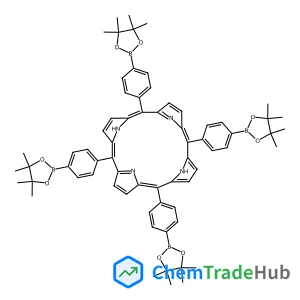
5,10,15,20-tetrakis(4-boronic acid pinacol ester phenyl) porphyrin
CAS Number:
1332748-00-1
Molecular Formula:
C68H74B4N4O8
X. C. Hu, E. Agostinelli, C. Ni, G. C. Hadjipanayis, A. Capobianchi
The FePt alloy in the high magnetic anisotropy L10 phase is one of the most promising magnetic materials in many applications, including ultra-high-density magnetorecording. A new green chemical approach to synthesize magnetically hard L10 FePt nanoparticles is described in this paper by using crystalline saline complex hexaaquairon(II)hexachloroplatinate, [Fe(H2O)6]PtCl6, as the precursor. The crystal structure of this complex shows alternate layers of Fe and Pt atoms. After ball milling, annealing at 400 °C under a reducing atmosphere leads to the direct formation of FePt nanoparticles in the highly ordered L10 phase. This method is a green synthesis due to the low temperature for phase transformation, and the absence of organic solvents or surfactants in the reaction. Indeed the milling step is performed using NaCl as media, which can be easily removed with water. By varying the precursor/NaCl ratio, particles with size in the range of 6.2–13.2 nm were obtained. With the decrease of particle size, the room temperature coercivity of FePt nanoparticles also decreased from 10.9 kOe to 4.7 kOe.
Michèle Chevalier, Claudine Crépin
DOI: 10.1039/C6CP02796B
Hui Yu, Jose A. Sanchez-Rodriguez, Marvin Pollum, Carlos E. Crespo-Hernández, Sebastian Mai, Philipp Marquetand, Leticia González, Susanne Ullrich
DOI: 10.1039/C6CP01790H
Niranjan V. Ilawe, Alexandra E. Raeber, Reinhard Schweitzer-Stenner, Siobhan E. Toal, Bryan M. Wong
DOI: 10.1039/C5CP03646A
Tobias Göppel, Vladimir V. Palyulin, Ulrich Gerland
DOI: 10.1039/C6CP01034B
Niels Boon, René van Roij
DOI: 10.1039/C5CP02945G
A. S. Côté, R. Darkins, D. M. Duffy
DOI: 10.1039/C5CP03370E
Ki Chul Kim
DOI: 10.1039/C6CP02692C
Miao Miao, Gangling Wang, Shaomei Cao, Xin Feng, Jianhui Fang, Liyi Shi
DOI: 10.1039/C5CP04679C
Mouni Roy, Milan Kanti Naskar
DOI: 10.1039/C6CP02442D
Pedro Augusto Franco Pinheiro Moreira, Maurice de Koning
DOI: 10.1039/C5CP03346B
When handling 4-Methyl-6-(trifluoromethyl)quinoline (CAS: 40716-16-3), safety go...
4-(3,5-Difluorophenyl)aniline is an aromatic organic compound with the CAS numbe...
5-{[4-(Trifluoromethyl)phenyl]sulfanyl}-1,2,3-thiadiazole-4-carboxylic acid can ...
The market for 4-Benzylaniline hydrochloride (CAS: 6317-57-3) is steadily growin...
[3-(Diethylsulfamoyl)phenyl]boronic acid is generally considered safe when handl...
3-Bromo-2,5-dimethoxyaniline is mainly used in the pharmaceutical and chemical i...
N-Methyl-1-(5-methyl-1H-indol-3-yl)methanamine (CAS: 915922-67-7) is subject to ...
This compound is primarily used in the pharmaceutical industry for the synthesis...
2-Methyl-2-propanyl [(1S,3R)-3-aminocyclohexyl]carbamate (CAS: 1298101-47-9) sho...
Ethyl 2-bromo-4,4,4-trifluorobutanoate (CAS: 367-33-9) is utilized in the pharma...

Green Chemistry provides a unique forum for the publication of innovative research on the development of alternative green and sustainable technologies. The scope of Green Chemistry is based on, but not limited to, the definition proposed by Anastas and Warner (Green Chemistry: Theory and Practice, P T Anastas and J C Warner, Oxford University Press, Oxford, 1998). Green chemistry is the utilisation of a set of principles that reduces or eliminates the use or generation of hazardous substances in the design, manufacture and application of chemical products. Green Chemistry is at the frontiers of this continuously-evolving interdisciplinary science and publishes research that attempts to reduce the environmental impact of the chemical enterprise by developing a technology base that is inherently non-toxic to living things and the environment. Submissions on all aspects of research relating to the endeavour are welcome. The journal publishes original and significant cutting-edge research that is likely to be of wide general appeal. To be published, work must present a significant advance in green chemistry. Papers must contain a comparison with existing methods and demonstrate advantages over those methods before publication can be considered. For more information please see this Editorial. Coverage includes the following, but is not limited to: Design (e.g. biomimicry, design for degradation/recycling/reduced toxicity…) Reagents & Feedstocks (e.g. renewables, CO2, solvents, auxiliary agents, waste utilization…) Synthesis (e.g. organic, inorganic, synthetic biology…) Catalysis (e.g. homogeneous, heterogeneous, enzyme, whole cell…) Process (e.g. process design, intensification, separations, recycling, efficiency…) Energy (e.g. renewable energy, fuels, photovoltaics, fuel cells, energy storage, energy carriers…) Applications (e.g. electronics, dyes, consumer products, coatings, pharmaceuticals, preservatives, building materials, chemicals for industry/agriculture/mining…) Impact (e.g. safety, metrics, LCA, sustainability, (eco)toxicology…) Green chemistry is, by definition, a continuously-evolving frontier. Therefore, the inclusion of a particular material or technology does not, of itself, guarantee that a paper is suitable for the journal. To be suitable, the novel advance should have the potential for reduced environmental impact relative to the state of the art. Green Chemistry does not normally deal with research associated with 'end-of-pipe' or remediation issues.