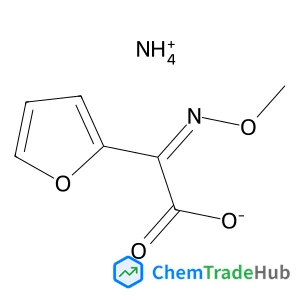
Ammonium (Z)-2-(furan-2-yl)-2-(methoxyimino)acetate
CAS Number:
97148-39-5
Molecular Formula:
C7H10N2O4
M. Alonso, P. Geerlings, F . De Proft
N-fused pentaphyrins (NFP) are the stable forms of fully meso-aryl pentaphyrins(1.1.1.1.1). In order to determine the optimum conditions for viable Möbius topologies of these porphyrinoids, the conformational preferences, Hückel–Möbius interconversion pathways and aromaticity of [22] and [24]NFP have been investigated using density functional theory calculations. The conformation of the macrocycle is shown to be strongly dependent on the oxidation state and the macrocyclic aromaticity. [22]NFP prefers a highly aromatic and relatively strain-free Hückel conformation. However, antiaromatic Hückel and weakly aromatic Möbius conformers coexist in dynamic equilibrium in [24]NFP. The Hückel–Möbius aromaticity switch requires very low activation energy barriers (Ea = 3–4 kcal mol−1). Interestingly, the balance between Möbius and Hückel conformations in [24]NFP can be controlled by meso-substituents. The structure–property relationship between the molecular conformation, number of π electrons and aromaticity has been established in our study using energetic, magnetic, structural, and reactivity descriptors of aromaticity. Although the Möbius topology is indeed accessible for [24]NFP, it does not exhibit a distinct macrocyclic aromaticity mainly due to the large dihedral angles around the molecular twist. Regarding the computational methodology, B3LYP and M06 show the best overall performance for describing the experimental geometries of NFP and, importantly, our computational results support the experimental evidence available for N-fused pentaphyrins.
Shivamurthy Ravindra Yashas, Shadakshari Sandeep, Ballagere Puttaraju Shivakumar, Ningappa Kumar Swamy
DOI: 10.1039/C9AY01468C
Meng Yu, Yali Wang, Yi Di, Changchun Wang
DOI: 10.1039/C4CC10285A
Yue Wang, Mengxue Shang, Yaning Wang, Zhangrun Xu
DOI: 10.1039/C9AY01213C
Mercy W. Maina, Phelix Makoto Were, Jamie L. Luther, Sarah L. Bliese, Nils Oberhof, Doaa Aldulaimi, Marya Lieberman
DOI: 10.1039/C9AY01547G
Ian M. Walton, Jordan M. Cox, Jarrett A. Coppin, Crysania M. Linderman, Dinesh G. (Dan) Patel, Jason B. Benedict
DOI: 10.1039/C3CC44119A
Xiaocui Huang, Ying Zhang, Wen Xu, Wei Xu, Longhua Guo, Bin Qiu, Zhenyu Lin
DOI: 10.1039/C9CC06210F
Min Tian, Yaoming Liu, Yingte Wang, Yong Zhang
DOI: 10.1039/C9AY01244C
Feng Zhu, Xiaosong Wu, Fang Li, Wei Wang, Wenliang Ji, Zongli Huo, Yan Xu
DOI: 10.1039/C9AY00937J
1H-Indazole-6-carbonitrile finds applications in pharmaceuticals, where it serve...
Waste containing Dioctyl (2E)-2-butenedioate (CAS: 2997-85-5) should be collecte...
Sodium [(1,2-benzoxazol-3-ylmethyl)sulfonyl]azanide is primarily used in pharmac...
Dimethyl 4-(4,4,5,5-tetramethyl-1,3,2-dioxaborolan-2-yl)-2,6-pyridinedicarboxyla...
Waste containing 2-Fluoro-6-hydrazinopyridine (CAS: 80714-39-2) should be manage...
6-Formyl-2-pyridinecarboxylic acid is an organic compound with the molecular for...
Research trends for this compound indicate a focus on its potential applications...
9H-Tribenzo[b,d,f]azepine is typically synthesized via a multi-step process invo...
1-Cyclopropyl-7-ethoxy-6-fluoro-8-methoxy-4-oxo-1,4-dihydro-3-quinolinecarboxyli...
Waste containing Methyl 3-oxo-1,2,3,4-tetrahydro-6-quinoxalinecarboxylate (CAS: ...

Physical Chemistry Chemical Physics (PCCP) is an international journal co-owned by 19 physical chemistry and physics societies from around the world. This journal publishes original, cutting-edge research in physical chemistry, chemical physics and biophysical chemistry. To be suitable for publication in PCCP, articles must include significant innovation and/or insight into physical chemistry; this is the most important criterion that reviewers and Editors will judge against when evaluating submissions. The journal has a broad scope and welcomes contributions spanning experiment, theory, computation and data science. Topical coverage includes spectroscopy, dynamics, kinetics, statistical mechanics, thermodynamics, electrochemistry, catalysis, surface science, quantum mechanics, quantum computing and machine learning. Interdisciplinary research areas such as polymers and soft matter, materials, nanoscience, energy, surfaces/interfaces, and biophysical chemistry are welcomed if they demonstrate significant innovation and/or insight into physical chemistry. Joined experimental/theoretical studies are particularly appreciated when complementary and based on up-to-date approaches.